Philosophy & Religion Thread

I’m curious if anyone has read Jonathan Haidt’s The Righteous Mind?

I’m finding it fascinating, as it seems to explain why we are so divided regarding politics and religion.

Haidt argues that our moral judgments are rooted primarily in intuition rather than reason, and that we often use reasoning after the fact to justify our intuitive beliefs. He introduces the idea of multiple moral foundations, likening them to taste buds that vary among individuals and cultures.

- Care/Harm focuses on protecting others and avoiding suffering.
- Fairness/Cheating focuses on justice, reciprocity, and punishing exploitation.
- Loyalty/Betrayal focuses on commitment to one’s group or team.
- Authority/Subversion focuses on respect for hierarchy, duty, and legitimate leadership.
- Sanctity/Degradation focuses on purity, disgust, and avoiding contamination, often in religious or moral language.
- Liberty/Oppression is sometimes added as a newer foundation centered on resistance to domination.

Haidt tries to explain how human morality works, not tell people what they should value. It also helps explain political and cultural conflict, because people often prioritize different foundations when judging the same issue.

For example

If two people disagree about the same policy, one may focus on Care and Fairness while the other focuses on Loyalty, Authority, or Sanctity. Both can sound “moral,” but they are reasoning from different foundations.
 
I’m curious if anyone has read Jonathan Haidt’s The Righteous Mind?

I’m finding it fascinating, as it seems to explain why we are so divided regarding politics and religion.

Haidt argues that our moral judgments are rooted primarily in intuition rather than reason, and that we often use reasoning after the fact to justify our intuitive beliefs. He introduces the idea of multiple moral foundations, likening them to taste buds that vary among individuals and cultures.

- Care/Harm focuses on protecting others and avoiding suffering.
- Fairness/Cheating focuses on justice, reciprocity, and punishing exploitation.
- Loyalty/Betrayal focuses on commitment to one’s group or team.
- Authority/Subversion focuses on respect for hierarchy, duty, and legitimate leadership.
- Sanctity/Degradation focuses on purity, disgust, and avoiding contamination, often in religious or moral language.
- Liberty/Oppression is sometimes added as a newer foundation centered on resistance to domination.

Haidt tries to explain how human morality works, not tell people what they should value. It also helps explain political and cultural conflict, because people often prioritize different foundations when judging the same issue.

For example

If two people disagree about the same policy, one may focus on Care and Fairness while the other focuses on Loyalty, Authority, or Sanctity. Both can sound “moral,” but they are reasoning from different foundations.
So the argument of the book is highlighting psychological differences that result in different morality values? Does he have a basis for the faultiness in the intuitions we bring? That sounds interesting for real. Was it a very long read?
 
So the argument of the book is highlighting psychological differences that result in different morality values? Does he have a basis for the faultiness in the intuitions we bring? That sounds interesting for real. Was it a very long read?
Imagine two siblings, a brother and a sister, who are both adults. They are traveling together and decide to spend a night in a private cabin. They talk things through and mutually agree that they would like to try having sex with each other, partly out of curiosity and to share a special experience.

The sister is already using reliable birth control, and the brother uses a condom as well, so there is no risk of pregnancy. They both enjoy the experience and feel closer afterward, but they decide not to do it again. They keep the night as a private secret between them, and no one else ever finds out.
There is no physical harm, no coercion, and no one else is affected.
Now ask:
• Do you think what they did was wrong?
• If yes, what exactly makes it wrong, given that no harm came to anyone?
 
Imagine two siblings, a brother and a sister, who are both adults. They are traveling together and decide to spend a night in a private cabin. They talk things through and mutually agree that they would like to try having sex with each other, partly out of curiosity and to share a special experience.

The sister is already using reliable birth control, and the brother uses a condom as well, so there is no risk of pregnancy. They both enjoy the experience and feel closer afterward, but they decide not to do it again. They keep the night as a private secret between them, and no one else ever finds out.
There is no physical harm, no coercion, and no one else is affected.
Now ask:
• Do you think what they did was wrong?
• If yes, what exactly makes it wrong, given that no harm came to anyone?
I know that was a weird post seemingly out of the blue. But it’s a moral vignette Haidt used in his research. He found that most subjects would find the scenario morally objectionable. When the interviewer pressed for the reasoning behind the judgment, the individuals would become dumbfounded to explain themselves.

So, the point wasn’t that intuition is faulty. It is more that it leads our reasoning, not the other way around.

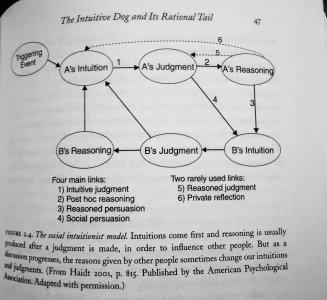
He proposes that we can’t change most people’s minds through arguing reason. We have to use social reflection. Exposure to other views and cultural norms that persuade us over time.

Intuition is a heuristic we use to function in a world where snap decisions are necessary.

Social reflection is a corrector.

Our values are the target where we want our judgments to align.
 
I know that was a weird post seemingly out of the blue. But it’s a moral vignette Haidt used in his research. He found that most subjects would find the scenario morally objectionable. When the interviewer pressed for the reasoning behind the judgment, the individuals would become dumbfounded to explain themselves.

So, the point wasn’t that intuition is faulty. It is more that it leads our reasoning, not the other way around.

He proposes that we can’t change most people’s minds through arguing reason. We have to use social reflection. Exposure to other views and cultural norms that persuade us over time.

Intuition is a heuristic we use to function in a world where snap decisions are necessary.

Social reflection is a corrector.

Our values are the target where we want our judgments to align.

That's how I felt. You hear siblings and think no that's wrong. But you ask yourself why and it gets uncomfortable trying to justify your reasoning.

Morality can be grey.
 
When the interviewer pressed for the reasoning behind the judgment, the individuals would become dumbfounded to explain themselves.
You can do the same thing with almost any opinion that someone holds.

"Why do you like Taylor Swift?" The individuals would become dumbfounded to explain themselves. The ultimate answer is "I just do." You will get very few in=depth explanations.

Opinion: Fleetwood Mac Rumours is the greatest American rock album of all time.
Why is Rumours an American album when the band started in England and three of the members who recorded that album, the founders, are British and the title uses the British spelling of "Rumours"?
Why is it the greatest of all time?

I can answer those questions.

If you asked the redhead why her favorite album of all time was her favorite album of all time she would be dumbfounded to answer. Press her on it and she's likely to tell you she doesn't want to talk about it anymore.
 
You can do the same thing with almost any opinion that someone holds.

"Why do you like Taylor Swift?" The individuals would become dumbfounded to explain themselves. The ultimate answer is "I just do." You will get very few in=depth explanations.

Opinion: Fleetwood Mac Rumours is the greatest American rock album of all time.
Why is Rumours an American album when the band started in England and three of the members who recorded that album, the founders, are British and the title uses the British spelling of "Rumours"?
Why is it the greatest of all time?

I can answer those questions.

If you asked the redhead why her favorite album of all time was her favorite album of all time she would be dumbfounded to answer. Press her on it and she's likely to tell you she doesn't want to talk about it anymore.
When you’re simply dealing with opinions, many people will abandon their opinion when the reasoning fails. With moral judgments, people stay committed long after it is shown there is no basis of reason. This is because the judgment was made based on intuition and social norms.
 
Imagine two siblings, a brother and a sister, who are both adults. They are traveling together and decide to spend a night in a private cabin. They talk things through and mutually agree that they would like to try having sex with each other, partly out of curiosity and to share a special experience.

The sister is already using reliable birth control, and the brother uses a condom as well, so there is no risk of pregnancy. They both enjoy the experience and feel closer afterward, but they decide not to do it again. They keep the night as a private secret between them, and no one else ever finds out.
There is no physical harm, no coercion, and no one else is affected.
Now ask:
• Do you think what they did was wrong?
• If yes, what exactly makes it wrong, given that no harm came to anyone?
Well, I never fit in with others on things like this but the only problem I see with it is that society has a blanket no on the topic and that blanket no has it's own effect.

While you did a great job covering nearly all of the extingencies, the one you can't cover with a situation like this is the potential for long term mental health issues for someone who has to live with a secret that they went against a rule that to my knowledge is in pretty much every human society.
 
When you’re simply dealing with opinions, many people will abandon their opinion when the reasoning fails. With moral judgments, people stay committed long after it is shown there is no basis of reason. This is because the judgment was made based on intuition and social norms.
Opinions aren't based on intuition and social norms? What is a moral judgment but an opinion about a human interaction? Ethics is opinion about what you ought to do. Ethics is morality. Hippocrates radically changed the social norm.
 
Opinions aren't based on intuition and social norms? What is a moral judgment but an opinion about a human interaction? Ethics is opinion about what you ought to do. Ethics is morality. Hippocrates radically changed the social norm.
I guess a better description is that moral judgments are more heavily grounded in emotion, our identity, and social pressure. So, yes, someone may cling to their identity as a Swiftie beyond reason. But their religious and political views will still be more stubborn because they are built on their moral foundation instead of musical taste and pop culture trends.

Case in point, we have seen many conservatives abandon Taylor Swift because of her vocal support of more progressive ideas and candidates.
 
I guess a better description is that moral judgments are more heavily grounded in emotion, our identity, and social pressure. So, yes, someone may cling to their identity as a Swiftie beyond reason. But their religious and political views will still be more stubborn because they are built on their moral foundation instead of musical taste and pop culture trends.

Case in point, we have seen many conservatives abandon Taylor Swift because of her vocal support of more progressive ideas and candidates.
The opposite happened with her latest album. It was called "Trad-wife".

But an opinion that is more stubborn is still just an opinion, and they are all grounded in emotion, our identity, and social pressure. Why do Swifties abandon Swift because of a particular song or album? Emotion, identity, and social pressure.
 
The opposite happened with her latest album. It was called "Trad-wife".

But an opinion that is more stubborn is still just an opinion, and they are all grounded in emotion, our identity, and social pressure. Why do Swifties abandon Swift because of a particular song or album? Emotion, identity, and social pressure.
Yes. Opinions are opinions. Glad we cleared that up. The point IS that moral judgments are more stubborn. They are also more divisive. This is why people are more likely to lose relationships over politics and religion. Moral issues invite blame, condemnation, and exclusion, not just debate.
 
I know that was a weird post seemingly out of the blue. But it’s a moral vignette Haidt used in his research. He found that most subjects would find the scenario morally objectionable. When the interviewer pressed for the reasoning behind the judgment, the individuals would become dumbfounded to explain themselves.

So, the point wasn’t that intuition is faulty. It is more that it leads our reasoning, not the other way around.

He proposes that we can’t change most people’s minds through arguing reason. We have to use social reflection. Exposure to other views and cultural norms that persuade us over time.

Intuition is a heuristic we use to function in a world where snap decisions are necessary.

Social reflection is a corrector.

Our values are the target where we want our judgments to align.
Sorry I don’t reply initially! But I love the idea that perhaps our intuition tells us something morally wrong without knowing why. Almost “God-given” if you will 😜.

The idea that social reflection is a corrector is interesting to me. Does Haidt make any argument that morality is best worked out in a group?
 
Yes. Opinions are opinions. Glad we cleared that up. The point IS that moral judgments are more stubborn. They are also more divisive. This is why people are more likely to lose relationships over politics and religion. Moral issues invite blame, condemnation, and exclusion, not just debate.
Is this a fair approximation of you and Haidt's thoughts: ethics is a dispassionate analysis of outcomes versus morality is a belief system?
 
Sorry I don’t reply initially! But I love the idea that perhaps our intuition tells us something morally wrong without knowing why. Almost “God-given” if you will 😜.

The idea that social reflection is a corrector is interesting to me. Does Haidt make any argument that morality is best worked out in a group?
One might say “God-given” while another says “innate.” But then you can go down a rabbit hole about total depravity.

I don’t think Haidt proposes morality is best worked out in a group. More so that this is how human nature works. Our judgments are mostly intuition backed by reason and influenced by social norms. Other people’s reasoning doesn’t directly impact our reasoning. We react to it intuitively. See the diagram below.
IMG_1284.jpeg
 
Is this a fair approximation of you and Haidt's thoughts: ethics is a dispassionate analysis of outcomes versus morality is a belief system?
I’m not sure what Haidt would say to that. Maybe that ethics is similar to our reasoning of moral judgment. It is the rational justification we use to align more closely to our values.

But there is another, messier side of moral judgment which is based on intuition and social norms and reason has not tethered it to our values.
 
Back
Top