

I’m curious if anyone has read Jonathan Haidt’s The Righteous Mind?
I’m finding it fascinating, as it seems to explain why we are so divided regarding politics and religion.
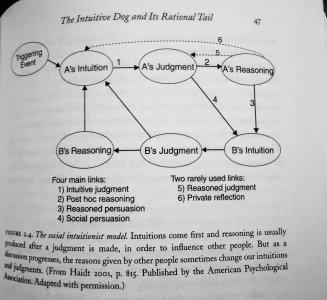
Haidt argues that our moral judgments are rooted primarily in intuition rather than reason, and that we often use reasoning after the fact to justify our intuitive beliefs. He introduces the idea of multiple moral foundations, likening them to taste buds that vary among individuals and cultures.
- Care/Harm focuses on protecting others and avoiding suffering.
- Fairness/Cheating focuses on justice, reciprocity, and punishing exploitation.
- Loyalty/Betrayal focuses on commitment to one’s group or team.
- Authority/Subversion focuses on respect for hierarchy, duty, and legitimate leadership.
- Sanctity/Degradation focuses on purity, disgust, and avoiding contamination, often in religious or moral language.
- Liberty/Oppression is sometimes added as a newer foundation centered on resistance to domination.
Haidt tries to explain how human morality works, not tell people what they should value. It also helps explain political and cultural conflict, because people often prioritize different foundations when judging the same issue.
For example
If two people disagree about the same policy, one may focus on Care and Fairness while the other focuses on Loyalty, Authority, or Sanctity. Both can sound “moral,” but they are reasoning from different foundations.
I’m finding it fascinating, as it seems to explain why we are so divided regarding politics and religion.
Haidt argues that our moral judgments are rooted primarily in intuition rather than reason, and that we often use reasoning after the fact to justify our intuitive beliefs. He introduces the idea of multiple moral foundations, likening them to taste buds that vary among individuals and cultures.
- Care/Harm focuses on protecting others and avoiding suffering.
- Fairness/Cheating focuses on justice, reciprocity, and punishing exploitation.
- Loyalty/Betrayal focuses on commitment to one’s group or team.
- Authority/Subversion focuses on respect for hierarchy, duty, and legitimate leadership.
- Sanctity/Degradation focuses on purity, disgust, and avoiding contamination, often in religious or moral language.
- Liberty/Oppression is sometimes added as a newer foundation centered on resistance to domination.
Haidt tries to explain how human morality works, not tell people what they should value. It also helps explain political and cultural conflict, because people often prioritize different foundations when judging the same issue.
For example
If two people disagree about the same policy, one may focus on Care and Fairness while the other focuses on Loyalty, Authority, or Sanctity. Both can sound “moral,” but they are reasoning from different foundations.


 .
.