US continues to go backward...

I was at dinner with my more liberal group of friends the other night. When I agreed that this administration’s deportation tactics were fascist in nature but disagreed that we live in a fascist country, I got the usual “easy for you to say being a white male” stuff. Am I the one going crazy or are people a lot more “if you aren’t for me you’re against me” nowadays?

Weird being in the middle. Being a “libtard” around my MAGA friends for being anti-Trump and “right wing” around my liberal friends for not agreeing with everything they say. Just over here alone politically.
 
Last edited:
I was at dinner with my more liberal group of friends the other night. When I agreed that this administration’s deportation tactics were fascist in nature but disagreed that we live in a fascist country, I got the usual “easy for you to say being a white male” stuff. Am I the one going crazy or are people a lot more “if you aren’t for me you’re against me” nowadays?

Weird being in the middle. Being a “libtard” around my MAGA friends for being anti-Trump and “right wing” around my liberal friends for not agreeing with everything they say. Just over here alone politically.
It's gotten so crazy man, and you aren't alone.
FB_IMG_1768747378695.jpg

No matter what side you’re on, we’ve reached a point in our lives where right is always wrong to someone else, and wrong is always right to the other side.
There’s no winning—only noise.
We let the social world consume us. Drain us. Shape us.
We scroll until we’re empty, argue until we’re numb, and share things we haven’t even had time to feel yet.
I remember a time before social media—when we didn’t see everything, didn’t dissect everything, didn’t turn every moment into a headline or a weapon. We weren’t fed lies wrapped as truth, or truth twisted until it fit a narrative. We didn’t hate each other for being red or blue. We were just people.
Somewhere along the way, we tore each other apart.
And it wasn’t one side or the other.
It was all of us.
Not one single person is to blame—and we all know that.
I’m guilty too. I’ve been pulled in, reacted, judged, shared, felt the anger. But at some point, I chose to keep living. If something affects me, I find a way around it instead of letting it own me. I step back. I breathe. I live my life.
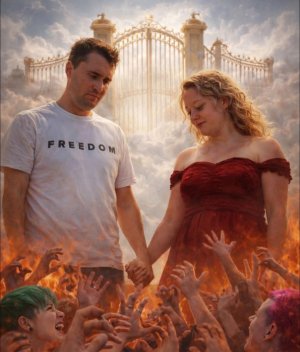
I saw this image ( I did not create this image saw it circulating) and it speaks volumes—because we all watched it unfold in real time.
A hundred million different versions.
Jokes. Fingers pointed. Opinions screamed.
Everyone talking… no one listening.
And in the end—what did it solve?
Nothing was healed. Nothing was fixed.
Just more division. More exhaustion. More distance between people who were never meant to be enemies.
Maybe the real problem isn’t the moment we’re arguing about.
Maybe it’s that we’ve forgotten how to be human with each other.

And maybe—just maybe—that’s where the healing has to start.

 
I was at dinner with my more liberal group of friends the other night. When I agreed that this administration’s deportation tactics were fascist in nature but disagreed that we live in a fascist country, I got the usual “easy for you to say being a white male” stuff. Am I the one going crazy or are people a lot more “if you aren’t for me you’re against me” nowadays?

Weird being in the middle. Being a “libtard” around my MAGA friends for being anti-Trump and “right wing” around my liberal friends for not agreeing with everything they say. Just over here alone politically.
Welcome to my world. During the pandemic on the old site I was called a "bleeding heart liberal commie pinko". I voted for Reagan. I am a Reaganite conservative.
 
I was at dinner with my more liberal group of friends the other night. When I agreed that this administration’s deportation tactics were fascist in nature but disagreed that we live in a fascist country, I got the usual “easy for you to say being a white male” stuff. Am I the one going crazy or are people a lot more “if you aren’t for me you’re against me” nowadays?

Weird being in the middle. Being a “libtard” around my MAGA friends for being anti-Trump and “right wing” around my liberal friends for not agreeing with everything they say. Just over here alone politically.
I have dealt with a lot of that going from Australia to Oklahoma.

There are two issues.
Some people don't discuss politics as specific issues. They seem to pick their side and align their views to that side. So, when they can't fit someone else into the tidy little boxes they have created, they get frustrated or try anyway.

Two, liberal and conservative in the world of MAGA have changed significantly and now overlap. Conservative in the past used to mean to conserve or essentially leave stuff alone. This was the old-school pro-business republicans. Life was good for them so did not want big government coming in and changing everything. Liberals were progressive, wanting to change things for what they thought was better. But for the conservative mentioned above "better" was a risk. Now, MAGA has removed that. And it has split the conservative world. The regular college educated, high-income or small business owning conservative just might find the democrat party as more conservative in the sense of leaving things alone and avoiding change risk. While many "progressives" really just wanted things to disrupt as they thought others got the advantages. So that type has often bought MAGA hook-line-sinker because things are now changing. Twitter is full of "I used to be a democrat now I'm a pATriOt" types. And, like many old-school progressives were, they are damn near intolerable, IMHO.
 
Welcome to my world. During the pandemic on the old site I was called a "bleeding heart liberal commie pinko". I voted for Reagan. I am a Reaganite conservative.
@GratefulPoke mentioned basically that Reagan/Reaganism is what brought us a lot of federal debt and the trickle-down theory didn't really trickle and has been a source of the income mal-distribution that we still deal with today and has become so engrained in our society that even many that are harmed by it embrace it.

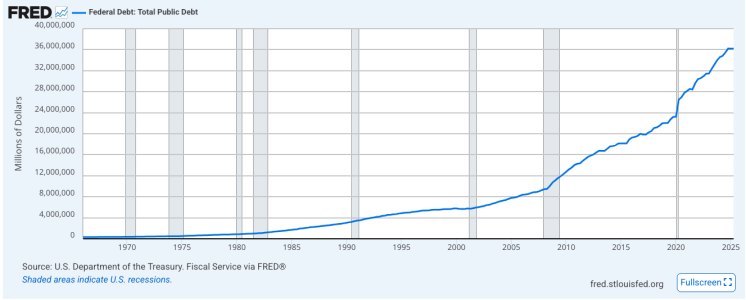
Given that you have said many times that the debt is our downfall and that we are circling the drain because of it, do you ever think that support of Reagan/entrenched Reagan policies could be part of our downfall? Debt/deficit really began its climb in the 1980s. I think the easy answer is "well, it is the spending," but the Reagan years were a start of persistent deficit spending.
Screenshot 2026-01-18 at 1.28.39 PM.png

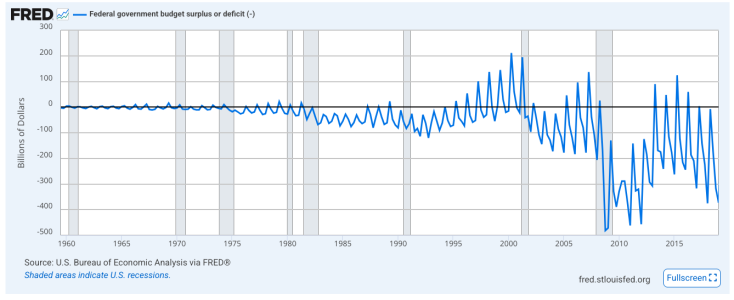
Looking at deficits, Reagan was not good even as things got better in the later part of the 1980s. Clinton (Gingrich) tried. Bush, meh. Given his plight, Obama wasn't horrible. Trump inherited a good economy and spent like a drunken sailor, pure grift. I cut off COVID as it is so bad it destroys the graph.
Screenshot 2026-01-18 at 1.34.01 PM.png

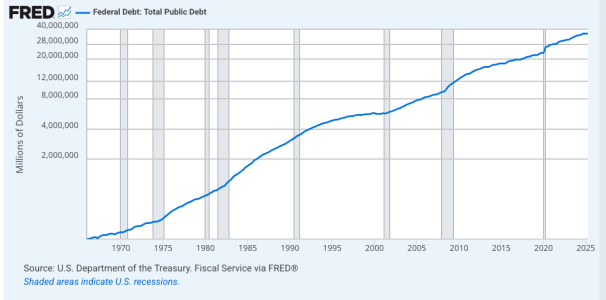
Also, in fairness to Reagan, if you look at the log graph of the debt, it does not look like quite as bad for him.
Screenshot 2026-01-18 at 1.43.47 PM.png
 
I was at dinner with my more liberal group of friends the other night. When I agreed that this administration’s deportation tactics were fascist in nature but disagreed that we live in a fascist country, I got the usual “easy for you to say being a white male” stuff. Am I the one going crazy or are people a lot more “if you aren’t for me you’re against me” nowadays?

Weird being in the middle. Being a “libtard” around my MAGA friends for being anti-Trump and “right wing” around my liberal friends for not agreeing with everything they say. Just over here alone politically.
I appreciate you sharing your experience. I think it is not an easy environment to be "in the middle" in. I also have gone from someone who agreed with the right on some issues and the left on some issues in 2016-2017 to not agreeing with the right on much at all. For what it is worth, I don't agree with establishment dems either. We need a new direction altogether.

For your bolded part it really comes down to that. If one thinks just some of the government's actions are fascist, you are more likely to think that it can just be reformed or things will pass on their own. If you think the government is now fascistic, then active resistance is not just an option, it is a requirement: something that must be done, because one cannot find the middle ground in fascism.

For me, it was learning about the academic definition of fascism and how it has manifested itself in the last 100 years. When going through the signs of fascism, it becomes pretty clear it is the threat that we are facing:
  1. Powerful and Continuing Nationalism
    Fascist regimes tend to make constant use of patriotic mottos, slogans, symbols, songs, and other paraphernalia. Flags are seen everywhere, as are flag symbols on clothing and in public displays.
  2. Disdain for the Recognition of Human Rights
    Because of fear of enemies and the need for security, the people in fascist regimes are persuaded that human rights can be ignored in certain cases because of “need.” The people tend to look the other way or even approve of torture, summary executions, assassinations, and long incarcerations of prisoners.
  3. Identification of Enemies/Scapegoats as a Unifying Cause
    The people are rallied into a unifying patriotic frenzy over the need to eliminate a perceived common threat or foe: racial , ethnic or religious minorities; liberals; communists; socialists, terrorists…
  4. Supremacy of the Military
    Even when there are widespread domestic problems, the military is given a disproportionate amount of government funding, and the domestic agenda is neglected. Soldiers and military service are glamorized.
  5. Rampant Sexism
    The governments of fascist nations tend to be almost exclusively male-dominated. Under fascist regimes, traditional gender roles are made more rigid. Opposition to abortion is high, as is homophobia and anti-gay legislation.
  6. Controlled Mass Media
    Sometimes the media is directly controlled by the government, but in other cases, the media is indirectly controlled by government regulation or by sympathetic media spokespeople and executives. Government censorship and secrecy, especially in war time, are very common.
  7. Obsession with National Security
    Fear of hostile foreign powers is used as a motivational tool by the government over the masses.
  8. Religion and Government are Intertwined
    Governments in fascist nations tend to use the most common religion in the nation as a tool to manipulate public opinion. Religious rhetoric and terminology is common from government leaders, even when the major tenets of the religion are diametrically opposed to the government’s policies or actions.
  9. Protection of Corporate Power
    The industrial and business aristocracy of a fascist nation often are the ones who put the government leaders into power, creating a mutually beneficial business/government relationship and power elite.
  10. Suppression of Labor Power
    Because the organizing power of labor is the only real threat to a fascist government, labor unions are either eliminated entirely, or are severely suppressed .
  11. Disdain for Intellectuals and the Arts
    Fascist nations tend to promote and tolerate open hostility to higher education and academia. It is not uncommon for professors and other academics to be censored or even arrested. Free expression in the arts is openly attacked, and governments often refuse to fund the arts.
  12. Obsession with Crime and Punishment
    Under fascist regimes, the police are given almost limitless power to enforce laws. The people are often willing to overlook police abuses and even forego civil liberties in the name of patriotism. There is often a national police force with virtually unlimited power in fascist nations.
  13. Rampant Cronyism and Corruption
    Fascist regimes almost always are governed by groups of friends and associates who appoint each other to government positions and use governmental power and authority to protect their friends from accountability. It is not uncommon in fascist regimes for national resources and even treasures to be appropriated or even outright stolen by government leaders.
  14. Fraudulent Elections
    Sometimes elections in fascist nations are a complete sham. Other times elections are manipulated by smear campaigns against or even assassination of opposition candidates, use of legislation to control voting numbers or political district boundaries, and manipulation of the media. Fascist nations also typically use their judiciaries to manipulate or control elections.
There are many prose examples that match most of these bullet points.

What is your rationale that we do not have a fascist country at this point?
 
@GratefulPoke mentioned basically that Reagan/Reaganism is what brought us a lot of federal debt and the trickle-down theory didn't really trickle and has been a source of the income mal-distribution that we still deal with today and has become so engrained in our society that even many that are harmed by it embrace it.

Given that you have said many times that the debt is our downfall and that we are circling the drain because of it, do you ever think that support of Reagan/entrenched Reagan policies could be part of our downfall? Debt/deficit really began its climb in the 1980s. I think the easy answer is "well, it is the spending," but the Reagan years were a start of persistent deficit spending.
View attachment 17569

Looking at deficits, Reagan was not good even as things got better in the later part of the 1980s. Clinton (Gingrich) tried. Bush, meh. Given his plight, Obama wasn't horrible. Trump inherited a good economy and spent like a drunken sailor, pure grift. I cut off COVID as it is so bad it destroys the graph.
View attachment 17570

Also, in fairness to Reagan, if you look at the log graph of the debt, it does not look like quite as bad for him.
View attachment 17571
There is no such thing as “trickle down”. That is a leftist bogeyman. Reaganomics was supply-side economics. Increasing competition, increasing supply brings down prices and improves quality.

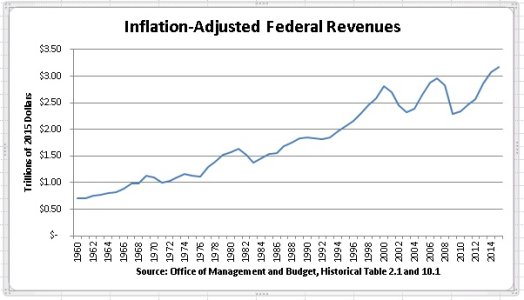
Note what happened to revenue in 1980.
IMG_5602.jpeg

The problem with government debt is spending. The government simply won’t stop spending.
 
I have dealt with a lot of that going from Australia to Oklahoma.

There are two issues.
Some people don't discuss politics as specific issues. They seem to pick their side and align their views to that side. So, when they can't fit someone else into the tidy little boxes they have created, they get frustrated or try anyway.

Two, liberal and conservative in the world of MAGA have changed significantly and now overlap. Conservative in the past used to mean to conserve or essentially leave stuff alone. This was the old-school pro-business republicans. Life was good for them so did not want big government coming in and changing everything. Liberals were progressive, wanting to change things for what they thought was better. But for the conservative mentioned above "better" was a risk. Now, MAGA has removed that. And it has split the conservative world. The regular college educated, high-income or small business owning conservative just might find the democrat party as more conservative in the sense of leaving things alone and avoiding change risk. While many "progressives" really just wanted things to disrupt as they thought others got the advantages. So that type has often bought MAGA hook-line-sinker because things are now changing. Twitter is full of "I used to be a democrat now I'm a pATriOt" types. And, like many old-school progressives were, they are damn near intolerable, IMHO.

A lot of the diehard MAGA types I know consider themselves conservative. I am positive if Trump was a democrat they would feel the same way I do about him right now. Some of the older ones were democrats in the past but changed sides between 2000 and 2008. To be fair I don't think they ever aligned with democratic principles prior to that, just voted that way. SE Oklahoma was similar to the south as a democratic stronghold but seemed to hold on a little longer than states like Alabama and Mississippi.
 
A lot of the diehard MAGA types I know consider themselves conservative. I am positive if Trump was a democrat they would feel the same way I do about him right now. Some of the older ones were democrats in the past but changed sides between 2000 and 2008. To be fair I don't think they ever aligned with democratic principles prior to that, just voted that way. SE Oklahoma was similar to the south as a democratic stronghold but seemed to hold on a little longer than states like Alabama and Mississippi.
They aren’t conservative in any meaningful definition of the term. Trump is not conservative.
 
They aren’t conservative in any meaningful definition of the term. Trump is not conservative.

Yep. It's amazing how so many who saw compliance as being a sheep 5 years ago are now wondering why people won't just go with it now. Aside from a couple of hot button issues nothing about this should even be considered partisan. Even the old school war hawks would take a step back at a colonialist policy that threatens NATO.

And to be completely fair Im sure there are just as many on the left who are appalled now that would be fine with him if he had a D in front of his name.
 
@GratefulPoke mentioned basically that Reagan/Reaganism is what brought us a lot of federal debt and the trickle-down theory didn't really trickle and has been a source of the income mal-distribution that we still deal with today and has become so engrained in our society that even many that are harmed by it embrace it.

Given that you have said many times that the debt is our downfall and that we are circling the drain because of it, do you ever think that support of Reagan/entrenched Reagan policies could be part of our downfall? Debt/deficit really began its climb in the 1980s. I think the easy answer is "well, it is the spending," but the Reagan years were a start of persistent deficit spending.
View attachment 17569

Looking at deficits, Reagan was not good even as things got better in the later part of the 1980s. Clinton (Gingrich) tried. Bush, meh. Given his plight, Obama wasn't horrible. Trump inherited a good economy and spent like a drunken sailor, pure grift. I cut off COVID as it is so bad it destroys the graph.
View attachment 17570

Also, in fairness to Reagan, if you look at the log graph of the debt, it does not look like quite as bad for him.
View attachment 17571
There is no such thing as “trickle down”. That is a leftist bogeyman. Reaganomics was supply-side economics. Increasing competition, increasing supply brings down prices and improves quality.

Note what happened to revenue in 1980.
View attachment 17575

The problem with government debt is spending. The government simply won’t stop spending.
There is such thing as trickle-down economics, its the pejorative term for supply side economics (neoliberalism), which was a reaction to demand side economics (keynesianism).

Supply side economics has consistently lead to budget deficits, because the #1 priority of that economic school of thought is economic growth, not balanced budgets. So taxes are cut to spur economic growth without cutting expenditures.

On top of this, there is good data that massive cuts to government spending (austerity!) policies don't actually help address debt in a meaningful way, because when government cuts its spending, it slows the economy down, which then causes lower amounts of taxes to be collected. Lets take Greece as an example, they famously implementing severe austerity measures due to a ballooning debt to GDP ratio and they then had their GDP contract by 13% in response. Wealth inequality also got even worse under that policy.

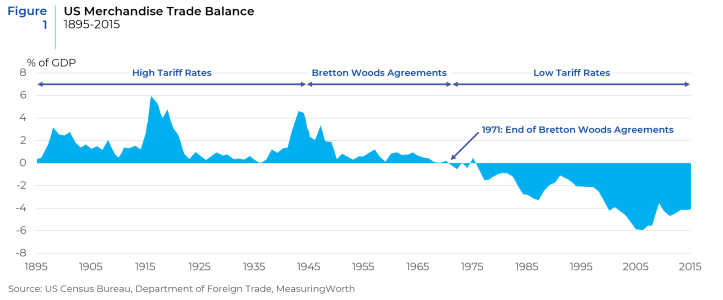
The other issue that one never hears domestically on why the US has to deficit spend is because it is the reserve currency of the world. If the US were actually to invert its trade deficit, it would cause a worldwide recession by crushing the other economies of the world: they need dollars for their own trade! You can see this once we went off of the Bretton-Woods system:
1768771147584.png
So what does this mean?

If we want to meaningfully address the debt, we would need to:
1) Go off of the dollar standard to some other system, maybe a basket of currencies system. This also has its cons though. Going off the dollar standard would also mean a lot of entities would sell our debt, which could also increase the interest rates on the debt, leading to larger debt payments.
2) Increase taxes, particularly on the top 1%. Not only do they have a lot of extra money that is not in circulation, but this would also help address the wealth and power discrepancy we have in our society while helping level out our spending and revenues.

What do I think will happen though? We will fire up the money printer and inflation will be a mainstay until the system itself collapses.
Federal Reserve Inflation GIF by eToro
 
There is no such thing as “trickle down”. That is a leftist bogeyman. Reaganomics was supply-side economics. Increasing competition, increasing supply brings down prices and improves quality.

Note what happened to revenue in 1980.
View attachment 17575

The problem with government debt is spending. The government simply won’t stop spending.
Meh, the sematic argument is irrelevant, the principle is the same and the data shows where the money stayed.

Looks to me like revenues accelerated in 77 for Carter. Went back toward baseline rate for most of Reagan/Bush then jumped again with Clinton.

As I said, the easy answer is "spending" and as I showed Reagan was one of the ones not good about that. There are definite periods that we tried to climb out of deficit spending and times we did not.
 
There is such thing as trickle-down economics, its the pejorative term for supply side economics (neoliberalism), which was a reaction to demand side economics (keynesianism).

Supply side economics has consistently lead to budget deficits, because the #1 priority of that economic school of thought is economic growth, not balanced budgets. So taxes are cut to spur economic growth without cutting expenditures.

On top of this, there is good data that massive cuts to government spending (austerity!) policies don't actually help address debt in a meaningful way, because when government cuts its spending, it slows the economy down, which then causes lower amounts of taxes to be collected. Lets take Greece as an example, they famously implementing severe austerity measures due to a ballooning debt to GDP ratio and they then had their GDP contract by 13% in response. Wealth inequality also got even worse under that policy.

The other issue that one never hears domestically on why the US has to deficit spend is because it is the reserve currency of the world. If the US were actually to invert its trade deficit, it would cause a worldwide recession by crushing the other economies of the world: they need dollars for their own trade! You can see this once we went off of the Bretton-Woods system:
View attachment 17578
So what does this mean?

If we want to meaningfully address the debt, we would need to:
1) Go off of the dollar standard to some other system, maybe a basket of currencies system. This also has its cons though. Going off the dollar standard would also mean a lot of entities would sell our debt, which could also increase the interest rates on the debt, leading to larger debt payments.
2) Increase taxes, particularly on the top 1%. Not only do they have a lot of extra money that is not in circulation, but this would also help address the wealth and power discrepancy we have in our society while helping level out our spending and revenues.

What do I think will happen though? We will fire up the money printer and inflation will be a mainstay until the system itself collapses.
Federal Reserve Inflation GIF by eToro
What happened in Greece should not be used as an example to argue that the United States cannot reduce spending. Greece’s economic collapse was the result of years of chronic government overspending combined with weak tax collection, poor fiscal management, and a lack of economic competitiveness.

Those problems were compounded when Greece revealed inaccurate fiscal data, which severely damaged investor confidence and led to sharp credit-rating downgrades. At the same time, Greece had recently adopted the euro, meaning it no longer controlled its own currency and could not devalue or use monetary policy to stimulate its economy during the crisis. Getting off the dollar standard could have similar impact.

In response, Greece implemented austerity measures that included not only spending cuts but also significant tax increases, the creation of new taxes, and the expansion of the tax base to reach more people—all during a deep recession. Those policies worsened the economic contraction, but they were imposed in a context that is fundamentally different from the United States.
 
Meh, the sematic argument is irrelevant, the principle is the same and the data shows where the money stayed.

Looks to me like revenues accelerated in 77 for Carter. Went back toward baseline rate for most of Reagan/Bush then jumped again with Clinton.

As I said, the easy answer is "spending" and as I showed Reagan was one of the ones not good about that. There are definite periods that we tried to climb out of deficit spending and times we did not.
Where do spending bills originate?
 
There is such thing as trickle-down economics, its the pejorative term for supply side economics (neoliberalism), which was a reaction to demand side economics (keynesianism).

Supply side economics has consistently lead to budget deficits, because the #1 priority of that economic school of thought is economic growth, not balanced budgets. So taxes are cut to spur economic growth without cutting expenditures.

On top of this, there is good data that massive cuts to government spending (austerity!) policies don't actually help address debt in a meaningful way, because when government cuts its spending, it slows the economy down, which then causes lower amounts of taxes to be collected. Lets take Greece as an example, they famously implementing severe austerity measures due to a ballooning debt to GDP ratio and they then had their GDP contract by 13% in response. Wealth inequality also got even worse under that policy.

The other issue that one never hears domestically on why the US has to deficit spend is because it is the reserve currency of the world. If the US were actually to invert its trade deficit, it would cause a worldwide recession by crushing the other economies of the world: they need dollars for their own trade! You can see this once we went off of the Bretton-Woods system:
View attachment 17578
So what does this mean?

If we want to meaningfully address the debt, we would need to:
1) Go off of the dollar standard to some other system, maybe a basket of currencies system. This also has its cons though. Going off the dollar standard would also mean a lot of entities would sell our debt, which could also increase the interest rates on the debt, leading to larger debt payments.
2) Increase taxes, particularly on the top 1%. Not only do they have a lot of extra money that is not in circulation, but this would also help address the wealth and power discrepancy we have in our society while helping level out our spending and revenues.

What do I think will happen though? We will fire up the money printer and inflation will be a mainstay until the system itself collapses.
Federal Reserve Inflation GIF by eToro
In 1980, U.S. federal revenue was around $517 billion, marking the start of a decade where revenues nearly doubled despite significant tax cuts under President Ronald Reagan (Reaganomics), driven by strong economic growth and supply-side policies that incentivized work and investment, though deficits also widened due to increased defense spending.

Key Developments in 1980 & Early 1980s:
  • Revenue Base: Total federal revenue was approximately $517 billion in fiscal year 1980, a figure that would grow to over $1 trillion by 1990.
  • Reaganomics: The administration implemented major tax cuts, notably the Economic Recovery Tax Act of 1981 (ERTA), reducing top marginal income tax rates from 70% to 50%.
  • Economic Growth: These cuts, coupled with indexing against "bracket creep" from inflation, spurred significant economic expansion, boosting overall tax receipts.
From 1980-1988, under President Reagan, U.S. federal spending saw significant increases in defense alongside cuts in domestic programs, resulting in large budget deficits and a nearly tripling of the national debt, driven by massive defense buildup (Cold War), tax cuts, and limited cuts in non-defense spending, creating a shift towards higher defense outlays and increased borrowing.
Key Changes in Spending:
  • Defense Spending Soared: A major focus was rearming the U.S. military, particularly with initiatives like the Strategic Defense Initiative (SDI) or "Star Wars," dramatically increasing defense outlays.
  • Domestic Spending Slashed: Reagan pursued cuts in non-defense discretionary spending, affecting programs like community development and social services, though these cuts didn't offset increased defense spending.
  • Non-Defense Spending Varied: While cuts occurred, some areas saw increases, such as for air traffic control modernization, immigration reform, and clean-coal technology, but overall domestic spending growth slowed.
Impact on Budgets & Debt:
  • Massive Deficits: Tax cuts (Economic Recovery Tax Act of 1981) combined with increased defense spending led to huge budget deficits, never balanced during Reagan's tenure.
  • National Debt Exploded: The national debt grew from under $1 trillion in 1980 to $2.6 trillion by 1988, as the government borrowed heavily to cover the shortfall.
  • "Wartime Deficits": Some conservatives argued these deficits were necessary "wartime deficits" to challenge the Soviet Union, contributing to the Cold War's end.
In essence, the period was characterized by a massive reorientation of federal priorities towards military strength.

The problem isn't supply-side economics, which increased revenues, it's spending. Spending outpaced the growth in revenues.

OTOH, our current inflation is the direct result of Keynesian dumping money into the economy.
 
Back
Top