

You are using an out of date browser. It may not display this or other websites correctly.
You should upgrade or use an alternative browser.
You should upgrade or use an alternative browser.
Trump 47
- Thread starter PF5
- Start date

Polds4OSU
Marshall
The Justice Dept. releases documents to Congress that included "damning evidence" about President Trump's procurement of highly sensitive documents, including some related to his business interests, when he left office after his first term, Rep. Jamie Raskin says.

 www.threads.com
NBC News (@nbcnews) on Threads
The Justice Dept. releases documents to Congress that included "damning evidence" about President Trump's procurement of highly sensitive documents, including some related to his business interests, when he left office after his first term, Rep. Jamie Raskin says.
www.threads.com
Polds4OSU
Marshall
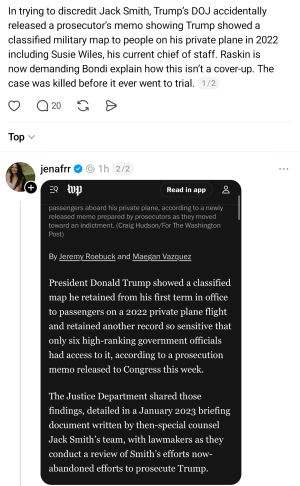
President Trump showed a classified map from his first term to passengers on a 2022 private plane flight and retained another record so sensitive that only six government officials had access to it, according to a prosecution memo released to Congress.
 www.threads.com
The Washington Post (@washingtonpost) on Threads
President Trump showed a classified map from his first term to passengers on a 2022 private plane flight and retained another record so sensitive that only six government officials had access to it, according to a prosecution memo released to Congress.
www.threads.com

PF5
Sheriff
The SAVE America Act Trump wants is pretty openly a voter suppression measure: voting by undocumented immigrants is already virtually nonexistent, and it is already illegal. And the Brookings Institution reported in 2025 that only about four cases of mail fraud occur per 10 million mail-in ballots, or 0.000043% of total mail ballots cast. But Republicans are using the idea of voter fraud to argue for measures that could toss more than 21 million Americans off the voter rolls.
Polds4OSU
Marshall
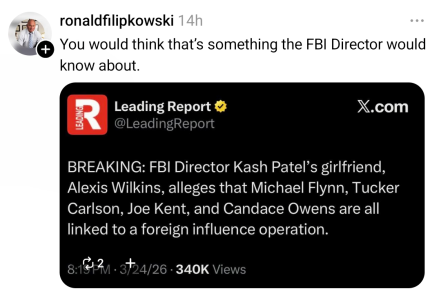
The DOJ just agreed to pay Michael Flynn $1.2 million in a settlement.
Flynn sued claiming malicious prosecution. He asked for $50 million. A federal judge threw the case out in 2024 after ruling he failed to meet the basic legal standard for that claim.
This DOJ reopened it and cut a check.
For context: Flynn pled guilty to lying to the FBI. Got pardoned by Trump. Has been a vocal Trump supporter since.
The $1.2 million is coming from taxpayers.
 www.threads.com
Flynn sued claiming malicious prosecution. He asked for $50 million. A federal judge threw the case out in 2024 after ruling he failed to meet the basic legal standard for that claim.
This DOJ reopened it and cut a check.
For context: Flynn pled guilty to lying to the FBI. Got pardoned by Trump. Has been a vocal Trump supporter since.
The $1.2 million is coming from taxpayers.
Ashley Renee (@ash.renee411) on Threads
The DOJ just agreed to pay Michael Flynn $1.2 million in a settlement. Flynn sued claiming malicious prosecution. He asked for $50 million. A federal judge threw the case out in 2024 after ruling he failed to meet the basic legal standard for that claim. This DOJ reopened it and cut a check...
www.threads.com

The DOJ just agreed to pay Michael Flynn $1.2 million in a settlement.
Flynn sued claiming malicious prosecution. He asked for $50 million. A federal judge threw the case out in 2024 after ruling he failed to meet the basic legal standard for that claim.
This DOJ reopened it and cut a check.
For context: Flynn pled guilty to lying to the FBI. Got pardoned by Trump. Has been a vocal Trump supporter since.
The $1.2 million is coming from taxpayers.
Ashley Renee (@ash.renee411) on Threads
The DOJ just agreed to pay Michael Flynn $1.2 million in a settlement. Flynn sued claiming malicious prosecution. He asked for $50 million. A federal judge threw the case out in 2024 after ruling he failed to meet the basic legal standard for that claim. This DOJ reopened it and cut a check...
Should have taken a bullet for dear leader. Babbit's estate got more.

Polds4OSU
Marshall
BREAKING: Trump official makes new criminal referrals against Letitia James after the DOJ failed three times to prosecute the N.Y. attorney general.
Polds4OSU
Marshall
From Fox News: “The U.S. Postal Service is going to impose their first ever fuel surcharge of 8% on packages because of higher gasoline prices…. You're ultimately going to see higher prices.”
 www.threads.com
Casey (@mamasissiesays) on Threads
From Fox News: “The U.S. Postal Service is going to impose their first ever fuel surcharge of 8% on packages because of higher gasoline prices…. You're ultimately going to see higher prices.” WOOF. Imagine this being your presidential legacy 🥴🥴
www.threads.com
Polds4OSU
Marshall
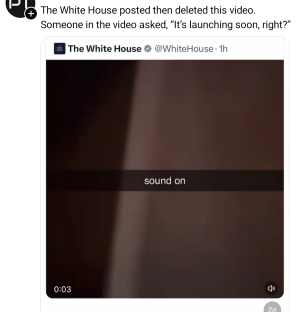
COVFEFE!!!!!
Polds4OSU
Marshall
Congressional Republicans have invented a new award called The America First Award and are giving it to Donald Trump
Congressional Republicans created an award to give to President Donald Trump on Wednesday.
House Republicans held their annual National Republican Congressional Committee fundraiser on Wednesday night in Washington, D.C. Before Trump spoke, Speaker Mike Johnson (R-LA) announced that the NRCC had come up with a new honor to bestow on the president.
“We wanted to do one thing before we bring the president out to the stage,” Johnson said, before saying Trump works “literally around the clock to fix every issue” and is solving “all the domestic problems.” As such, the speaker said, House Republicans created a new award:
Mike Johnson announces, ‘We have created a new award’ to give Trump: ‘This beautiful golden statue’
Congressional Republicans created an award to give to President Donald Trump on Wednesday.
House Republicans held their annual National Republican Congressional Committee fundraiser on Wednesday night in Washington, D.C. Before Trump spoke, Speaker Mike Johnson (R-LA) announced that the NRCC had come up with a new honor to bestow on the president.
“We wanted to do one thing before we bring the president out to the stage,” Johnson said, before saying Trump works “literally around the clock to fix every issue” and is solving “all the domestic problems.” As such, the speaker said, House Republicans created a new award:
And we want to honor him in some small way, some token of our appreciation for his leadership. And so, tonight, we have created a new award. We’re going to do something we’ve never done before. We’re going to honor him with a new award that we’ll present annually from this point forward. But he is the suitable and fitting receipient of the first-ever America First Award. We could think of no better title for what that is. That’s this beautiful golden statue here. Appropriate for the new golden era in America.
Polds4OSU
Marshall
Trump’s visa policy could force World Cup Fans and the Players from 5 countries to put up Bond Payments of $15k per Fan / Player / Coach / Support Personnel etc to enter the US. Also includes a $5K per child fee as well. Money would be refunded if they leave "In a Timely Manner" after the Events
FIFA President Gianni Infantino, right, awards President Donald Trump with the FIFA Peace Prize during the draw for the 2026 soccer World Cup at the Kennedy Center in Washington, Friday, Dec. 5, 2025. (AP Photo/Chris Carlson, File)
International travelers coming to the U.S. for this summer’s World Cup could be forced to pay tens of thousands of dollars thanks to President Donald Trump’s visa policy.
A Wednesday report from The Athletic highlighted the struggles a handful of countries are facing ahead of the international tournament. As noted in the report, visitors seeking B-1 or B-2 visas must pay for bonds that cost between $5,000 and $15,000 per person. Of the 50 countries listed in this new policy — called the “Visa Pilot Bond Program” — five of them will be participating in the World Cup.
Those countries are Algeria, Cape Verde, Senegal, the Ivory Coast, and Tunisia.
When asked for comment by The Athletic, a State Department spokesperson emphasized that visitors who leave the U.S. “in a timely fashion” after the World Cup will have their money returned to them. The department, however, stood by the policy and stated that all international visitors would be “subject to the same legal standards.” That applies to competing athletes, as well.
The report continued:
According to The Athletic, FIFA has privately been pushing for the Trump administration to make exemptions. In the meantime, the organization is reportedly ironing out backup plans to get teams into the U.S.The bond payments are per person, rather than per travelling party, meaning that a parent travelling with a child would have to make two separate bond payments. Sources familiar with the process indicate that the $5,000 payments will be broadly reserved for children entering the country, with payments of $10,000 or $15,000 for adults.

First sign of prices coming down!!
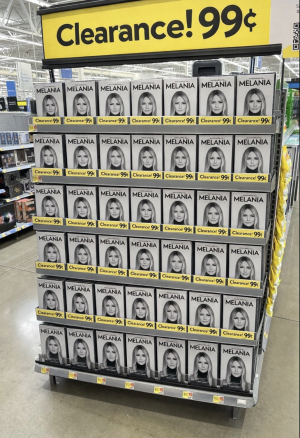
I know this is fake but if it were real you know some dumbo who spent all of Bidens term griping about how things are unaffordable and he has no money would buy them all up. Because nothing says broke like owning 50 copies of a random documentary to please dear leader.
Similar threads

- Replies
- 0
- Views
- 94


- Replies
- 3
- Views
- 183
- Replies
- 48
- Views
- 2K