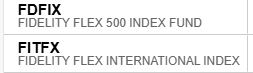
For those that index, do you have international exposure? One theory of indexing is that because the huge US companies are all global, there really isn't a need to obtain foreign indexes because you already have foreign exposure. That might be changing with the path we chose to take.
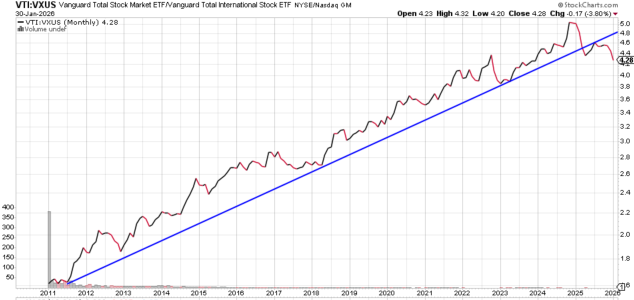
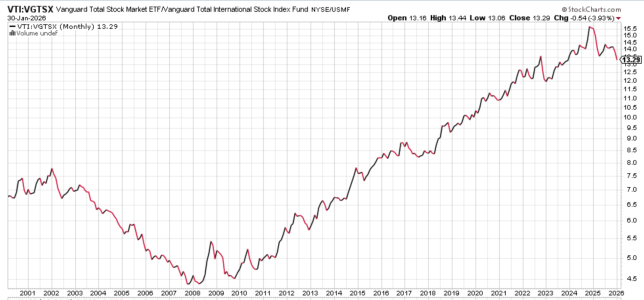
This is a graph of the Total US market divided by the Total world minus the US. So, it goes up when the US is outperforming and down when the US is underperforming the world. We have had a very long term upswing in US performance, and that trendline is broken. That doesn't mean that it will continue down, but it is broken and relative to the past 15 years the world is performing better than US.
View attachment 18225
Zoom and Microsoft are among those companies that could lose business as Europe seeks tech sovereignty, says Matthew Tuttle

www.marketwatch.com
Europe just started building a ‘kill switch’ for U.S. tech — and the market isn’t priced for it, says this strategist
“The main event is this: the world is building optionality away from U.S. policy and platform dependence. And once you see it, you can’t unsee it — because it’s showing up in procurement decisions, supply chains, defense budgets, and capital flows,” Tuttle says.
This trend has meant big gains for European defense stocks for example, as the Trump administration is no longer seen as a reliable military ally. But there is another important shift underway, Tuttle reckons: “It’s digital sovereignty — and it’s quietly becoming the civilian version of rearmament.”
From Europe’s perspective, digital sovereignty means that if relations with the U.S. worsen then communications and core systems can’t just be turned off. “If alliances wobble, we control our own pipes,” he believes is the continent’s thinking.
And this is not just theory. France is pushing state workers to stop using Zoom to “guarantee the security, confidentiality and resilience of public electronic communications.” And Tuttle notes that the German state of Schleswig-Holstein has been moving public-sector workflows away from Microsoft-dependent infrastructure toward open-source / European-controlled solutions.
“If defense is Europe’s ‘hard power’ rebuild, EuroStack-style thinking is the ‘soft power’ rebuild: a push toward a European-controlled tech stack across compute, cloud, security, and apps,” says Tuttle.



 www.latimes.com

 electrek.co