Philosophy & Religion Thread

This part of the discussion right now reminds me of this book: The Rise and Triumph of the Modern Self: Cultural Amnesia, Expressive Individualism, and the Road to Sexual Revolution
https://share.google/9BCcLUo8LVAweqQPy

@GratefulPoke you might find this guy interesting in terms of what you brought up about transhumanism. I think his next big work is going to be on that subject.
 
I’ve shared thoughts on “soul mate” which is a concept that comes from Platonic Gnosticism.

Neo-Gnosticism has become the default worldview in our culture. It began with Descartes, “I think therefore I am.” It has become “I think is what I am.” Whereas in classical Gnosticism, the dualism is spirit and material, the spirit is true self and material body is non-self; in neo-Gnosticism the mind is true self And the body is non-self. In this view it makes perfect sense to modify the non-self body to match the true self mind. It is also perfectly consistent to say things like “trans are the most highly evolved members of society” because they were brave enough to modify their nonself bodies to match their true self minds.
@RxCowboy this reminded me of this discussion and I thought you might find it interesting:
 
I think you are oversimplifying.

People of faith tend to want to attribute a similar level of faith in people without faith, hence the common "Atheism is a religion!"

The reality, when you talk to those people, they often have a wide variety of feelings on these subjects and those feelings are fluid as it is unknown. I think very few live forever in a "what I think is what I am."
Maybe I’m not doing an adequate job of explaining what I mean by “default worldview.”

People buy Sooners hats at Loves but can’t tell you what the team’s record is, who the next game is against, or whether the next game is home or away. The Sooners are the “default”. Of course they don’t live purposely in a what I think is what I am, it is a default condition like buying a hat at Loves. Their worldview is an amalgamation. My former sister in law, the redhead’s sister, claims to be an atheist but also claims that her mom and dad are both in heaven, atheist heaven I guess. But “I think therefore I am” is what the majority of the hats at Loves are made of.
 
AI Overview


Whether modern Israel is the same as the biblical Israel is a subject of intense debate, involving religious, political, and historical perspectives.
While they share the same geographical location and name, they differ significantly in nature: the Bible describes a covenant-based, often theocratic kingdom, whereas modern Israel, founded in 1948, is a secular parliamentary democracy.

Key Perspectives on the Comparison:
  • Yes (Prophetic/Historical View): Some believe the establishment of modern Israel is the fulfillment of biblical prophecy regarding the return of the Jewish people to their promised land, representing a continuation of the biblical nation.
  • No (Theological/Political View):
    Others argue that modern Israel is a 20th-century geopolitical entity, not the "theocratic kingdom" described in the Bible
    . Some interpretations suggest "Israel" in the New Testament refers to a spiritual community (the Church) rather than a physical state
    Geographical/Historical Context: The land has been known by various names, including Canaan, and later split into kingdoms (Israel and Judah).
Ultimately, whether they are considered "the same" depends on whether one views Israel through a lens of political history or religious covenant.
 
Its absolutely not the same entity.

Here is a timeline that has been pieced together from the scriptures.

Patriarchal Period (c. 2000–1700 BC)

  • Genesis 32:28 — Jacob is renamed Israel after wrestling with the angel.
  • Genesis 35:10–12 — God reaffirms the name “Israel.”
  • “Israel” at this stage = one man + eventually his 12 sons (the tribes).


Egyptian Sojourn & Exodus (c. 1700–1250 BC)

Meaning: A People/Nation Without Land

  • Growth of the “children of Israel” (Exodus 1:1–7).
  • Moses leads the people called Israel out of Egypt (Exodus 3:10).

Conquest & Judges Period (c. 1250–1050 BC)

  • Joshua leads Israel into the promised land.
  • The term “Israel” still refers chiefly to the people, not a political state.
  • By late Judges, regions are loosely called “territories of Israel.”

United Monarchy — Saul, David, Solomon (c. 1050–930 BC)

  • “Israel” becomes a political state under a single king.
  • The whole land is referred to as Israel (1 Samuel through 2 Samuel).


Divided Monarchy (c. 930–722 BC)

After Solomon, the kingdom splits:​

  • Northern Kingdom = Israel
  • Southern Kingdom = Judah
Books like 1–2 Kings and the prophets (e.g., Hosea, Amos) use “Israel” primarily to mean the northern political kingdom, though sometimes still the people as a whole.


Assyrian Exile (722 BC and after)

  • The Northern Kingdom is destroyed (2 Kings 17).
  • “Israel” now refers mostly to the scattered people, not a land.


Babylonian Exile & Post-Exile Period (586–400 BC)

  • Prophets like Ezekiel and Jeremiah use “Israel” for the restored people God will bring back.
  • After the return (Ezra–Nehemiah), “Israel” once again refers to the whole covenant community, not just the north.

However, you also have to consider God's own words in Genesis

Your name is Jacob; your name shall not be called Jacob anymore,
but Israel shall be your name.”

“I am God Almighty. Be fruitful and multiply;
a nation and a company of nations shall come from you,
and kings shall come from your body.
The land which I gave to Abraham and Isaac
I give to you, and to your descendants after you.”

However in Hebrew it's not called Israel. It is named Yisra’el

God says in Genesis 32
“for you have struggled with God and with men and have prevailed.”

Then God Himself Renames Jacob to Yisra’el which LITTERALLY translates to "One who struggles with God"

To me this doesn't say a Nation named Israel will created and belong to God and its people belong to God. It tells me that a man named Jacob was chosen by God and renamed to Yisra'el and told that Human that A Nation for his People and many Nations after him would be created by the Human named Yisra'el and they would own their own Land at some point.

To me it seems God named an individual Human Israel, and others named everything after him because God had given him that name ?
 
The secular geo-political state of Israel is not the same as the people group of Israel which is also not the same as the ancient kingdom of Israel.
Modern Christians believe in a Triune God and not a Triune Israel

Am I crazy to think Israel another metaphor and Holy example for the Trinity?
 
Modern Christians believe in a Triune God and not a Triune Israel

Am I crazy to think Israel another metaphor and Holy example for the Trinity?
That isn't as crazy as thinking the modern secular geo-political state of Israel is the same Israel that is spoke of in the OT.
 
If you mean that the Bible is a metanarrative of creation, fall, redemption, restoration, then yeah.
I asked as a joke, but the continuity/discontinuity discussion with Israel is answered best in the progressive covenantal framework of Biblical theology.

The reason people are confused about Israel and whether it is the same as OT Israel is because of another biblical theology framework called dispensationalism. Not trying to sound overdramatic, but dispensationalism has done the most damage to Christian's witness in these kinds of discussions. I think you can also draw a pretty clear line from the rise of dispensationalism to a rise in Christian nationalism. But that is a discussion for another thread.
 
I asked as a joke, but the continuity/discontinuity discussion with Israel is answered best in the progressive covenantal framework of Biblical theology.

The reason people are confused about Israel and whether it is the same as OT Israel is because of another biblical theology framework called dispensationalism. Not trying to sound overdramatic, but dispensationalism has done the most damage to Christian's witness in these kinds of discussions. I think you can also draw a pretty clear line from the rise of dispensationalism to a rise in Christian nationalism. But that is a discussion for another thread.
Well, dispensationalism and evangelicalism are historically linked, so you are absolutely correct about the relationship to Christian Nationalism. If you’ve read my posts on approaching scripture interpretation from literary type, and that the Bible is not a history text, science text, or chronograph, you might guess that I am not a big fan of the Scofield study bible. I don’t own one.

But that doesn’t mean the Bible isn’t a metanarrative or that progressive revelation isn’t true. What we have to bear in mind always is that we have a relatively finished canon while the original audiences did not.

Scofield has done a lot of damage.
 
I asked as a joke, but the continuity/discontinuity discussion with Israel is answered best in the progressive covenantal framework of Biblical theology.

The reason people are confused about Israel and whether it is the same as OT Israel is because of another biblical theology framework called dispensationalism. Not trying to sound overdramatic, but dispensationalism has done the most damage to Christian's witness in these kinds of discussions. I think you can also draw a pretty clear line from the rise of dispensationalism to a rise in Christian nationalism. But that is a discussion for another thread.
I am pretty interested in thoughts regarding dispensationalism. My BIL is a true believer. We used to grab coffee together weekly before my job change made it challenging to meet. We did a book study together after the Pandemic on dispensationalism. This was at a time my deconstruction of faith was accelerating.

Based on his preview, I anticipated the study would help restore my footing in evangelical Christianity. Instead, I found it to be the an exercise in mental gymnastics like none I had ever witnessed. My BIL is incredibly smart, but this made me realize he takes everything in the Bible quite literally. Like a history book (which also should not be taken too literally). It takes an extra large dose of cognitive dissonance to swallow dispensationalism, IMHO.
 
Last edited:
I am pretty interested in thoughts regarding dispensationalism. My BIL is a true believer. We used to grab coffee together weekly before my job change made it challenging to meet. We did a book study together after the Pandemic on dispensationalism. This was at a time my deconstruction of faith was accelerating.

Based on his preview, I anticipated the study would help restore my footing in evangelical Christianity. Instead, I found it to be the an exercise in mental gymnastics like none I had ever witnessed. My BIL is incredibly smart, but this made me realize he takes everything in the Bible quite literally. Like a history book (which also should not be taken too literally). It takes an extra large dose of cognitive dissonance to swallow dispensationalism, IMHO.
Can you give us a for instance of the mental gymnastics?

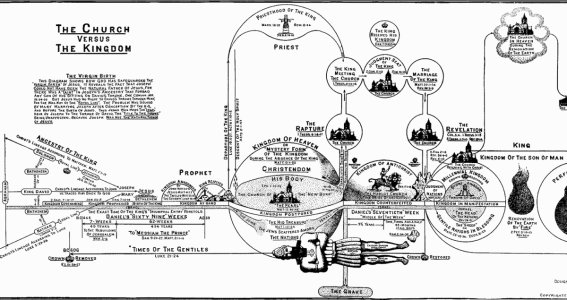
Dispensationalism is a 20th century invention, primarily by John Nelson Darby (also premillenial rapture) that was made widespread with the Scofield study bible. It requires a wooden, literal reading of scripture. It also requires that the timelines found in the SSB be accepted as accurate. But as I’ve asserted, the Bible is not a chronograph. Not a single word of it was written with the intent and purpose of creating timelines, so by definition the Scofield timelines are an extra-scriptural exercise.

IMG_5865.jpeg
 
I find myself moving towards agnosticism more and more each day...

In a few billion years the sun will have expanded into Earth's orbit and there will be no trace of us save Voyager 1 and 2.
We are apes. No better than the flies buzzing outside my window. Groups of atoms, DNA that only seeks to copy itself.
We don't matter. At all.
We see groups of wolves kill each other over territory or monkeys kill each other in the trees and we say it's nature. We're natural. Wouldn't even nuclear war be a totally natural thing?

So I'm between that and:

The odds that we even exist are so astronomically low that we should be ever grateful and seek to preserve precious life.
For trillions of miles in each direction we've seen no signs that any of the other atoms are "awake."
We're made of the same stuff that is throughout the universe. We are the universe. That's amazing.
I mean what a gift.
 
Back
Top