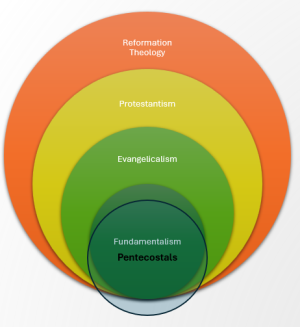
I'm probably not going to do a very good job at this and if I get things wrong then please correct me, but what I'm going to attempt to do is give the relationship between Reformation theology, Protestantism, evangelicalism, and fundamentalism, particularly in the US. IOW, everything that has happened since Martin Luther nailed his theses to the door of the church.
Of course, Martin Luther nailed his 95 theses to the door of Castle Church in Wittenberg, Germany on October 31, 1517 and this is widely regarded as the start of the Protestant Reformation. At the center of the theses were the Pope's power to grant plenary indulgences, which in theses 41-47 Luther criticizes for discouraging works of mercy by those who purchase them (sound familiar?). He also believe they conflicted with justification by faith.
The Reformation, or Reformation theology is based on the four "solas". Sola scriptura, that scripture is the only source of divine revelation. I don't particularly want to get into the debate between Reformation and Catholic theology here. But I will just say that this is a specific refutation of the Pope as the Holy See, the mouthpiece of God on earth. Sola fide, we are justified by faith alone. "Justification" requires some explanation and I will save that for another post. Sola gracia, by grace alone. Grace is God's unmerited favor. Again, grace requires explanation, another day, another post. Sola Christus, in Christ alone.
All mainline Protestant churches accept Reformation theology. They all fit within the Reformation like Russian nesting dolls. If they differ they differ on matters of polity or less important doctrinal issues.
As I said before, evangelicalism is generally a movement within protestantism that emphasizes the primacy of the authority of scripture, the necessity of personal conversion (being born again), the centrality of the atoning death of Jesus, and active evangelism (The Great Commission Matthew 28:18-20). I've pretty recently learned that evangelicalism is splitting into political evangelicals and theological evangelicals, the latter are people like me who are disgusted with the conflation of faith and politics.
Christian fundamentalism was born in the early 20th century as a response to post-modernism. It emphasizes a strict-literal interpretation of scripture (young-earth, anti-evolution), bible inerrancy, and is generally very legalistic and culturally separatist.
Pentecostals... where do they fit? The Pentecostal movement began in Topeka, Kansas when Agnes Ozman spoke at Charles Fox Parham's Bethel Bible College. Parham was a Methodist holiness preacher and that event established speaking in tongues as "the initial physical evidence" of baptism in the Holy Spirit. It was witnessed by William J. Seymour, a one-eyed black man who watched through a window because he wasn't allowed in the church, who then started the Azusa Street Revival in Los Angeles in 1906, which was the birth place of Pentecostalism. Pentecostal churches are sometimes lumped into "Protestant" but I think this is incorrect because they were not born of the Protestant Reformation. However, they all generally do accept the four Solas. Except... some pentecostals believe that "prophecy" given after speaking in tongues is on the same level as scripture, so in a sense, they might not entirely accept sola scriptura. All pentecostals are fundamentalists, except the Assemblies of God. All pentecostals are evangelicals. I say all pentecostals are fundamentalists, except the AG, there are a few important doctrinal points with which the AG different from fundamentalists, the biggest of which is women in ministry; complementarianism versus egalitarianism. The AG is egalitarian, they ordain women. Where I to apply to my former university as a member of an egalitarian church I would not get an interview, which is sad and pathetic.
I've attempted a Venn diagram. Again, I'm open to corrections and discussion.