Philosophy & Religion Thread

I've struggled with fellowship the past few years. Getting divorced in the middle of the pandemic, being isolated, and then moving to Michigan where I didn't know anyone and living alone has had... an effect. I didn't realize how much of an effect it had. I'm starting to deal with it.
I’m sure you have your reasons and a plan but move back to Stillwater. We stay busy year round w sporting events and now the McKnight Center (amazing pac w even more amazing artists and performers). We’ve made new friends w people that have season tickets next to us in different events that have retired or semi retired back to Stillwater. My almost 80 yr old in-laws did this about 7 yrs prior to us and we can’t keep them at home. They go way more than we do
 
Oscoda, a town of about 3000 on the shore of Lake Huron in Northern Michigan, well above the population line. I've lived in small towns a long time, but this is the most remote place I've ever lived. It's 45 minutes one way to Alpena to Meijer and Home Depot, and an hour and a half the other way to Saginaw to Guitar Center and Kroger. If you draw a line horizontally roughly through Grand Rapids about 80% of the population of Michigan lives below that line.

The UP rules. I haven't been on the east side though. I've only been to Detroit and Grand Rapids for work. We showed up to Grand Rapids before the work began to enjoy the area. We took a jeep up to Traverse City and that is my UP experience on the west side. Mackinaw Island looks awesome. Not sure if/when I'll ever go back, but it would be cool.
 
I’m sure you have your reasons and a plan but move back to Stillwater. We stay busy year round w sporting events and now the McKnight Center (amazing pac w even more amazing artists and performers). We’ve made new friends w people that have season tickets next to us in different events that have retired or semi retired back to Stillwater. My almost 80 yr old in-laws did this about 7 yrs prior to us and we can’t keep them at home. They go way more than we do

If you go see Allison Krause there make sure you don't miss her opener, Theo Lawrence. He is excellent.
 
The UP rules. I haven't been on the east side though. I've only been to Detroit and Grand Rapids for work. We showed up to Grand Rapids before the work began to enjoy the area. We took a jeep up to Traverse City and that is my UP experience on the west side. Mackinaw Island looks awesome. Not sure if/when I'll ever go back, but it would be cool.
The Lake Michigan side supposedly has more money than the Lake Huron side. That’s where the casinos and resorts are.
 
I’m sure you have your reasons and a plan but move back to Stillwater. We stay busy year round w sporting events and now the McKnight Center (amazing pac w even more amazing artists and performers). We’ve made new friends w people that have season tickets next to us in different events that have retired or semi retired back to Stillwater. My almost 80 yr old in-laws did this about 7 yrs prior to us and we can’t keep them at home. They go way more than we do
My only reason for being here is work. I needed a job, wanted a job in the VA system, and this is the one I found. There was one at the OKC VA and I was a finalist, but I didn’t get it.
 
Finding your "soul mate".

There are currently approximately 8.3 billion people on the planet. The idea that there is one person to whom you are perfectly matched and that it is God's will that you seek out and find that person and marry them is pretty preposterous. And if it is true that there is "one person" that it is God's will that you find and marry, well, then having been married twice I am forever out of God's will because I obviously missed it.

The concept of "soul mate" is not a Christian concept. It comes from Platonic gnosticism. To Plato, souls pre-existed in the ether and were mated to one another in the ether. Then when a body was ready the souls were poured into the body. Then it was your mission in life to find the soul that you were mated with in the ether, your soul mate, and finding your soul mate would result in perfect harmonious bliss.

By contrast, the Judeo-Christian belief is not that we have souls but that we are souls... that everything that we are, body, mind, spirit is created in the womb and nothing pre-exists prior to that creation and that these are inseparable except by death when the spirit leaves the body. And what I mean by "we are souls", the term for "soul" that is used in the OT, nephesh, means "living, breathing creature." It is also used of animals. Animals are nephesh, living breathing creatures. They do not have souls, they are souls (Genesis 1:21 So God created the great sea creatures (nephesh) and every living creature (nephesh) that moves, with which the waters swarm, according to their kinds, and every winged bird according to its kind. And God saw that it was good).

I'm not on any dating sites any more and haven't been in a good while, but nearly every woman's profile, especially Christian women, says she's looking for her "soul mate". It ought to say "next soul mate" because her last one was her soul mate, at least until he wasn't anymore. This idea that your life is supposed to be perfect harmonious bliss is pretty destructive. It doesn't exist in nature. Life can be good, and it should be. But perfect harmonious bliss? That's why people keep going from one to another.

So, what is "God's will" for finding a mate? That we choose wisely. Which obviously, I haven't.
 
The Bible is not a science textbook. Science that is represented in the Bible is only accurate in that it accurately represents the understanding of the natural world at the time that the oral histories and books were created. To attempt to take 21st century understanding of the natural world and retrofit it back into scripture is to torture scripture. There weren’t dinosaurs on the ark and the flood wasn’t geoglobal because the original author didn’t have those things in mind and the original audience wouldn’t have understood it that way. The ancient Hebrews believed the earth was flat, that the firmament was suspended above the earth by four pillars, and that the “world” was pretty much the Mediterranean and North Africa. They certainly had no concept of the Americas, the Arctic, Antarctica, the Pacific, etc.

The Bible isn’t a history textbook. Much of the Bible is narrative which is a literary form. But even when it is talking about persons that historians, archaeologists, anthropologists generally agree actually existed such as the davidic kings, historical narrative is still not a history textbook, it is a theological text and historical accuracy isn’t the point, theology is. You’ll find two different authors telling the same story with events in different orders because they are making different theological statements; or in the case of the Gospels (eg. Judas’ betrayal and suicide) conflicting accounts for making different theological statements. Apologists attempt to reconcile these, but they really don’t have to be. Accept the point that they make, which isn’t history.

The Bible isn’t a chronograph. Not a single syllable of the bible was written to be able to interpret the age of the universe or the earth. So by definition using the bible as a chronograph to determine, say the age of the earth, is by definition an extra-scriptural exercise. And interpreting times in between events in the bible is sometimes like judging the distance between two mountains from a 2D photograph. What is the distance between the two peaks below?
IMG_5711.jpeg

The Bible consists of a number of different literary types: narrative makes up the majority. I’ve already said that narratives are not history. Narratives are also not allegory filled with hidden meaning. The meaning is there in the narrative and it would have been there for the original audience. There is also poetry, wisdom literature, psalms, epistles, apocalypses, prophecies (which generally are not telling the future), etc. and each has its own rules for interpretation, and the original audiences would have understood those rules so we should understand them and use them too. A passage cannot mean now what it has never meant.
 
Last edited:
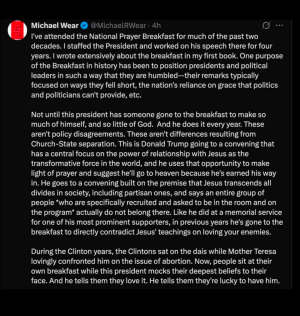
Pete Hegseth: "Like Christ, in earthly ways our brave warriors are not called to appease the world, they must confront it. We fight a physical battle ultimately grounded as Trump said in a spiritual battlefield. Not only are we armed with the arsenal of freedom, but with the arsenal of faith."

Ahh yes, Jesus famously said "take up arms in a physical battle".
 
Ahh yes, Jesus famously said "take up arms in a physical battle".
At this point, they literally know they can say whatever they want and their people will love it.

The only slight blowback I have seen is Trump being nice to the Clintons but that was on Juanita Broderick's X post. But, other than being collegial to a democrat, they could suggest stomping puppies and people would be like, "Yes! Dang puppies are a YUGE problem!"
 
At this point, they literally know they can say whatever they want and their people will love it.

The only slight blowback I have seen is Trump being nice to the Clintons but that was on Juanita Broderick's X post. But, other than being collegial to a democrat, they could suggest stomping puppies and people would be like, "Yes! Dang puppies are a YUGE problem!"
Go watch the video of the ICE agent kicking the puppy and breaking it's ribs published yesterday

They aren't SUGGESTING stomping puppies..they are literally ALREADY doing it
 
Pete Hegseth: "Like Christ, in earthly ways our brave warriors are not called to appease the world, they must confront it. We fight a physical battle ultimately grounded as Trump said in a spiritual battlefield. Not only are we armed with the arsenal of freedom, but with the arsenal of faith."

There is another thread for politics and Christian nationalism.
 
If you want to know why Mormons currently get bristly at being called Mormons.


Dueling prophets.

Russell Nelson gave a general conference talk in the early 90s saying they should use the full name of the church. 6 months later, Gordon Hinckley said that using the word Mormon was just fine and basically put Nelson in his place. Once Nelson got the top job, he gives basically the same talk he gave ~30 years earlier but now no one else could contradict him.

It had been a pet peeve of his for decades, and now church members have gotten obnoxious in trying to adhere to his “revelation” that they shouldn’t use the word “Mormon” in naming the church since he said it is a “victory for Satan” when they omit Jesus Christ’s name from the name of his church.

Some day it will change back.
 
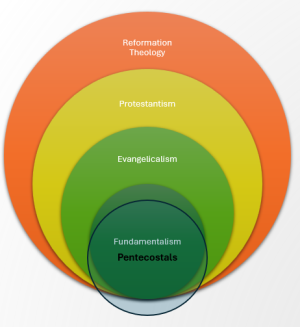
I'm probably not going to do a very good job at this and if I get things wrong then please correct me, but what I'm going to attempt to do is give the relationship between Reformation theology, Protestantism, evangelicalism, and fundamentalism, particularly in the US. IOW, everything that has happened since Martin Luther nailed his theses to the door of the church.

Of course, Martin Luther nailed his 95 theses to the door of Castle Church in Wittenberg, Germany on October 31, 1517 and this is widely regarded as the start of the Protestant Reformation. At the center of the theses were the Pope's power to grant plenary indulgences, which in theses 41-47 Luther criticizes for discouraging works of mercy by those who purchase them (sound familiar?). He also believe they conflicted with justification by faith.

The Reformation, or Reformation theology is based on the four "solas". Sola scriptura, that scripture is the only source of divine revelation. I don't particularly want to get into the debate between Reformation and Catholic theology here. But I will just say that this is a specific refutation of the Pope as the Holy See, the mouthpiece of God on earth. Sola fide, we are justified by faith alone. "Justification" requires some explanation and I will save that for another post. Sola gracia, by grace alone. Grace is God's unmerited favor. Again, grace requires explanation, another day, another post. Sola Christus, in Christ alone.

All mainline Protestant churches accept Reformation theology. They all fit within the Reformation like Russian nesting dolls. If they differ they differ on matters of polity or less important doctrinal issues.

As I said before, evangelicalism is generally a movement within protestantism that emphasizes the primacy of the authority of scripture, the necessity of personal conversion (being born again), the centrality of the atoning death of Jesus, and active evangelism (The Great Commission Matthew 28:18-20). I've pretty recently learned that evangelicalism is splitting into political evangelicals and theological evangelicals, the latter are people like me who are disgusted with the conflation of faith and politics.

Christian fundamentalism was born in the early 20th century as a response to post-modernism. It emphasizes a strict-literal interpretation of scripture (young-earth, anti-evolution), bible inerrancy, and is generally very legalistic and culturally separatist.

Pentecostals... where do they fit? The Pentecostal movement began in Topeka, Kansas when Agnes Ozman spoke at Charles Fox Parham's Bethel Bible College. Parham was a Methodist holiness preacher and that event established speaking in tongues as "the initial physical evidence" of baptism in the Holy Spirit. It was witnessed by William J. Seymour, a one-eyed black man who watched through a window because he wasn't allowed in the church, who then started the Azusa Street Revival in Los Angeles in 1906, which was the birth place of Pentecostalism. Pentecostal churches are sometimes lumped into "Protestant" but I think this is incorrect because they were not born of the Protestant Reformation. However, they all generally do accept the four Solas. Except... some pentecostals believe that "prophecy" given after speaking in tongues is on the same level as scripture, so in a sense, they might not entirely accept sola scriptura. All pentecostals are fundamentalists, except the Assemblies of God. All pentecostals are evangelicals. I say all pentecostals are fundamentalists, except the AG, there are a few important doctrinal points with which the AG different from fundamentalists, the biggest of which is women in ministry; complementarianism versus egalitarianism. The AG is egalitarian, they ordain women. Where I to apply to my former university as a member of an egalitarian church I would not get an interview, which is sad and pathetic.

I've attempted a Venn diagram. Again, I'm open to corrections and discussion.
1770470749673.png
 
I think it is much more complex than that. It is more like 42.0…………. The problem is that the ……….. is not exactly zero. It’s something but we don’t know what it is. And that is where religion enters the picture. A lot of people want solid answers to all their questions but some questions can’t be answered. I wasn’t raised in a church but my parents, aunts, uncles and many cousins were raised in the Church of the First Born. They went to church on Sunday, Wednesday and Friday nights. My parents quit going when the Elders grilled my dad in front of the whole congregation about missing so much because he was working hard to raise a family and life was hard. Years later when the Church needed money, they asked my dad for financial help after he became successful in the oil business. He never refused. My primary exposure to religion was watching a children's tv show out of Oklahoma City on WKY-TV called Sunday School with Miss Jane. She told bible stories with pictures. Other than that and reciting the 23rd Psalm or the Lord’s Prayer in elementary school I didn’t have much religious exposure. After high school when I started dating women who went to church, I got some exposure to Bible Baptist, Methodist and Presbyterian churches. My first wife wife was Presbyterian so I was of that denomination for about seven years. We moved to Drumright and joined the Methodist church because there wasn’t a Presbyterian church in town. I’ve now been a faithful member for 43 years.

I was much more biased toward people and science driven growing up. I wanted answers to why this and why that or how can this be what it appears to be. Religion and spirituality have tempered that. I’m much more forgiving and look to the teachings and example of Jesus Christ. What I see going on in the world and even in our own country makes me sick just thinking about it. I wonder why we can’t just get long with other people. Too many power hungry people want to control other people or a greedy. I just want to be left alone to do my thing. My greatest shortcoming is probably not doing enough for other people.
 
Do I believe in the four solas? Absolutely.

Am I a fundamentalist? Given what I’ve said about not using scripture as a chronograph and interpreting scripture according to literary type and not literal I would have to say absolutely not. Also with respect to women in ministry I am egalitarian. And my position on recreational marijuana has changed, it should be legalized. I live in a state where it is legal and it is not Sodom and Gomorrah.

Am I still an evangelical? A week ago my answer would have been no. Now my answer might be theologically I am but politically I am not.

Am I still a Pentecostal? I still believe in the work of the Holy Spirit and believe we are living in the age that the Holy Spirit works through the church. I like the freedom of worship. I think that sometimes the emphasis on “signs” and chasing the next spiritual fad has been misplaced. This has led to abuses and embarrassing falls from grace by televangelists. So, I’m not sure this is an accurate descriptor for me anymore either.

I’ve heard about deconstructing, peeling away layers to get deeper down to what you really believe and why you believe it. What I’ve seen is that this often means people abandoning their faith. I don’t think that is what I’m doing. I think I am finding the meat and throwing away the bones.
 
Last edited:
Back
Top