What has the U.S. war with Iran accomplished? NPR
President Trump's
goals for the war with Iran included putting an end to the country's nuclear program, destroying its military capabilities and creating regime change.
Yet after more than five weeks of fighting, and with a two-week ceasefire now in place, the president has fallen well short of those aims.
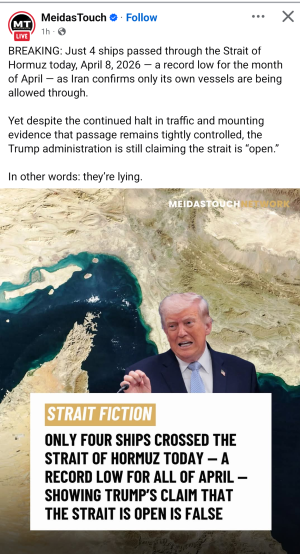
In addition, Iran's control over the economically crucial Strait of Hormuz has created a crisis that didn't exist before the war began.
The Trump administration stresses that U.S. and Israeli military successes have inflicted severe damage to Iran's military. Still, Iran's military and government survived the onslaught, are still functioning, and are now making their own demands in negotiations that lie ahead.
...
Iran's military is degraded but still retains capability
...
The Strait of Hormuz remains under Iran's control
...
But Ian Ralby, a nonresident senior fellow with the Atlantic Council's Global Energy Center, says a ceasefire that leaves Iran in control of the strait is a worse outcome than the status quo before the war. It puts Tehran in "a pretty powerful position," he says. "In some ways, it legitimizes Iran's control" of the strait.
"So now they're in a position to use that to their advantage much more proactively," he adds. Before the war, Iran allowed ships to pass unimpeded.
Daniel Benaim, a distinguished diplomatic fellow at the Middle East Institute and former senior State Department official for the Gulf, says closing the strait "created a new deterrence and new economic weapon" for Iran.
There is also no indication whether the deal includes an end to passage fees that Iran began charging some tankers after the start of the war to ensure safe passage through the strait. If the steep tolls continue, it could mean that oil prices remain higher than before the conflict started.
...
Iran's nuclear program still exists, and Iran is likely more motivated to develop weapons
At the onset of the war, Trump insisted that Iran was only weeks away from acquiring a nuclear weapon. But
many nuclear experts dispute that claim, saying Tehran still had a way to go. In fact, then-Supreme Leader Ali Khamenei had issued a fatwa, or religious decree, against nuclear weapons, according to Shibley Telhami, the Anwar Sadat professor for peace and development at the University of Maryland. "That was definitely a constraining factor for them," he says. "He's now gone and with him, the fatwa dies."
Instead, he says the war has taught Iran's leadership a lesson about nuclear weapons: States that have them, such as North Korea, are safe, while Iran has been attacked multiple times. Now, he says, Iran has "every incentive" to develop a nuclear capability "in short order."
Benaim agrees, saying that the assasination of the elder Khamenei and other top leaders might cause the others "to conclude that a nuclear weapon is the main path to Iran's kind of durable deterrence."
...
The Iranian leadership may have changed, but there's no sign of changed policies
...
Instead, Khamenei's son, Mojtaba Khamenei, assumed the top post in Iran. Though
relatively little is known about the younger Khamenei, Benaim and other experts describe him as a younger, more hardline version of his father.
Referring to the elite, hardline paramilitary Islamic Revolutionary Guard Corps, he says: "We've replaced a resolute, heavily ideological, and IRGC-dominated regime with another resolute, ideological and obdurate IRGC-dominated regime under a man 30 years younger."
The conflict may have shattered trust with U.S. allies
The U.S. did not warn its Gulf allies — countries such as Qatar, Bahrain, UAE, Saudi Arabia and Kuwait — that it was planning an imminent attack on Iran in conjunction with Israel, according to an
Associated Press report. And in the opening days of the war, Iran hit several of those countries with missiles and drones, primarily targeting their oil infrastructure.
Trump acknowledged that his administration was caught off guard by the move. "They weren't supposed to go after all these other countries in the Middle East,"
Trump said last month. "Nobody expected that. We were shocked," he added.
Benaim says it is difficult to understand how an attack on Gulf states — or the Strait of Hormuz closure — could have been a surprise to the Trump White House. "I think that [the attack on Iran] was probably lobbied for with a bunch of people who presented a lot of best-case scenarios" to Trump, he says. "I think that some of the worst-case scenarios weren't adequately thought through and some of the worst-case scenarios were more likely than we realized."
For U.S. allies in the Gulf and elsewhere, a failure to properly account for those worst-case scenarios, which includes a global spike in petroleum prices that has
hit hard in Europe,
Japan and South Korea. There are outright shortages elsewhere in the world,
such as Thailand.
These consequences have rattled allies' confidence in the Trump administration, Benaim says. "It's caused significant tensions with European allies. It's caused major economic disruptions from the price of fertilizer and food in Africa and South Asia to the price of microchips," he says.
Speaking to NPR's Morning Edition last week, Michael McFaul, who served as U.S. ambassador to Russia in the Obama administration, said it makes the U.S. "look like we're the cowboys, like the Russians, like we don't care about the rules-based international order."
To some in the world, "China, in contrast, looks like the status quo power. Looks like they're the ones that play by the U.N. rules," he said.