The Steross Market and Investing Thread


This is a really good article about our current K shaped economy and how the middle class is now starting to not be able to afford nessesities (depending on the area)
 
Not sure what my point really is. I just think the goalpost of being middle class may have shifted. And I think that captures a small piece of the article.

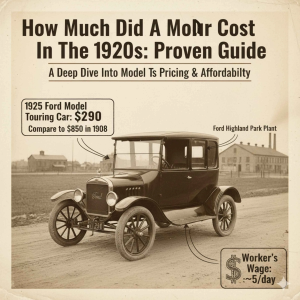
The goalposts as far as the material goods you are speaking about have always shifted. Think about who could own vehicles in the 1910s vs then 1920s. I don't think the availaability of goods is a great marker of being in the middle class. In 1998, as a new Doc, my wife and I decided to splurge and get a cell phone between us. More recently, I traveled Asia and people making hourly wages under a dollar now have them.

Economic security and financial equity to current peers shows it much better.


1773451389857.png
 
Last edited:

This is a really good article about our current K shaped economy and how the middle class is now starting to not be able to afford nessesities (depending on the area)

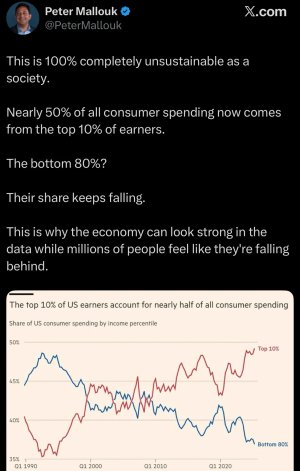
"Yes, many upper-middle-class households fall within the top 20% or even top 10% of earners. Statistically, they’re doing well. But the chasm between the upper middle class and the actual ownership class — the people whose wealth generates its own income without labor — is quite large, and widening. The top 20% accounts for 59% of all consumer spending. But within that top 20%, the real divide is between people who earn and people who own."


This paragraph perfectly sums up my experience. As a doc I have been in the highest earning worker group (but the lower end of that group). Still, it has put me in a position to be around people with money. And, the ones that really have money, always own stuff. Even dermatologists making $1.2 million a year do not live like the people that own successful "small" businesses. Our country hits high W-2 workers pretty hard. If you own things, there are significantly more ways to stash income.

I talked my kids out of professional schools. Just go take a risk and start a business.
 
Last edited:
They need giant TVs.

Outside of just things:
They need fancier go out to eat nights than Goldies. They need fancier vacations than campouts. They need to pay or lawn service. I could still go on and on.

Not sure what my point really is. I just think the goalpost of being middle class may have shifted.
That is a great point.
What the middle class purchases, uses, and consumes today is very different from what the middle class consumed 40–50 years ago. In many ways, the modern middle-class lifestyle includes goods and experiences that were rare or nonexistent for the previous generation. Telecommunications and smart-home technology, international travel, and housing are good examples of this shift.

Telecommunications: The industry I spent my career in is a great example. Modern communication and smart-home technology represent a category of spending that largely didn’t exist for middle-class families prior to the mid-1990s. Today, many middle-class households pay for multiple mobile phone lines, high-speed home internet with Wi-Fi throughout the house, several streaming services, and multiple large-screen TVs. Many homes also include smart devices such as connected door locks, cameras, whole-home audio systems, robot vacuums, and other automated technology. These conveniences were simply not part of middle-class life a generation ago. But now they spend money to buy these devices, repair and replace them, and in many cases pay a subscription.

Travel: Your point about more elaborate vacations is also accurate. Americans travel abroad at far higher rates today than they did in the 1970s and 1980s. As recently as 1988, only about 5% of Americans had a passport. By 2024, that number had grown to roughly 48%. The middle class today travels internationally much more frequently, largely because airline deregulation increased competition, flights became cheaper relative to income, passports became more common, and global tourism became easier to access.

Homes: It is true that home prices have risen faster than income, but the type of homes Americans purchase has also changed dramatically. Builders are constructing what buyers want: larger homes with more amenities. The average new home today is roughly 45% larger than it was 40 years ago and often includes features like multiple-car garages, larger kitchens, home offices, and dedicated entertainment spaces. In other words, part of the increase in housing cost reflects the fact that the modern middle-class home is significantly bigger and more feature-rich than the typical home of previous generations.

Overall, the middle-class lifestyle today includes technologies, travel opportunities, and home amenities that were far less common—or did not exist at all—for middle-class families a few decades ago.

 
Last edited:

This is a really good article about our current K shaped economy and how the middle class is now starting to not be able to afford nessesities (depending on the area)

YES.

the fallen working class turns atavistic — nostalgic for a past economy that included them. The educated-but-blocked class turns progressive — demanding systemic reform. Both are responding to the same structural forces. But instead of recognizing that shared position, they organize against each other. The resentment becomes horizontal instead of vertical.

I maintain that the Occupy Wall Street and Tea Party movements of the 2000’s were both right on track. The dismantling of both and the supercharged divisive rhetoric from the media since then has been deliberate.

Anyway…
 
If one thing is right in the article, the products provided today are being built with the higher classes in mind. I grew up in a middle class home. I would say most of us did. Now it seems the entry level of middle class needs a lot. They need granite countertops instead of laminate. They need shower doors instead of curtains. They need heated car seats and steering wheels. They need giant TVs. They need more sauces than Ketchum, mayo, mustard. I could go on and on.

Outside of just things:
They need fancier go out to eat nights than Goldies. They need fancier vacations than campouts. They need to pay or lawn service. I could still go on and on.

Not sure what my point really is. I just think the goalpost of being middle class may have shifted. And I think that captures a small piece of the article.
That is because companies make products to the segment of the population that will make them the most money. That used to be the middle class, but now it is the upper middle class and upper class.

I agree with you regarding the "premium" products, however, that is immaterial when the basic necessities of life (food, housing, healthcare and childcare) are becoming no longer affordable for a significant segment of the middle class. Whether or not they can afford a $400 TV once every few years is immaterial when groceries now cost $200-300 a week, mortgages are close to $3k a month for an average/below average priced home, healthcare premiums are $800/month and childcare costs are around $20k a year.

These folks make too much money for state assistance on the last two, but not enough to afford living and thus are now forced to skip meals or forego medical care to survive. This isn't sustainable and while you are correct some nice to haves are much cheaper and ubiquitous, those are nice to haves and not necessities.
 
That is because companies make products to the segment of the population that will make them the most money. That used to be the middle class, but now it is the upper middle class and upper class.

I agree with you regarding the "premium" products, however, that is immaterial when the basic necessities of life (food, housing, healthcare and childcare) are becoming no longer affordable for a significant segment of the middle class. Whether or not they can afford a $400 TV once every few years is immaterial when groceries now cost $200-300 a week, mortgages are close to $3k a month for an average/below average priced home, healthcare premiums are $800/month and childcare costs are around $20k a year.

These folks make too much money for state assistance on the last two, but not enough to afford living and thus are now forced to skip meals or forego medical care to survive. This isn't sustainable and while you are correct some nice to haves are much cheaper and ubiquitous, those are nice to haves and not necessities.

Homes are less of an issue here in Oklahoma than most places but still too much. People are going broke on a mortgage to live in certain climates. Quite honestly, at some point that becomes a choice. In this state you can get a livable house for the same cost as rent, you just have to muster the credit. Healthcare costs are the biggest crock of S**t we have going and the fact that our elected officials reuse to step in is our largest testament to what their mentalities are. And childcare cost is outrageous in part due to insurance companies. For every dollar you spend on childcare you are flipping a quarter to the facilities insurance premiums. Daycares, ext. are not raking in profits in piles.
 
Homes are less of an issue here in Oklahoma than most places but still too much. People are going broke on a mortgage to live in certain climates. Quite honestly, at some point that becomes a choice. In this state you can get a livable house for the same cost as rent, you just have to muster the credit. Healthcare costs are the biggest crock of S**t we have going and the fact that our elected officials reuse to step in is our largest testament to what their mentalities are. And childcare cost is outrageous in part due to insurance companies. For every dollar you spend on childcare you are flipping a quarter to the facilities insurance premiums. Daycares, ext. are not raking in profits in piles.
While it is a choice, should we have a society that requires families that have lived for generations in parts of California, Colorado, Washington DC etc and tell them that the options for their children are to make money at least in the upper 20%, be a forever renter, or move away from your family to rural Oklahoma?

And, it is not just the US. My uncle was a cop in Sydney. His house is now worth $2 million dollars. Well, the house isn't, it will be torn down not long after he dies. But the small urban lot is now worth $2 million. No young Sydney cop is buying that like he did years ago.
 
While it is a choice, should we have a society that requires families that have lived for generations in parts of California, Colorado, Washington DC etc and tell them that the options for their children are to make money at least in the upper 20%, be a forever renter, or move away from your family to rural Oklahoma?

And, it is not just the US. My uncle was a cop in Sydney. His house is now worth $2 million dollars. Well, the house isn't, it will be torn down not long after he dies. But the small urban lot is now worth $2 million. No young Sydney cop is buying that like he did years ago.

We should, but that ship has sailed in the places mentioned above and there is no going back. You/your family has either claimed your stake or you will be forever screwed in those places. I guess the question going forward is how to avoid this in the remaining areas that are not quite unobtainable.
 
We should, but that ship has sailed in the places mentioned above and there is no going back. You/your family has either claimed your stake or you will be forever screwed in those places. I guess the question going forward is how to avoid this in the remaining areas that are not quite unobtainable.
Economics can always change. I think the only way to do it would be wildly unpopular with the people who control this country.

1. Massive tax incentives for owning a residence that you live in yourself. More than just a mortgage deduction.
2. Limitation or exclusion of corporate ownership of single family homes.
3. Removal of tax incentives for ownership of residential real estate that is not your residence. 1031 rule gone.

We now have a country in which the wealth has floated to the top and those people own a lot of the residential real estate. They have the money to bid up properties and exclude single family ownership. The government isn't going to make the wealth disparity go away any time soon but could make it more lucrative for the wealthy to stick their money somewhere other than residential real estate. They will never be able to make a house on the cliffs of Malibu affordable nor should they. But, if a young couple is bidding against other young couples and not cash offers from the local super-landlord and Blackstone, the prices would moderate or even fall.
 
Back
Top