

You are using an out of date browser. It may not display this or other websites correctly.
You should upgrade or use an alternative browser.
You should upgrade or use an alternative browser.
The Steross Market and Investing Thread
- Thread starter jobob85
- Start date

Store of value!

Aren't markets supposed to just continually rise forever?
Also being serious if there turns out to be some sort of bitcoin bubble how bad is that for the economy?

Polds4OSU
Marshall
Aren't markets supposed to just continually rise forever?
Also being serious if there turns out to be some sort of bitcoin bubble how bad is that for the economy?
Trump is literally trying to move the US economy to be Bitcoin based and part of the US economic engine is already invested in Cryptocurrency
President Trump has taken steps to position the U.S. as a global crypto leader, including plans for a Strategic Bitcoin Reserve and promoting digital asset adoption since taking office in early 2025. His administration aims to establish a national stockpile using existing government-held Bitcoin and other cryptocurrencies to support the economy.
Key details of this initiative include:
Strategic Bitcoin Reserve: Initiated in March 2025, the U.S. government is building a stockpile of cryptocurrencies, including Bitcoin (BTC), Ethereum (ETH), XRP, Cardano, and Solana.
Pro-Crypto Policies: Executive orders signed in 2025 aimed to support the U.S. crypto industry and create a regulatory framework.
Legislative Efforts: The GENIUS Act was introduced to establish regulations for stablecoins.
Industry & Personal Focus: Trump has aimed to make the U.S. the "crypto capital of the world," while his family has launched the crypto venture World Liberty Financial (WLFI), notes Al Jazeera and Wikipedia.
Despite this support, the crypto market has faced volatility, such as a sell-off in early 2026, says CNBC. The initiatives have received mixed reactions, with some economists raising concerns about risk, according to the Economic Policy Institute.

Don't know and can't say how bad that would be but I would say that in the world of BTC investing this is a pretty typical pullback so far.Aren't markets supposed to just continually rise forever?
Also being serious if there turns out to be some sort of bitcoin bubble how bad is that for the economy?
Looks horrible if you got in this year but not that bad if even 2 years ago:
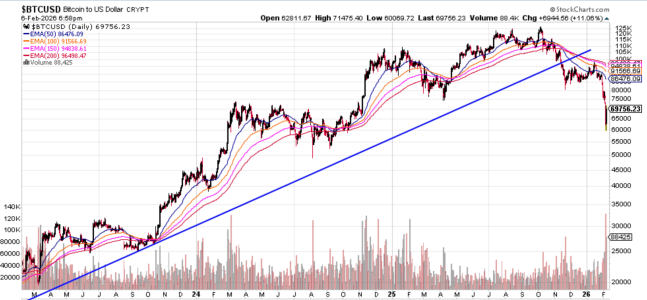
If you have held for years, this is barely a concern as you pull your yacht into the slip......
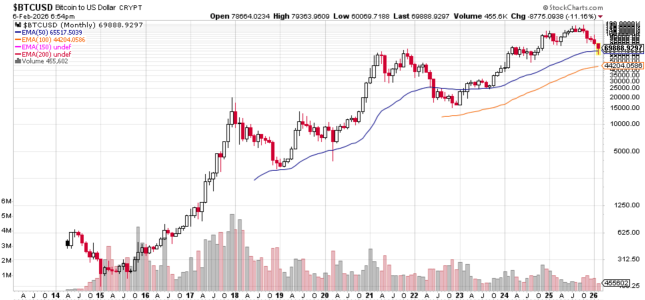
I've been a bitcoin/crypto doubter for all the time it has existed.
But, reality is reality. And it has been the greatest generator of passive wealth in the history of the world.
Is that about to end now? Maybe, but I suspect not.
Polds4OSU
Marshall
Peter Navarro: "The jobs report comes out tomorrow. We have to revise our expectations down significantly for what a monthly job number should look like ... Wall Street has to adjust for the fact that we're deporting millions of illegals out of the job market."

 www.threads.com
Aaron Rupar (@aaron.rupar) on Threads
Peter Navarro: "The jobs report comes out tomorrow. We have to revise our expectations down significantly for what a monthly job number should look like ... Wall Street has to adjust for the fact that we're deporting millions of illegals out of the job market."
www.threads.com
Polds4OSU
Marshall
US employment growth through March revised down by 862,000 jobs
WASHINGTON, Feb 11 (Reuters) - The U.S. economy created 862,000 fewer jobs in the 12 months through March 2025 than previously estimated, the Labor Department's Bureau of Labor Statistics (BLS) said on Wednesday.The final nonfarm payrolls benchmark revision was less than the reduction of 911,000 jobs the BLS estimated in August. The numbers are not seasonally adjusted. Economists had expected the level of employment over the 12-month period would be reduced by between 750,000 and 900,000 jobs following updates to the Quarterly Census of Employment and Wages data for the first quarter on which the BLS based the payrolls benchmark revision.
The change in total nonfarm employment for 2025 was revised down to a seasonally-adjusted 181,000 from the previously reported 584,000.
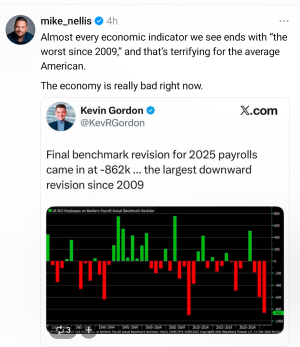
It’s a mess but our economy drives the world.

Europe's $24 Trillion Breakup With Visa and Mastercard
A 130-million-user payment system backed by 16 major banks just launched to challenge Visa/mastercard
 europeanbusinessmagazine.com
Europe’s $24 Trillion Breakup With Visa and Mastercard Has Begun
February 9, 2026ECB President Christine Lagarde has called for Europe to break its dependence on American payment infrastructure, warning that every card transaction sends European consumer data to the United States. A coalition of 16 banks thinks it has the answer.
QUICK ANSWER
What’s happening? ECB President Christine Lagarde told Irish radio that Europe needs its own digital payment system “urgently,” warning that virtually all European card and mobile payments currently run through non-European infrastructure controlled by Visa, Mastercard, PayPal or Alipay. Days later, on 2 February, the European Payments Initiative (EPI) and the EuroPA Alliance signed a landmark agreement to build a pan-European interoperable payment network covering 130 million users across 13 countries. The system, built around the digital wallet Wero, aims to let Europeans pay and transfer money across borders without touching a single American network.
Polds4OSU
Marshall

Consumer still doing the best out of the three aspects of the economy (corporate, government, consumer).
And listen I still think the economy is K shaped. I worry about the bottom 25ish percent of people with the near doubling of housing and grocery prices and the dismantling of our safety nets. But overall consumers are in good shape.
Credit Card Delinquencies, Balances, Burden, Credit Limits, and Collections in Q4 2025
And listen I still think the economy is K shaped. I worry about the bottom 25ish percent of people with the near doubling of housing and grocery prices and the dismantling of our safety nets. But overall consumers are in good shape.
Credit Card Delinquencies, Balances, Burden, Credit Limits, and Collections in Q4 2025
Despite the wailing about tapped-out, struggling and cracking consumers, the credit card delinquency rate dropped to multi-year low.
The 30-day-plus delinquency rate on credit cards issued by all commercial banks declined to 2.94% at the end of Q4, seasonally adjusted (SA, red in the chart), the lowest since, and the same as, Q3 2023, and down from 3.08% a year ago, and from 3.10% two years ago, according to the Federal Reserve Tuesday afternoon, based on regulatory reports filed by all commercial banks. This includes credit cards by subprime-rated cardholders.
Not seasonally adjusted (NSA, blue in the chart), the 30-day delinquency rate, at 3.03%, was the lowest for any Q4 since Q4 2022.
During the Free-Money era, credit card delinquency rates had dropped to very low levels. But after the Free-Money fizzled, delinquency rates rose out of the trough, overshot a little, and then in 2024 started heading lower again. Throughout, delinquency rates remained relatively low compared to the 25-year context of the data.

Credit card balances: a measure of spending, not of borrowing.
Credit card balances are statement balances before payments are made. They’re a measure of spending, not a measure of borrowing. Most of these charges get paid off every month by due date and never accrue interest.
Credit cards have become the dominant consumer payments method in the US, largely replacing checks and cash. Debit cards are the second most popular payment method. That’s why watchers of the economy keep an eye on credit card balances: They indicate growth of consumer spending.
Credit card balances (red line in the chart below) rose by $69 billion year-over-year at the end of Q4, or by 5.7%, to $1.28 trillion, on growth in consumer spending and price increases (data from the New York Fed’s Household Debt and Credit report based on Equifax data).
This data is not seasonally adjusted. Typically, spending spikes during the holiday period and then drops in Q1. The data confirms that spending growth was solid.
“Other” consumer loans (blue line) – such as personal loans, Buy-Now-Pay-Later (BNPL) loans, and payday loans – inched up 1.1% year-over-year, far less than the rate of inflation, to $560 billion. Many of these balances, except current BNPL balances, accrue interest.
These other consumer loans have barely risen over the past 22 years, despite the growth of the population, income, inflation, and spending.

The declining and relatively low delinquency rates and the rising statement balances are not hard to explain.
Consumers are earning record amounts of income, and there is a record number of consumers, and they’re buying record amounts of goods and services via electronic means, dominated by credit cards.
Consumers’ aggregate balance sheet is in good shape: 65% own their own homes, and about 40% of these homeowners don’t have a mortgage, and others have whittled down their mortgages. Over 60% of households have at least some stocks. Many hold precious metals and cryptos. Many are sitting on a record pile of interest-earning cash.
The burden of credit card balances.
Credit card balances (red in the chart above) and “other” consumer debt (blue above) combined, rose year-over-year by $75 billion, or by 4.2%, to $1.84 trillion.
The debt-to-income ratio is one of the classic ways of evaluating the burden of a debt. With households, we can use the debt-to-disposable-income ratio.
Disposable income, released by the Bureau of Economic Analysis, is essentially the monthly after-tax income consumers have available to spend on a monthly basis for their daily costs of living, and to service their debts, and then to save and invest the rest. It’s income from after-tax wages, plus income from interest, dividends, rentals, farm income, small business income, transfer payments from the government, etc.
It excludes income from capital gains, which is where the super-wealthy make most of their money. So this upper echelon of income is excluded here.
The ratio of credit card and other consumer loan balances to disposable income in Q4, at 8.0%, was where it had been in Q4 2024 and in Q4 2023 and below the Q4s in the years before the pandemic. And it has come way down from the years before the Financial Crisis.

Available Credit rises to record
Credit cards are very profitable for banks because of the swipe fees they earn on every purchase. So banks are trying aggressively to get people to set up new credit card accounts, and they incentivize people to use those cards by kicking back 1% or 2% or more in form of cash back, loyalty points, miles, etc., on the logic, “The more you spend, the more you make,” meaning, “The more you spend, the more we make.”
So the aggregate credit limit (blue in the chart below) rose to a record $5.4 trillion, outgrowing balances (red).
And the available unused credit has soared to a record $4.15 trillion (gray arrow).

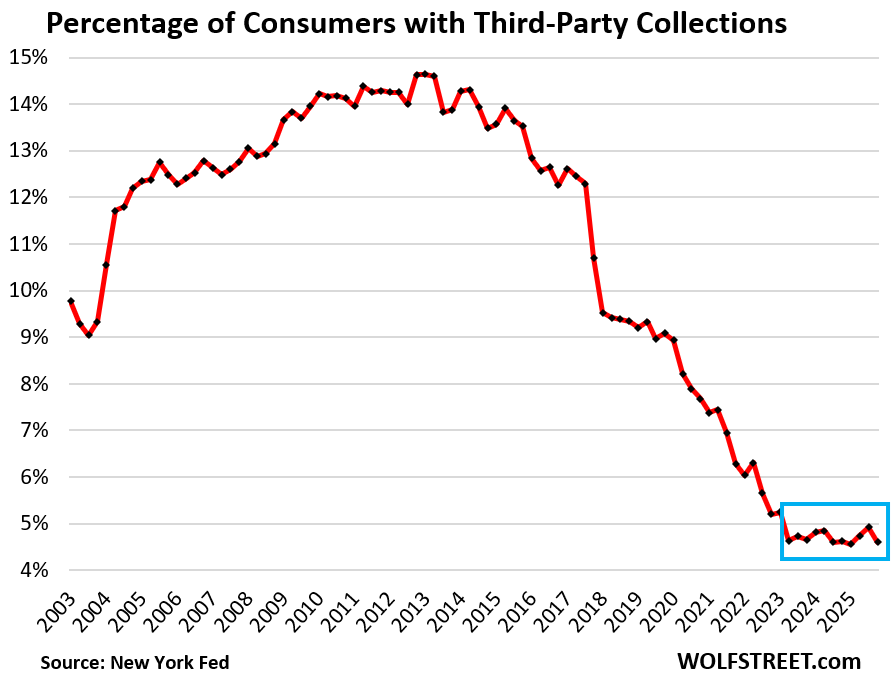
Third-party collections hit record low.
This is where defaulted credit card accounts end up if the cardholders fail to catch up with their payments or make some kind of deal with their bank.
In terms of credit reporting, a third-party collection entry is made into a consumer’s credit history when the lender reports to the credit bureaus, such as Equifax, that it sold the delinquent credit card debt to a collection agency for cents on the dollar.
The percentage of consumers with third-party collection entries on their credit reports again hit the rock-bottom of 4.6% in Q4.
Last edited:
WTI opens up another 14% at $104/barrel. When Russia attacked Ukraine we saw oil shoot to 120 over fears of oil supply being cut off. We're now seeing massive chunks of the world's oil supply actually being cut off. I'm not gonna be surprised if we see oil at $150 in the next few weeks.
Edit: now up 18% to $108/barrel since I started typing this.
Double edit: 28% to $116/barrel.
Edit: now up 18% to $108/barrel since I started typing this.
Double edit: 28% to $116/barrel.
Last edited:

Oil can be the tide that lifts all costs. With as many items that are transported by gas-powered vehicles, let alone increasing fuel costs for practically every household budget, this can easily pile onto inflation. Man, this administration just continues to stress test our economy.WTI opens up another 14% at $104/barrel. When Russia attacked Ukraine we saw oil shoot to 120 over fears of oil supply being cut off. We're now seeing massive chunks of the world's oil supply actually being cut off. I'm not gonna be surprised if we see oil at $150 in the next few weeks.
Edit: now up 18% to $108/barrel since I started typing this.

I make good money. Why do I still feel like this?
The middle class was a policy project. Every piece of it has been unbundled and repriced — and now two very different groups are living two very different nightmares.
 yourbrainonmoney.substack.com
This is a really good article about our current K shaped economy and how the middle class is now starting to not be able to afford nessesities (depending on the area)

If one thing is right in the article, the products provided today are being built with the higher classes in mind. I grew up in a middle class home. I would say most of us did. Now it seems the entry level of middle class needs a lot. They need granite countertops instead of laminate. They need shower doors instead of curtains. They need heated car seats and steering wheels. They need giant TVs. They need more sauces than Ketchum, mayo, mustard. I could go on and on.I make good money. Why do I still feel like this?
The middle class was a policy project. Every piece of it has been unbundled and repriced — and now two very different groups are living two very different nightmares.
This is a really good article about our current K shaped economy and how the middle class is now starting to not be able to afford nessesities (depending on the area)
Outside of just things:
They need fancier go out to eat nights than Goldies. They need fancier vacations than campouts. They need to pay or lawn service. I could still go on and on.
Not sure what my point really is. I just think the goalpost of being middle class may have shifted. And I think that captures a small piece of the article.
