Philosophy & Religion Thread

This seems like circular logic to me. What dimensions does free will exist in and how does it exist in those spaces?

There are a lot of Christian denominations that reject free will, so it is not even a universal claim inside of the faith.
If you don’t have free will, then every future event must already be scripted. In such case, there is nothing that is truly random. Think about Schrödinger’s cat. If nothing is random, then the outcome of that experiment would be the same. We know that it won’t be the same so randomness must exist. Free will is randomness based on what happens in our minds given any event,
 
Hey Socrates, how about if you have a different idea of the definition of those terms from the standard known ones you go ahead and tell us your thoughts on them. And, if you think there is some "physiologic term" for these that is different you can tell us that too. But, given the fact that your posts over the past few days have every other person thinking, "Ummm, what?" there is not a chance in hell that I am going to play along with "Guess what I am thinking."
Oddly enough, I was spurred on by others to ask you that question and several told me you wouldn't be able to answer it if I did.

I thought they were incorrect. I stand corrected.
 
I disagree with this summary. You continued to make claims without supporting evidence. I am already familiar with free will as a concept. What I haven't seen is you provide supporting documentation and build an argument to support your initial point. Instead, you made additional claims and shifted the goalposts toward some sort of pseudophilosophical metaphysics instead of making the case.
Again, this is not my personal Belief, philosophy or Theory. I'm just pointing out it exists

Modal realism (Lewis) and Many‑Worlds (Everett/Wallace) are independently motivated theories in philosophy and physics. The question isn’t whether multiplicity is respectable—it already is—but whether agency is compatible with it. These papers explicitly show that multiplicity does not imply determinism or theological necessity.


but if you want to dig into it. Here you go

Modal Realism (Philosophy)​

Foundational Works (David Lewis)​

  1. David Lewis (1973)
    Counterfactuals
    Harvard University Press
    • Introduces possible‑world semantics that later mature into modal realism.
    • Essential for understanding how “other worlds” do explanatory work.
  2. David Lewis (1986)
    On the Plurality of Worlds

    Blackwell
    • Canonical statement of modal realism.
    • Argues that all possible worlds are as real as the actual world.
    • Explicitly rejects theological necessity.
  3. David Lewis (1979)
    “Counterfactual Dependence and Time’s Arrow”
    Noûs13 (4): 455–476
    • Important for causation and branching discussions.

Key Secondary & Critical Analyses​

  1. Robert Stalnaker (1976)
    “Possible Worlds”
    Noûs10 (1): 65–75
    • Critiques Lewis; useful for defending modal realism against alternatives.
  2. Daniel Nolan (2002)
    Topics in the Philosophy of Possible Worlds
    Routledge
    • Systematic development and defense of modal realism.
  3. Fabian Kerj (2017)
    “A Comparative Analysis of David Lewis’ Modal Realism and Everett’s Many Worlds”

    PhilArchive
    • Directly bridges modal realism and MWI

II. Many‑Worlds Interpretation (Physics)​

Foundational Physics Papers​

  1. Hugh Everett III (1957)
    “‘Relative State’ Formulation of Quantum Mechanics”

    Reviews of Modern Physics29 (3): 454–462
    • The original Many‑Worlds paper.
    • No collapse, no hidden variables, no deity.
  2. Bryce DeWitt & Neill Graham (1973)
    The Many‑Worlds Interpretation of Quantum Mechanics
    Princeton University Press
    • Formalizes Everett’s work and introduces “branching worlds” language.

Modern Defenses & Clarifications​

  1. David Deutsch (1985)
    “Quantum Theory as a Universal Physical Theory”
    International Journal of Theoretical Physics
    • Argues MWI is required for explanatory completeness.
  2. David Deutsch (1997)
    The Fabric of Reality
    Penguin
    • Connects MWI to decision theory, counterfactuals, and realism.
  3. Simon Saunders, Jonathan Barrett, Adrian Kent, David Wallace (2010)
    Many Worlds? Everett, Quantum Theory, and Reality
    Oxford University Press
    • Definitive modern academic collection.
  4. David Wallace (2012)
    The Emergent Multiverse

    Oxford University Press
    • Most rigorous contemporary defense of MWI.
    • Emphasizes emergence, not metaphysical excess.

III. Papers Connecting MWI, Modality, and Agency​

These are especially relevant to free‑will discussion.

  1. David Wallace (2003)
    “Everett and Structure”
    Studies in History and Philosophy of Modern Physics
    • Argues branches are emergent structures, not metaphysical copies.
  2. Huw Price (1996)
    Time’s Arrow and Archimedes’ Point
    Oxford University Press
    • Relevant to causation, branching, and agency.
  3. Alastair Wilson (2013)
    “Everettian Quantum Mechanics Without Branching Time”
    Synthese
    • Explicitly discusses modal structure without naïve duplication.
 
Again, this is not my personal Belief, philosophy or Theory. I'm just pointing out it exists

Modal realism (Lewis) and Many‑Worlds (Everett/Wallace) are independently motivated theories in philosophy and physics. The question isn’t whether multiplicity is respectable—it already is—but whether agency is compatible with it. These papers explicitly show that multiplicity does not imply determinism or theological necessity.


but if you want to dig into it. Here you go

Modal Realism (Philosophy)​

Foundational Works (David Lewis)​

  1. David Lewis (1973)
    Counterfactuals
    Harvard University Press
    • Introduces possible‑world semantics that later mature into modal realism.
    • Essential for understanding how “other worlds” do explanatory work.
  2. David Lewis (1986)
    On the Plurality of Worlds

    Blackwell
    • Canonical statement of modal realism.
    • Argues that all possible worlds are as real as the actual world.
    • Explicitly rejects theological necessity.
  3. David Lewis (1979)
    “Counterfactual Dependence and Time’s Arrow”
    Noûs 13 (4): 455–476
    • Important for causation and branching discussions.

Key Secondary & Critical Analyses​

  1. Robert Stalnaker (1976)
    “Possible Worlds”
    Noûs 10 (1): 65–75
    • Critiques Lewis; useful for defending modal realism against alternatives.
  2. Daniel Nolan (2002)
    Topics in the Philosophy of Possible Worlds
    Routledge
    • Systematic development and defense of modal realism.
  3. Fabian Kerj (2017)
    “A Comparative Analysis of David Lewis’ Modal Realism and Everett’s Many Worlds”

    PhilArchive
    • Directly bridges modal realism and MWI (this is the paper you already have open).
    • Excellent for your current argument.

II. Many‑Worlds Interpretation (Physics)​

Foundational Physics Papers​

  1. Hugh Everett III (1957)
    “‘Relative State’ Formulation of Quantum Mechanics”

    Reviews of Modern Physics 29 (3): 454–462
    • The original Many‑Worlds paper.
    • No collapse, no hidden variables, no deity.
  2. Bryce DeWitt & Neill Graham (1973)
    The Many‑Worlds Interpretation of Quantum Mechanics
    Princeton University Press
    • Formalizes Everett’s work and introduces “branching worlds” language.

Modern Defenses & Clarifications​

  1. David Deutsch (1985)
    “Quantum Theory as a Universal Physical Theory”
    International Journal of Theoretical Physics
    • Argues MWI is required for explanatory completeness.
  2. David Deutsch (1997)
    The Fabric of Reality
    Penguin
    • Connects MWI to decision theory, counterfactuals, and realism.
  3. Simon Saunders, Jonathan Barrett, Adrian Kent, David Wallace (2010)
    Many Worlds? Everett, Quantum Theory, and Reality
    Oxford University Press
    • Definitive modern academic collection.
  4. David Wallace (2012)
    The Emergent Multiverse

    Oxford University Press
    • Most rigorous contemporary defense of MWI.
    • Emphasizes emergence, not metaphysical excess.

III. Papers Connecting MWI, Modality, and Agency​

These are especially relevant to your free‑will discussion.

  1. David Wallace (2003)
    “Everett and Structure”
    Studies in History and Philosophy of Modern Physics
    • Argues branches are emergent structures, not metaphysical copies.
  2. Huw Price (1996)
    Time’s Arrow and Archimedes’ Point
    Oxford University Press
    • Relevant to causation, branching, and agency.
  3. Alastair Wilson (2013)
    “Everettian Quantum Mechanics Without Branching Time”
    Synthese
    • Explicitly discusses modal structure without naïve duplication.
I am not interested in an AI copy pasta and could not care less what AI has to say on the topic. You have a position, you make the argument to support it. Don't outsource your thinking to social media or AI. Make the argument yourself.
 
I am not interested in an AI copy pasta and could not care less what AI has to say on the topic. You have a position, you make the argument to support it. Don't outsource your thinking to social media or AI. Make the argument yourself.

The argument is simple.

Physics can prove that data points can exists in 30+ dimensions at one time. Thats already Proven

The Top 5 Physics Theories humans have been able to come up with all point to the existence of more dimensions than we are currently aware of

So our best theories point to multiple dimensions 5-11 of them to be exact depending on the theory. CERN has Proven data can exists in 30+ at one time

So the idea that there can be multiple dimensions (Trillions upon Trillions) can account for the idea of Free Will where each dimension is a sum product of Free Will decisions made by every creature ever in that dimension and each is its own stand alone real time line

If you believe in a Deity at this point, then there is an Omnipotent being watching over all of these time lines created via free will (not necessarily only human free will).

If you don't believe in a Deity watching over all of this, then it is still possible as this theory provides opportunity to include and exclude a Deity and still work the same way....unless you believe the Deity intercedes on each stream to adjust as needed to their design.

This is a Theory of Physics and Philosophy that provides accountability and possibility of Free Will (not just human free will) in which multiple worlds exists and each is shaped in very different ways based on Free Will. Deity or Not. And it is supported and gaining more traction now that CERN has been able to prove what they have.

I don't care if you believe it or not but it is a real Theory and Philosophy that people are paid to study and write about every day.

Then I think about this Theory and Philosophy and compare it to the Bible. specifically Time related to God. the Bible clearly states that God is Omnipotent. which would hold up in this theory

The Bible also clearly states that God is outside of what Human know as "Time" and "Space" which this theory would also lend toward

Psalm 90:4​

“For a thousand years in your sight are but as yesterday when it is past, or as a watch in the night.

2 Peter 3:8​

“With the Lord one day is as a thousand years, and a thousand years as one day.”

Isaiah 46:9–10​

“I am God, and there is no other… declaring the end from the beginning.”

God’s different relation to time doesn’t automatically negate human agency. Knowing events timelessly is not the same as causing them, unless you assume a single fixed timeline—which is a philosophical assumption, not a biblical one.

If God is outside of Time and Space as the Bible suggest, this would also support the idea that multiple existences of time and space can also exists. And Why would the Bible need to inform us that God is outside of Time.....if there is Only one singular Time line ?

 
Last edited:
Oddly enough, I was spurred on by others to ask you that question and several told me you wouldn't be able to answer it if I did.

I thought they were incorrect. I stand corrected.

I'm not really sure I'm suppose to be offended at your attempt to insult me or if I'm supposed to be proud of the fact that my responses on a message board are significant enough to "several" people that they are getting together to have separate side chats to try to come up with something to see if they can stump me.

Do you have the ability to see the difference between declining to do something and being unable to do something?
 
Again, this is not my personal Belief, philosophy or Theory. I'm just pointing out it exists

Modal realism (Lewis) and Many‑Worlds (Everett/Wallace) are independently motivated theories in philosophy and physics. The question isn’t whether multiplicity is respectable—it already is—but whether agency is compatible with it. These papers explicitly show that multiplicity does not imply determinism or theological necessity.


but if you want to dig into it. Here you go

Modal Realism (Philosophy)​

Foundational Works (David Lewis)​

  1. David Lewis (1973)
    Counterfactuals
    Harvard University Press
    • Introduces possible‑world semantics that later mature into modal realism.
    • Essential for understanding how “other worlds” do explanatory work.
  2. David Lewis (1986)
    On the Plurality of Worlds

    Blackwell
    • Canonical statement of modal realism.
    • Argues that all possible worlds are as real as the actual world.
    • Explicitly rejects theological necessity.
  3. David Lewis (1979)
    “Counterfactual Dependence and Time’s Arrow”
    Noûs13 (4): 455–476
    • Important for causation and branching discussions.

Key Secondary & Critical Analyses​

  1. Robert Stalnaker (1976)
    “Possible Worlds”
    Noûs10 (1): 65–75
    • Critiques Lewis; useful for defending modal realism against alternatives.
  2. Daniel Nolan (2002)
    Topics in the Philosophy of Possible Worlds
    Routledge
    • Systematic development and defense of modal realism.
  3. Fabian Kerj (2017)
    “A Comparative Analysis of David Lewis’ Modal Realism and Everett’s Many Worlds”

    PhilArchive
    • Directly bridges modal realism and MWI (this is the paper you already have open).
    • Excellent for your current argument.

II. Many‑Worlds Interpretation (Physics)​

Foundational Physics Papers​

  1. Hugh Everett III (1957)
    “‘Relative State’ Formulation of Quantum Mechanics”

    Reviews of Modern Physics29 (3): 454–462
    • The original Many‑Worlds paper.
    • No collapse, no hidden variables, no deity.
  2. Bryce DeWitt & Neill Graham (1973)
    The Many‑Worlds Interpretation of Quantum Mechanics
    Princeton University Press
    • Formalizes Everett’s work and introduces “branching worlds” language.

Modern Defenses & Clarifications​

  1. David Deutsch (1985)
    “Quantum Theory as a Universal Physical Theory”
    International Journal of Theoretical Physics
    • Argues MWI is required for explanatory completeness.
  2. David Deutsch (1997)
    The Fabric of Reality
    Penguin
    • Connects MWI to decision theory, counterfactuals, and realism.
  3. Simon Saunders, Jonathan Barrett, Adrian Kent, David Wallace (2010)
    Many Worlds? Everett, Quantum Theory, and Reality
    Oxford University Press
    • Definitive modern academic collection.
  4. David Wallace (2012)
    The Emergent Multiverse

    Oxford University Press
    • Most rigorous contemporary defense of MWI.
    • Emphasizes emergence, not metaphysical excess.

III. Papers Connecting MWI, Modality, and Agency​

These are especially relevant to your free‑will discussion.

  1. David Wallace (2003)
    “Everett and Structure”
    Studies in History and Philosophy of Modern Physics
    • Argues branches are emergent structures, not metaphysical copies.
  2. Huw Price (1996)
    Time’s Arrow and Archimedes’ Point
    Oxford University Press
    • Relevant to causation, branching, and agency.
  3. Alastair Wilson (2013)
    “Everettian Quantum Mechanics Without Branching Time”
    Synthese
    • Explicitly discusses modal structure without naïve duplication.
You're also arguing on it's behalf. With, what appears to me, very little understanding of the theories themselves or the implications to "free will" about which you are presently arguing.

We see this a lot from you. Posting argument/authorities/social media posts/etc. that when challenged you back off of with a "hey, I'm not advocating over this, I'm just telling you what other people think.

So.....now question time:

What AI did you use to come up with that list?

Have your read and analyzed each of those authorities?

I'm frankly not particularly interested in proxy arguments and thoughts.

I'm interested in what the folks HERE ACTUALLY think, believe, and advocate over.
 
The argument is simple.

Physics can prove that data points can exists in 30+ dimensions at one time. Thats already Proven

The Top 5 Physics Theories humans have been able to come up with all point to the existence of more dimensions than we are currently aware of

So our best theories point to multiple dimensions 5-11 of them to be exact depending on the theory. CERN has Proven data can exists in 30+ at one time

So the idea that there can be multiple dimensions (Trillions upon Trillions) can account for the idea of Free Will where each dimension is a sum product of Free Will decisions made by every creature ever in that dimension and each is its own stand alone real time line

If you believe in a Deity at this point, then there is an Omnipotent being watching over all of these time lines created via free will (not necessarily only human free will).

If you don't believe in a Deity watching over all of this, then it is still possible as this theory provides opportunity to include and exclude a Deity and still work the same way....unless you believe the Deity intercedes on each stream to adjust as needed to their design.

This is a Theory of Physics and Philosophy that provides accountability and possibility of Free Will (not just human free will) in which multiple worlds exists and each is shaped in very different ways based on Free Will. Deity or Not. And it is supported and gaining more traction now that CERN has been able to prove what they have.

I don't care if you believe it or not but it is a real Theory and Philosophy that people are paid to study and write about every day.

Then I think about this Theory and Philosophy and compare it to the Bible. specifically Time related to God. the Bible clearly states that God is Omnipotent. which would hold up in this theory

The Bible also clearly states that God is outside of what Human know as "Time" and "Space" which this theory would also lend toward

Psalm 90:4​


2 Peter 3:8​


Isaiah 46:9–10​


God’s different relation to time doesn’t automatically negate human agency. Knowing events timelessly is not the same as causing them, unless you assume a single fixed timeline—which is a philosophical assumption, not a biblical one.

If God is outside of Time and Space as the Bible suggest, this would also support the idea that multiple existences of time and space can also exists. And Why would the Bible need to inform us that God is outside of Time.....if there is Only one singular Time line ?
Are you advocating for what you believe or are you continuing to just regurgitate other peoples' thoughts here?
 
I'm not really sure I'm suppose to be offended at your attempt to insult me or if I'm supposed to be proud of the fact that my responses on a message board are significant enough to "several" people that they are getting together to have separate side chats to try to come up with something to see if they can stump me.

Do you have the ability to see the difference between declining to do something and being unable to do something?
I take it as a sign that proves the theory and discussion is good. Multiple people can see both sides of it and some can see only one side of it and are seeking proof to prove to them both sides are viable and should be tested.

It is exactly what a theory should be.
 
My interpretation of the theory as a broad overview.

Like I said , I don't buy into it or believe it, but I know it exists and I understand the argument they are trying to make.
So your broad interpretation of a theory that you don't buy into or believe in and have exhibited little actual knowledge about, but have defended over 20 hours or so and insulted folks for not properly rebutting it in your eyes.....

Got it.
 
I take it as a sign that proves the theory and discussion is good. Multiple people can see both sides of it and some can see only one side of it and are seeking proof to prove to them both sides are viable and should be tested.

It is exactly what a theory should be.
Yet again too vague. You take what as a sign that proves what theory? How is it proven? What is "it" in your response?
 
The argument is simple.

Physics can prove that data points can exists in 30+ dimensions at one time. Thats already Proven

The Top 5 Physics Theories humans have been able to come up with all point to the existence of more dimensions than we are currently aware of

So our best theories point to multiple dimensions 5-11 of them to be exact depending on the theory. CERN has Proven data can exists in 30+ at one time

So the idea that there can be multiple dimensions (Trillions upon Trillions) can account for the idea of Free Will where each dimension is a sum product of Free Will decisions made by every creature ever in that dimension and each is its own stand alone real time line

If you believe in a Deity at this point, then there is an Omnipotent being watching over all of these time lines created via free will (not necessarily only human free will).

If you don't believe in a Deity watching over all of this, then it is still possible as this theory provides opportunity to include and exclude a Deity and still work the same way....unless you believe the Deity intercedes on each stream to adjust as needed to their design.

This is a Theory of Physics and Philosophy that provides accountability and possibility of Free Will (not just human free will) in which multiple worlds exists and each is shaped in very different ways based on Free Will. Deity or Not. And it is supported and gaining more traction now that CERN has been able to prove what they have.

I don't care if you believe it or not but it is a real Theory and Philosophy that people are paid to study and write about every day.

Then I think about this Theory and Philosophy and compare it to the Bible. specifically Time related to God. the Bible clearly states that God is Omnipotent. which would hold up in this theory

The Bible also clearly states that God is outside of what Human know as "Time" and "Space" which this theory would also lend toward

Psalm 90:4​


2 Peter 3:8​


Isaiah 46:9–10​


God’s different relation to time doesn’t automatically negate human agency. Knowing events timelessly is not the same as causing them, unless you assume a single fixed timeline—which is a philosophical assumption, not a biblical one.

If God is outside of Time and Space as the Bible suggest, this would also support the idea that multiple existences of time and space can also exists. And Why would the Bible need to inform us that God is outside of Time.....if there is Only one singular Time line ?
The argument is not simple and I don't think you are doing justice to your own position.

There is a difference between linking stuff and regurgitating information and formulating your own opinion and arguments. We know you know how to do the former, it is the latter I have not seen.

The latter is hard work. It takes time, concerted effort and it can be a bumpy ride. But it is the only way to learn & grow.
 
Yea, but do you really think that or do you only think that you think that and the reality is that the choice was already made for you? 🤔

I don't think the choice was made for me (what Polds is saying), but I was limited in my choices by all events and infinite probabilities since the universe came into existence (what Grateful is saying-ish?).
 
So.....now question time:

What AI did you use to come up with that list?

Have your read and analyzed each of those authorities?

I'm frankly not particularly interested in proxy arguments and thoughts.

I'm interested in what the folks HERE ACTUALLY think, believe, and advocate over.
1. Co- Pilot
2. NO
3. Okay

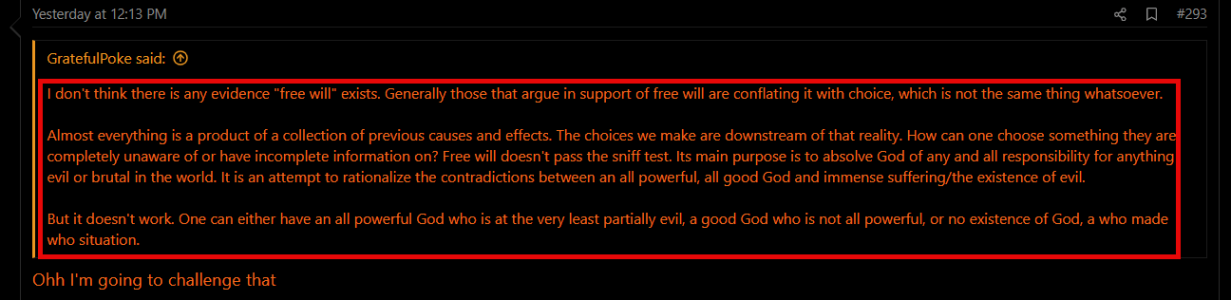
The original statement was as follows

1776440196049.png

And I challenged that pointing out there are Theories (many more than just the one I posted but the one I would think makes the best argument for Free Will)

Someone stated as a matter of Fact that there is no evidence that Free Will Exists and most arguments FOR Free Will are arguing nothing more than Choices. I provided a Theory which fully contested that claim

So I guess the answer you are looking for. I don't know if Free Will exists or Not. Someone on here said it did not as a matter of fact, and I provided what I personally think is the Best Theory for arguing the existence of Free Will.

Then we argued over that theory.

I even provided a theory that contradicts the original claim seen above AND specifically still supports what the poster specifically said "Almost everything is a product of a collection of previous causes and effects"

The theory provided even lends credibility to the original posters idea that everything IS a collection of Previous Causes and Affects (of free Will) and each one creates a different dimension or time variant
 
Last edited:
Yet again too vague. You take what as a sign that proves what theory? How is it proven? What is "it" in your response?
well I really didn't think about or give much attention to the idea of extra dimensions until X17B was discovered. When they discovered this and discovered this particle defies known Gravitational Forces and Electromagnetic forces we currently know about suggesting that something that can not be seen by us is interacting with that same particle at the same time we can see the particle....really made me wonder what the hell that thing is.

Particles don't just have gravitational forces and Electromagnetic forces interact with them that We don't know about and Can't see....especially in a highly controlled environment...that's some next level Sh**

The discovery of the X17b particle at CERN has sparked a flurry of excitement and concern among scientists. This new particle, which has been temporarily designated as X17b, is thought to belong to a hypothetical class of "fifth force" carriers, potentially linking visible matter to the long theorized dark sector of the universe. If confirmed through peer-reviewed replication, this discovery could expand the Standard Model of particle physics and open a door to understanding the 95% of the universe that remains invisible to current scientific instruments. The discovery emerged during a series of high energy proton proton collision experiments conducted in late 2024 and analyzed over the first half of 2025. Unlike previously known particles, X17b appears to interact extremely weakly with regular matter, bypassing detection in traditional electromagnetic sensors. Instead, it was inferred through anomalies in angular electron positron pair emissions, which suggested the influence of an unknown force mediating the decay process. These anomalies have now passed the statistical confidence threshold of 5 sigma, indicating a probability of less than 1 in 3.5 million that the results are due to chance. The particle seems to exist only for femtoseconds before decaying, yet its fleeting existence leaves a detectable imprint. Some theorists suggest it could be a portal particle a mediator between known matter and dark matter. This possibility has set off excitement across theoretical physics communities, many of whom have long posited the existence of such a connector particle but lacked empirical evidence.
sciandnature.com
 
Yea, but do you really think that or do you only think that you think that and the reality is that the choice was already made for you? 🤔
The Princess Bride Sicilian GIF
 
Back
Top