Philosophy & Religion Thread

Almost all doctrine is a theological construct. What a theological construct is is when you piece together a lot of different scriptures to make the case for the doctrine. I'll give an example, from the 16 Fundamental Truths of the Assemblies of God:

The Trinity
The One True God
The one true God has revealed Himself as the eternally self-existent "I AM," the Creator of heaven and earth and the Redeemer of mankind. He has further revealed Himself as embodying the principles of relationship and association as Father, Son and Holy Spirit.​
Deuteronomy 6:4 [KJV/NIV]​
Isaiah 43:10,11 [KJV/NIV]​
Matthew 28:19 [KJV/NIV]​
Luke 3:22 [KJV/NIV]​
The Adorable Godhead
1. Terms Defined​
The terms "Trinity" and "persons" as related to the Godhead, while not found in the Scriptures, are words in harmony with Scripture, whereby we may convey to others our immediate understanding of the doctrine of Christ respecting the Being of God, as distinguished from "gods many and lords many." We therefore may speak with propriety of the Lord our God who is One Lord, as a trinity or as one Being of three persons, and still be absolutely scriptural.​
Matthew 28:19 [KJV/NIV]​
2 Corinthians 13:14 [KJV/NIV]​
John 14:16-17 [KJV/NIV]​
2. Distinction and Relationship in the Godhead​
Christ taught a distinction of Persons in the Godhead which He expressed in specific terms of relationship, as Father, Son, and Holy Spirit, but that this distinction and relationship, as to its mode is inscrutable and incomprehensible, because unexplained.​
Luke 1:35 [KJV/NIV]​
1 Corinthians 1:24 [KJV/NIV]​
Matthew 11:25-27 [KJV/NIV]​
Matthew 28:19 [KJV/NIV]​
2 Corinthians 13:14 [KJV/NIV]​
1 John 1:3-4 [KJV/NIV])​
3. Unity of the One Being of Father, Son and Holy Spirit​
Accordingly, therefore, there is that in the Father which constitutes him the Father and not the Son; there is that in the Son which constitutes Him the Son and not the Father; and there is that in the Holy Spirit which constitutes Him the Holy Spirit and not either the Father or the Son. Wherefore the Father is the Begetter, the Son is the Begotten, and the Holy Spirit is the one proceeding from the Father and the Son. Therefore, because these three persons in the Godhead are in a state of unity, there is but one Lord God Almighty and His name one.​
John 1:18 [KJV/NIV]​
John 15:26 [KJV/NIV]​
John 17:11 [KJV/NIV]​
John 17:21 [KJV/NIV]​
Zechariah 14:9 [KJV/NIV]​
4. Identity and Cooperation in the Godhead​
The Father, the Son and the Holy Spirit are never identical as to Person; nor confused as to relation; nor divided in respect to the Godhead; nor opposed as to cooperation. The Son is in the Father and the Father is in the Son as to relationship. The Son is with the Father and the Father is with the Son, as to fellowship. The Father is not from the Son, but the Son is from the Father, as to authority. The Holy Spirit is from the Father and the Son proceeding, as to nature, relationship, cooperation and authority. Hence, neither Person in the Godhead either exists or works separately or independently of the others.​
John 5:17-30 [KJV/NIV]​
John 5:32 [KJV/NIV]​
John 5:37 [KJV/NIV]​
John 8:17,18 [KJV/NIV]​
5. The Title, Lord Jesus Christ​
The appellation, "Lord Jesus Christ," is a proper name. It is never applied in the New Testament, either to the Father or to the Holy Spirit. It therefore belongs exclusively to the Son of God.​
Romans 1:1-3,7 [KJV/NIV]​
2 John 3 [KJV/NIV]​
6. The Lord Jesus Christ, God with Us​
The Lord Jesus Christ, as to His divine and eternal nature, is the proper and only Begotten of the Father, but as to His human nature, He is the proper Son of Man. He is therefore, acknowledged to be both God and man; who because He is God and man is "Immanuel," God with us.​
Matthew 1:23 [KJV/NIV]​
1 John 4:2 [KJV/NIV]​
1 John 4:10 [KJV/NIV]​
1 John 4:14 [KJV/NIV]​
Revelation 1:13 [KJV/NIV]​
Revelation 1:17 [KJV/NIV]​
7. The Title, Son of God​
Since the name "Immanuel" embraces both God and man in the one Person, our Lord Jesus Christ, it follows that the title, Son of God, describes His proper deity, and the title, Son of Man, His proper humanity. Therefore, the title Son of God, belongs to the order of eternity, and the title, Son of Man, to the order of time.​
Matthew 1:21-23 [KJV/NIV]​
2 John 1:3 [KJV/NIV]​
1 John 3:8 [KJV/NIV]​
Hebrews 7:3 [KJV/NIV]​
Hebrews 1:1-13 [KJV/NIV]​
8. Transgression of the Doctrine of Christ​
Wherefore, it is a transgression of the Doctrine of Christ to say that Jesus Christ derived the title, Son of God, solely from the fact of the incarnation, or because of His relation to the economy of redemption. Therefore, to deny that the Father is a real and eternal Father, and that the Son is a real and eternal Son, is a denial of the distinction and relationship in the Being of God; a denial of the Father, and the Son; and a displacement of the truth that Jesus Christ is come in the flesh.​
2 John 9 [KJV/NIV]​
John 1:1 [KJV/NIV]​
John 1:2 [KJV/NIV]​
John 1:14 [KJV/NIV]​
John 1:18 [KJV/NIV]​
John 1:29 [KJV/NIV]​
John 1:49 [KJV/NIV]​
1 John 2:22,23 [KJV/NIV]​
1 John 4:1-5 [KJV/NIV]​
Hebrews 12:2 [KJV/NIV]​
9. Exaltation of Jesus Christ as Lord​
The Son of God, our Lord Jesus Christ, having by Himself purged our sins, sat down on the right hand of the Majesty on high; angels and principalities and powers having been made subject unto Him. And having been made both Lord and Christ, He sent the Holy Spirit that we, in the name of Jesus, might bow our knees and confess that Jesus Christ is Lord to the glory of God the Father until the end, when the Son shall become subject to the Father that God may be all in all.​
Hebrews 1:3 [KJV/NIV]​
1 Peter 3:22 [KJV/NIV]​
Acts 2:32-36 [KJV/NIV]​
Romans 14:11 [KJV/NIV]​
1 Corinthians 15:24-28 [KJV/NIV]​
10. Equal Honor to the Father and to the Son​
Wherefore, since the Father has delivered all judgment unto the Son, it is not only the express duty of all in heaven and on earth to bow the knee, but it is an unspeakable joy in the Holy Spirit to ascribe unto the Son all the attributes of Deity, and to give Him all honor and the glory contained in all the names and titles of the Godhead except those which express relationship (see Distinction and Relationship in the Godhead, Unity of the One Being of Father, Son and Holy Spirit , and Identity and Cooperation in the Godhead) and thus honor the Son even as we honor the Father.​
John 5:22,23 [KJV/NIV]​
1 Peter 1:8 [KJV/NIV]​
Revelation 5:6-14 [KJV/NIV]​
Philippians 2:8,9 [KJV/NIV]​
Revelation 7:9-10 [KJV/NIV]​
Revelation 4:8-11 [KJV/NIV]​

You can say "The Bible says it", but look at how many steps and scriptures it takes to construct the doctrine of the Trinity. Is it any wonder that lay people have difficulty explaining it.
 
Hebrews 11:1
Now faith is the assurance of things hoped for, the conviction of things not seen.

Once you have seen it, touched it, defined it, it is empirical evidence and no longer a matter of faith. The Hebrew term there for "assurance" is "hypostasis", a steadfastness of mind. Faith is having a steadfastness of mind without empirical evidence, "not seen".

Thomas was absolutely right to doubt, because he did not have faith, as any other person would that did not have faith. Thus Jesus said, "blessed are those who have not seen and believed."
I am not even sure what you are talking about. Have you even read what I wrote? As I have said repeatedly this account of Thomas is a lesson on faith, without a doubt. If you don't understand that I'm sorry. I can explain it to you, but I can't understand it for you.

I have never said that Thomas was an "example of faith" because he wasn't in this instance, he lacked faith. Read the rest of Hebrews 11 ("the Hall of Faith"), Thomas ain't in there because he is not an example of faith. That is why Jesus explained to him what true faith should look like, thus the lesson on faith.

I don't want to put words into the Cptn's mouth, but I took his doubting Thomas comments to mean that maybe these theologians could use a lesson in faith just liked Thomas did. If you are implying that these theologians are some how above an apostle, I think you might be mistaken. They don't deserve empirical evidence anymore than the rest of us, and if you are waiting on empirical evidence to prove everything in the Bible you are going to be waiting a long time. Christianity requires faith, end of story.

Finally, (and this just as much for me as anyone) I think any Christian in this thread that always has to be right, might want to read what the Bible says about pride and humility. With that said, I am going to take my own advice and bow out of this thread for a little while, because Scripture is something I hold dear and I feel pride creeping up on me.
 
Yes, in the OT, Sheol was simply the place of the dead, and the concept of an afterlife didn't begin to develop within Judaism until about the second century BC, well after the diaspora and the Assyrian and Babylonian exiles; during the Hellenistic period.

There is some syncretism of Christianity in orthopraxy, because the Christian orthopraxy is nowhere spelled out in scripture. Orthodoxy? Was Jesus really an Essene? From Nazareth? I know the idea is popular among some, but there really isn't much evidence.
Do we know for sure? No. But based on his teachings which borrow heavily from essene traditions, he was either and essene or heavily influenced essenes/essene adjacent. He certainly was not a pharasee, sadducee or a zealot based on that piece.
 
I am not even sure what you are talking about. Have you even read what I wrote? As I have said repeatedly this account of Thomas is a lesson on faith, without a doubt. If you don't understand that I'm sorry. I can explain it to you, but I can't understand it for you.

I have never said that Thomas was an "example of faith" because he wasn't in this instance, he lacked faith. Read the rest of Hebrews 11 ("the Hall of Faith"), Thomas ain't in there because he is not an example of faith. That is why Jesus explained to him what true faith should look like, thus the lesson on faith.

I don't want to put words into the Cptn's mouth, but I took his doubting Thomas comments to mean that maybe these theologians could use a lesson in faith just liked Thomas did. If you are implying that these theologians are some how above an apostle, I think you might be mistaken. They don't deserve empirical evidence anymore than the rest of us, and if you are waiting on empirical evidence to prove everything in the Bible you are going to be waiting a long time. Christianity requires faith, end of story.

Finally, (and this just as much for me as anyone) I think any Christian in this thread that always has to be right, might want to read what the Bible says about pride and humility. With that said, I am going to take my own advice and bow out of this thread for a little while, because Scripture is something I hold dear and I feel pride creeping up on me.
Well okie doke.

Just to answer the one thing, I didn’t imply any such thing. They are not looking for empirical evidence nor did I say they are. They are looking at scriptural evidence for a scripturally constructed doctrine.
 
Last edited:
I am not even sure what you are talking about. Have you even read what I wrote? As I have said repeatedly this account of Thomas is a lesson on faith, without a doubt. If you don't understand that I'm sorry. I can explain it to you, but I can't understand it for you.

I have never said that Thomas was an "example of faith" because he wasn't in this instance, he lacked faith. Read the rest of Hebrews 11 ("the Hall of Faith"), Thomas ain't in there because he is not an example of faith. That is why Jesus explained to him what true faith should look like, thus the lesson on faith.

I don't want to put words into the Cptn's mouth, but I took his doubting Thomas comments to mean that maybe these theologians could use a lesson in faith just liked Thomas did. If you are implying that these theologians are some how above an apostle, I think you might be mistaken. They don't deserve empirical evidence anymore than the rest of us, and if you are waiting on empirical evidence to prove everything in the Bible you are going to be waiting a long time. Christianity requires faith, end of story.

Finally, (and this just as much for me as anyone) I think any Christian in this thread that always has to be right, might want to read what the Bible says about pride and humility. With that said, I am going to take my own advice and bow out of this thread for a little while, because Scripture is something I hold dear and I feel pride creeping up on me.
Yes those words you used explains what I was trying to say. As I said, I’m a simple man when it comes to faith. One simply has to believe without proof.
 
Yes those words you used explains what I was trying to say. As I said, I’m a simple man when it comes to faith. One simply has to believe without proof.
When one is talking about doctrine, then believing without proof is dogma. And again, the proof we’re talking about here isn’t empirical, touching Jesus’ wounds or turning on a light switch, but scriptural support for the doctrine.
 
When one is talking about doctrine, then believing without proof is dogma. And again, the proof we’re talking about here isn’t empirical, touching Jesus’ wounds or turning on a light switch, but scriptural support for the doctrine.
Now you are trying to replace spirituality in God with religion which is the church.
 
Before I can answer that, let me ask you who you believe God is?
Post in thread 'Philosophy & Religion Thread'
https://rideemcowboys.com/threads/philosophy-religion-thread.2253/post-211522

Lol... You answered my question with a question. You thought it was a trap, but it wasn't, or at least it wasn't intended to be. The question was one for which finding scriptural support would be pretty easy. In fact, I gave you all the scriptural support you need in the message above.
 
Last edited:
Post in thread 'Philosophy & Religion Thread'
https://rideemcowboys.com/threads/philosophy-religion-thread.2253/post-211522

Lol... You answered my question with a question. You thought it was a trap, but it wasn't, or at least it wasn't intended to be. The question was one for which finding scriptural support would be pretty easy. In fact, I gave you all the scriptural support you need in the message above.
That’s all doctrine. I asked you what you believe, not what others have written. After you assimilate all the doctrine that that you can, ultimately you have a belief that is an amalgamation separate from all the doctrine. What is that belief?
 
That’s all doctrine. I asked you what you believe, not what others have written. After you assimilate all the doctrine that that you can, ultimately you have a belief that is an amalgamation separate from all the doctrine. What is that belief?

My belief in the Godhead pretty much aligns with what is laid out in the doctrine of the Godhead in the 16 Fundamental Truths. There are other parts of the 16 FTs where I differ. But I wouldn't describe them as an "amalgamation separate from all the doctrine". That isn't quite the way that is has worked. My beliefs are supported by scripture. They are doctrine. At least many of them are. Some are opinions. Some are questions I have to which I haven't yet found answers, but have hypotheses.

Remember when I defined the Reformation theology, Protestantism, etc.? The "Four Solas"? Sola Scriptura means that scripture is the sole, infallible, inerrant and sufficient authority for faith and practice. I believe you said you've attended Methodist churches, correct? Methodists are Protestant and accept the Four Solas including Sola Scriptura. So, if a belief isn't based on scripture, that is, doctrine, then it doesn't align with the principle of Sola Scriptura.
 
My belief in the Godhead pretty much aligns with what is laid out in the doctrine of the Godhead in the 16 Fundamental Truths. There are other parts of the 16 FTs where I differ. But I wouldn't describe them as an "amalgamation separate from all the doctrine". That isn't quite the way that is has worked. My beliefs are supported by scripture. They are doctrine. At least many of them are. Some are opinions. Some are questions I have to which I haven't yet found answers, but have hypotheses.

Remember when I defined the Reformation theology, Protestantism, etc.? The "Four Solas"? Sola Scriptura means that scripture is the sole, infallible, inerrant and sufficient authority for faith and practice. I believe you said you've attended Methodist churches, correct? Methodists are Protestant and accept the Four Solas including Sola Scriptura. So, if a belief isn't based on scripture, that is, doctrine, then it doesn't align with the principle of Sola Scriptura.
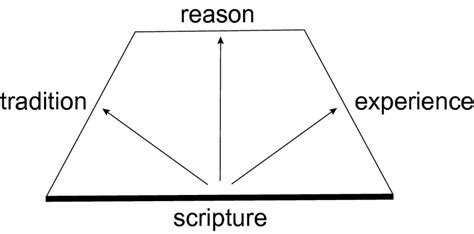
Actually, Methodism usually follows the Wesleyan Quadrilateral.
1771260457098.jpeg
While scripture is the sole foundation, it is not the sole authority. So, many consider it prima scriptura instead.

More below:
The Wesleyan Quadrilateral is a theological framework developed by John Wesley, a key figure in the Methodist movement. It consists of four components that guide theological reflection:

  • Scripture: The primary source of authority, considered the foundation of Christian faith.
  • Tradition: The historical interpretations and teachings of the Church that inform understanding of Scripture.
  • Reason: The logical analysis that helps interpret Scripture and tradition coherently.
  • Experience: The personal and communal experiences of faith that validate and vivify the teachings of Scripture.

Importance of Each Component​

Scripture​

  • Regarded as the sole foundational source.
  • Wesley emphasized its centrality, famously identifying as "a man of one book."

Tradition​

  • Involves the historical context and teachings of the Church.
  • Helps clarify and illuminate the interpretation of Scripture.

Reason​

  • Provides logical coherence and aids in understanding complex theological issues.
  • Acts as a mediator between differing interpretations of Scripture.

Experience​

  • Reflects the lived faith of individuals and communities.
  • Validates the truth of Scripture when aligned with tradition and reason.

Application in Theology​

The Wesleyan Quadrilateral is not just a theoretical model; it is a practical approach used by Methodists to address moral and theological questions. It emphasizes that while Scripture is primary, tradition, reason, and experience are essential aids in understanding and applying biblical teachings in contemporary contexts. This framework encourages both clergy and laypeople to engage in theological discussions, making it a vital part of Methodist education and practice.
 
Actually, Methodism usually follows the Wesleyan Quadrilateral.
View attachment 18697
While scripture is the sole foundation, it is not the sole authority. So, many consider it prima scriptura instead.

More below:
The Wesleyan Quadrilateral is a theological framework developed by John Wesley, a key figure in the Methodist movement. It consists of four components that guide theological reflection:

  • Scripture: The primary source of authority, considered the foundation of Christian faith.
  • Tradition: The historical interpretations and teachings of the Church that inform understanding of Scripture.
  • Reason: The logical analysis that helps interpret Scripture and tradition coherently.
  • Experience: The personal and communal experiences of faith that validate and vivify the teachings of Scripture.

Importance of Each Component​

Scripture​

  • Regarded as the sole foundational source.
  • Wesley emphasized its centrality, famously identifying as "a man of one book."

Tradition​

  • Involves the historical context and teachings of the Church.
  • Helps clarify and illuminate the interpretation of Scripture.

Reason​

  • Provides logical coherence and aids in understanding complex theological issues.
  • Acts as a mediator between differing interpretations of Scripture.

Experience​

  • Reflects the lived faith of individuals and communities.
  • Validates the truth of Scripture when aligned with tradition and reason.

Application in Theology​

The Wesleyan Quadrilateral is not just a theoretical model; it is a practical approach used by Methodists to address moral and theological questions. It emphasizes that while Scripture is primary, tradition, reason, and experience are essential aids in understanding and applying biblical teachings in contemporary contexts. This framework encourages both clergy and laypeople to engage in theological discussions, making it a vital part of Methodist education and practice.
Sola Scriptura doesn’t mean that you can’t have a theological framework for building doctrine from scripture. Sola Scriptura means that you don’t build doctrine by divine inspiration from or through non-scriptural sources. The Wesleyan quadrilateral is entirely consistent with Sola Scriptura.
 
My belief in the Godhead pretty much aligns with what is laid out in the doctrine of the Godhead in the 16 Fundamental Truths. There are other parts of the 16 FTs where I differ. But I wouldn't describe them as an "amalgamation separate from all the doctrine". That isn't quite the way that is has worked. My beliefs are supported by scripture. They are doctrine. At least many of them are. Some are opinions. Some are questions I have to which I haven't yet found answers, but have hypotheses.

Remember when I defined the Reformation theology, Protestantism, etc.? The "Four Solas"? Sola Scriptura means that scripture is the sole, infallible, inerrant and sufficient authority for faith and practice. I believe you said you've attended Methodist churches, correct? Methodists are Protestant and accept the Four Solas including Sola Scriptura. So, if a belief isn't based on scripture, that is, doctrine, then it doesn't align with the principle of Sola Scriptura.
I am a member of the Methodist Church but I don’t necessarily believe everything that it promotes. Much of it I do agree with, maybe even most of it. I was a Presbyterian before that for a few years. That was the first church I joined. I wasn’t raised in any church but most of my early beliefs were rooted in bible stories I watched on tv as a child and learned from some adults. Oh, in school before prayer by teachers was removed I learned the 23rd Psalm and the Lord’s Prayer. Both had meaning but I also didn’t understand all of it. After joining the Presbyterian church and later in the Methodist church I learned many things which are probably best summarized in the Nicene and Apostles Creeds. I believe in God as spirit, in Jesus as spirit and of course the Holy Spirit (or Ghost) as spirit, all the same one. Jesus was the spirit in a particular man who had his own trepidation as he neared the end of his life yet did what he had to do, the ultimate sacrifice of a man. I believe the Holy Spirit is the part of God that far too many of us tend to forget, yet that is the spirit that holds us together by our faith when nothing seems to make sense to us. That’s why I try to remember to thank God through and for the Holy Spirit in prayer. As far as Hell is concerned, to me it is reserved for only those who are truly evil with hate in their hearts. I don’t know the construction of Hell but I know it isn’t good. I don’t see how God would condemn people who have sinned but are not truly evil to Hell. My son has done many, many things for which I should simply be done with him but I just can’t do that. I believe God loves every one of us sinners and we should strive to do the same. Do unto others as you would have them do unto you. Certainly don’t hate them.
 
I am a member of the Methodist Church but I don’t necessarily believe everything that it promotes. Much of it I do agree with, maybe even most of it. I was a Presbyterian before that for a few years. That was the first church I joined. I wasn’t raised in any church but most of my early beliefs were rooted in bible stories I watched on tv as a child and learned from some adults. Oh, in school before prayer by teachers was removed I learned the 23rd Psalm and the Lord’s Prayer. Both had meaning but I also didn’t understand all of it. After joining the Presbyterian church and later in the Methodist church I learned many things which are probably best summarized in the Nicene and Apostles Creeds. I believe in God as spirit, in Jesus as spirit and of course the Holy Spirit (or Ghost) as spirit, all the same one. Jesus was the spirit in a particular man who had his own trepidation as he neared the end of his life yet did what he had to do, the ultimate sacrifice of a man. I believe the Holy Spirit is the part of God that far too many of us tend to forget, yet that is the spirit that holds us together by our faith when nothing seems to make sense to us. That’s why I try to remember to thank God through and for the Holy Spirit in prayer. As far as Hell is concerned, to me it is reserved for only those who are truly evil with hate in their hearts. I don’t know the construction of Hell but I know it isn’t good. I don’t see how God would condemn people who have sinned but are not truly evil to Hell. My son has done many, many things for which I should simply be done with him but I just can’t do that. I believe God loves every one of us sinners and we should strive to do the same. Do unto others as you would have them do unto you. Certainly don’t hate them.
Regarding hell, I would recommend a book by Rob Bell entitled “Love Wins.” It gives a new perspective on our modern understanding of hell.
 
Regarding hell, I would recommend a book by Rob Bell entitled “Love Wins.” It gives a new perspective on our modern understanding of hell.
Give me the cliff notes. I don’t read books much anymore. No attention span. Mad cow, you know.
 
I'd be willing to bet my post on hell comes pretty close to a cliff notes version.
Give me the cliff notes. I don’t read books much anymore. No attention span. Mad cow, you know.
I find Bell to be an easy read. He lays things out well and is very conversational. Almost stream of consciousness. His book “How To Read The Bible” is similar. The audiobooks are great as well.
 
Back
Top