Philosophy & Religion Thread

I was raised in a hardcore United Pentecostal Church. Not quite Snake handling but not very far off. (Seriously, I've been to snake handling churches as a visitor before.

As a Child :

We went to church 5 days a week
I was taught that Women wearing Makeup, Anything but a Long Dress, if they cut their Hair OR if they wore make up or Jewelry it was a sin
I was not allowed to watch TV until I was 11 (when we left the church) as that was a Sin
I was not allowed to wear shorts or anything that exposed my legs as that was a Sin
I was taught that Black People were inferior to white people and the color of their skin was because they were murders and this was how God punished them.
I was taught that Black and Brown People were Anatomically different than White People making them stronger, faster and more dangerous than White people
I was taught that if you didn't speak in tongues you couldn't get into Heaven and were not saved unless you did.

IF anyone here reads this and was raised this same way or still hold any of the views listed above...I am PLEADING with you. PLEASE read the BIBLE on your own!

I had to "rediscover" religion in my Mid 30's because of how I was brought up and the things they taught me that Made me feel awful about thinking those things about other Humans. Then I begin to read the Bible on my own, Ask Myself what does it REALLY say and is all that stuff they taught me as a Kid real.

Turns out, the UPC sect of the cult I was raised in was WAY OFF. Unfortunately I meet at least 5 people a YEAR who grew up in a very similar background with very similar teachings in Oklahoma. Met one just this Christmas actually and we discussed our time in "The Cult" as we called it.
 
Not much to say at the level that @GratefulPoke and others discuss religion.

I will say something that bothers me. I am a data driven person. I want things to make sense to me. Assume for a second that there really is no deity, I still understand completely how and why the idea came to humans and the benefits that came from it in the history of man.

What I cannot understand and honestly bothers me is that ~75-80% of the world is still religious today. I really don't enjoy being in a minority on concepts that require significant thought. Doesn't mean the majority is right, but it does give me pause.

That said, I can't fake it. I cannot get any religion to fully make sense to me (just me, not trying at all to convince anyone else.) I've talked to "religious" friends before who eventually confided in me that they didn't really believe. It was just easier with family/friends etc. Seems tough to live like that to me.
 
Last edited:
On a suggestion from @TheMonkey lets get a philosophy & religion thread going. The goal of this thread will be a home for cordial, respectful and rigorous discussion of the former.

To get things started, what philosophic or religious ideas, authors or theories resonate with you?
Thanks for making space for this. I’m not a theologian nor a serious student of philosophy, so I am here to learn from others and gain from our shared and differing perspectives.

I was a pastor’s kid growing up in rural Oklahoma, so my roots are from an evangelical upbringing. We followed the Kenneth Copeland style pentecostal “word of faith” movement. Some similarity to Polds because they spoke in tongues, but less restrictive and more about the prosperity gospel. I left that in the mid-90s for a more contemporary Christianity.

The last 20 years or so, I have been deconstructing my faith and recently building it back. As one of my spiritual heroes, Richard Rohr says, you spend the first half of your life building the container. Then the second half, you fill it up. In other words, I realized I was empty.

Along the way, I began to frame Jesus and Christianity differently. I realized Jesus—if he existed—came around at the ideal moment in history. It was the transition from tribalism to civilization under the Roman Empire.

Up to this point, Judaism was all about tribal survival. Their laws emphasized keeping their people and their culture intact. What you eat, how you clean, who you marry and have sex with, etc. can determine if you live or die and how you propagate people. Also, there were countless other tribes ready to dominate, kill, and/or assimilate your tribe at any moment. So, you had to fight and kill in order to ensure your people had resources and would survive. This is why the God of the Old Testament seems so violent.

All of this was about to change.

Jesus's teachings were about the “abundant life.” It was no longer about taking from others so you could live. We all can live together. But we need to love and forgive in order to do so. It’s no longer about preserving a tribe. It’s about loving your enemy, because that is the only way to break the cycle of violence. It’s not about sustaining the rule of patriarchy and a holy lineage. It’s about no longer seeing a race, gender, or social class as being better than others.

I also came across the teachings of a French philosopher and historian, Rene Girard. One of his principles is called the Scapegoat Mechanism. He believed that every ancient society had to use this to survive. Basically, violence would begin to build in a society. Eventually, it would create instability and threaten their ability to survive as a group. The leaders would choose someone—usually a peasant, diseased person, or foreign wanderer—as a scapegoat. They would claim this person was the cause of all the violence and calamity. Everyone would turn against the scapegoat, who would be punished. Sometimes exiled or killed. This would unify the people until violence builds back up again. Then the cycle repeats.

Girard believed Jesus was the perfect scapegoat. At the same time, his story is the first one told from the perspective of the scapegoat. He is seen as innocent and not the reason for the calamity. But he becomes a willing scapegoat. Voluntarily sacrificing himself so the people can finally live in peace. Forever, if they accept his gift. But if they reject him and decide they don’t need his sacrifice, then they choose selfishness and violence with one another. And the cycle continues.

So, I see Christianity as a form of placebo. But it is one that works if we accept it. It is a story that can help us reset our society when things go astray. It gives us a way to view life and principles for living it. But many have distorted it into a magic fairy tale that gives them assurance, control, and privilege. They use it to create winners and losers, insiders and outsiders, us vs them. They miss the point and accomplish the opposite of what Jesus set out to do.
 
Last edited:
My parents graduated from a Nazarene college, but tended to bounce around from denomination to denomination, always staying on the evangelical/fundamentalist spectrum. Growing up, we were baptist (I cannot recall the denomination), Presbyterian (PCA), bible church, Lutheran (Missouri Synod), and various evangelical churches, some of which were unaffiliated or non-denominational. My parents were significant proponents of Focus on the Family’s teachings and ideology, and routinely utilized those “parenting” techniques in our home. I was also homeschooled until 7th grade.

I had faith as much as I knew what it was until late high school and early college when I began asking questions that sunday school teachers could not address, and became a militant atheist. After a really rough patch late in college, I returned to the faith due to existential angst, and remember thinking that even though I didn’t really believe it, I had to just “buy into the BS” to get through that difficult time. Despite that mindset it actually worked, and over time, I forgot about that whole rationalization. At least for awhile.

As an adult, I attended a couple non-denominational evangelical churches and an Assemblies of God church. I became more passionate over time decided to do a career change and become a Theology professor. So I decided to get my Masters from evangelical seminary as the first step before later getting a PhD, which was a good experience despite me non “using” the degree after I graduated. The areas that resonated with me were:

Contemplative Spirituality/Christian Mysticism. The Cloud of Unknowing and the writings and teachings of Julian of Norwich (she was illiterate, so other people who had talked to her wrote them), Meister Eckhart, Thomas Merton all resonated with me and still made a lasting impact. I realized from reading Huston Smith, a professor of religion who actually lived out and practiced multiple contemplative religions over his lifetime that the contemplative branches of the various religions had more in common with one another than their parent faiths. I didn’t take is word on this and started reading Sufi (Islam), Advaita Vedanta (Hindu), and some mahayana (Buddhist) works, while dabbling practicing the latter. He was right: the contemplative paths all fit together--they are the same path. For those interested, Smith’s idea actually came from Adolous Huxley in his book The Perennial Philosophy, which is a great read.

Process Theology/Panentheism. Process theology did not view God as possessing the 3 O’s (omniscience, omnipotence and omnipresence), but defined by an unlimited potentiality. Something constantly growing, learning and morphing.

Liberation Theology. It is uncanny how much of the old testament resonates with Gustavo Gutierrez’ readings and the plight of marginalized peoples. In highly religious societies, it is one of the few ways to break up the ruling classes hegemony and mistreatment of common people. It is probably one of the more useful/pragmatic approaches to theology today.

That being said, as I kept at my studies, more and more gaps kept chipping away my faith. First, the discrepancies in the gospel accounts, then the number and nature of the New Testament pseudographs. Then the textual/codex issues, and the political nature of the Council of Nicea, stripping canon away from some texts and adding it to others, in some cases less likely to be authentic. The fantastical claims of creation, worldwide floods, plagues, prophecies, divine approval/disapproval, satan, virgin births, resurrections all powerful gods have no basis or evidence in reality. They weren’t even unique to Christianity/Judaism and in many cases were borrowed from other contemporary religions. I came to the realization that it is highly unlikely that any of it was true. It had humanity’s fingerprints all over it. Who made who?

So then I looked for other reasons to keep the faith. I knew of “Christian atheists” and priests who kept the trappings of religion because they believed it helped more than it hurt thought “well at least the lessons it imparted and the morality that it taught was good”; so it overall it helped people lived moral lives. But far too many examples ran counter to this, whether it was on genocide, sexuality, treatment of other groups, the treatment of women, slavery, the idea that God even has a “chosen people”, how authority should be treated and I realized that it was conflicted at best and actually was a source of suffering and ignorance at worst, so I left the church and the faith shortly after I graduated from seminary.

I think we have little to gain from studying the bible outside of an anthropological approach. Religion is a heuristic that has outlived its utility, something that provided an evolutionary advantage to humans in a previous era. Only certain portions of the gospels have useful moral teachings and it is still mixed with magical thinking and dualism. The majority of people alive today are more moral than the ancients, almost down to a person. For everything that is covered in the text, there is a better source for those things elsewhere. We know so much more than the ancients and our knowledge of how morality works is so much more sophisticated than theirs. We have had 2000+ more years of cause and effect to observe, how could we not have more insight than them into morality, ethics and the nature of things? Again this goes back to epistemology. Does knowledge come down from the heavens, or is it up to us to go out and discover it for ourselves? I think we have to be a light onto our own path. No one else can do it for us.

Since then, I have been a nontheist and have practiced secular buddhism, as most sects in buddhism function not as a religion (although they have the trappings and ritual of a religion), but as a philosophy. A way of living and approaching life. There is no litmus test for belief, no creed to cling to. Some that I sit with still practice Christianity or Judaism. Some believe in reincarnation, while others like myself do not. But there still is one constant, and that is of a continual opening to the nature of reality, whatever it happens to be.

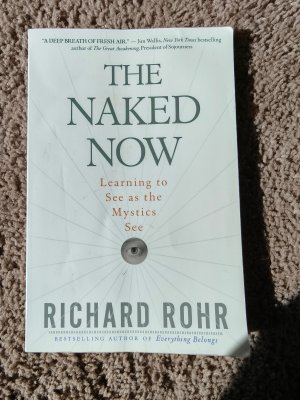
@TheMonkey I read a Richard Rohr book awhile back at it was pretty good. Have you read this one?

 

Attachments

  • IMG20260127130329.jpg
    IMG20260127130329.jpg
    1.6 MB · Views: 0
Back
Top