Oklahoma is going backwards

So, if you can't afford to own a house and rent you would still be on the hook for the MUCH higher property taxes required to cover this.
Possibly the best way to make up for $1.2 billion in lost revenue is to hike the state sales tax. Oklahoma, if I got it correct, took in a bit over $3 billion in state sales tax in 2023. That means the state sales tax would have to be raised by around 2%. Efforts from a vote around 10 years ago on a question to raise state sales tax by 1% to improve funding for education failed. It reflected the anti-education culture in Oklahoma.

If the property tax abatement measure gets on the ballot, legislators should be asked if they support a 2% sales tax hike or whatever the amount arrived at. If less than the required number of them to raise taxes, I'd probably vote no. If legislators won't raise state sales tax, then I guess they would have to tell counties and cities to determine how much they need to raise their own sales taxes and take a citizen vote on it, if required.

If it gets on the ballot, it will likely discourage business and industry from coming to Oklahoma until the tax situation gets settled. If homeowner property taxes are abolished, it could encourage more Texans to move to Oklahoma.

A Houston billboard asked me to leave Texas for Oklahoma. No thanks.​

https://www.chron.com/culture/article/move-to-oklahoma-billboards-texas-21208046.php
 
Last edited:
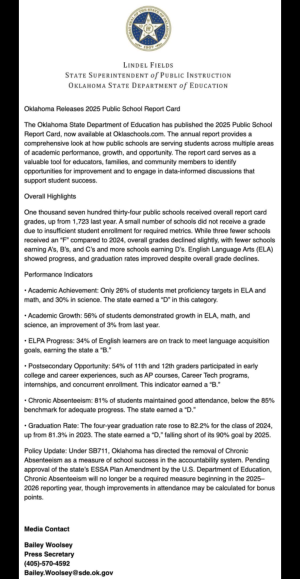
Clear, well defined information without a hint of bias. What a breath of fresh air, and a sad low bar from what we have been experiencing recently.
All states have these or similar metrics. I don’t care if ideas come from the reddest of red states or bluest of blue states. Find out how states that are excelling and improving are getting it done. And then I don’t care if it costs money and my taxes are raised. Get our schools performing. Unleash educators and let the really good ones mentor and lead. And pay them to do it.

When our education exceeds and we become more than easy casino grounds for Texans businesses will come to Oklahoma. Higher incomes and higher population will result in higher tax income and then we can lower taxes.

This sh!+ ain’t difficult.
 
All states have these or similar metrics. I don’t care if ideas come from the reddest of red states or bluest of blue states. Find out how states that are excelling and improving are getting it done. And then I don’t care if it costs money and my taxes are raised. Get our schools performing. Unleash educators and let the really good ones mentor and lead. And pay them to do it.

When our education exceeds and we become more than easy casino grounds for Texans businesses will come to Oklahoma. Higher incomes and higher population will result in higher tax income and then we can lower taxes.

This sh!+ ain’t difficult.

I would also want to know what were we doing when we were 17th (at our highest ranking?) in education when Brad Henry was in office. And why did we get away from it?
 
I would also want to know what were we doing when we were 17th (at our highest ranking?) in education when Brad Henry was in office. And why did we get away from it?

Its not a red vs blue state thing. You see states like Utah ranked pretty high and California is middle of the pack. I can tell you from my observations Minnesota blows Oklahoma away but compared to Iowa and Nebraska they aren't that different. New Mexico seems to suck and the deep south usually struggles (with the exception of Florida) so its probably a regional thing.
 
Its not a red vs blue state thing. You see states like Utah ranked pretty high and California is middle of the pack. I can tell you from my observations Minnesota blows Oklahoma away but compared to Iowa and Nebraska they aren't that different. New Mexico seems to suck and the deep south usually struggles (with the exception of Florida) so its probably a regional thing.

I'm sorry. I wasn't trying to imply it was a red/blue thing.

I think our state leaders need to do the simple thing that Hackleman implied which is find out how the successful states are successful. That's a data point and one to rip off/duplicate and steal with pride. We should figure out how the bigger states do it and figure out how states similar to Oklahoma in population/size are successful if there are any. The next data point it to figure out why we were good at it when Brad Henry was in office because 17 is pretty damn respectable.
 
I would also want to know what were we doing when we were 17th (at our highest ranking?) in education when Brad Henry was in office. And why did we get away from it?
Speaking of no. 17, during an election debate last year I heard the Republican candidate say that when you take out Oklahoma City and Tulsa, Oklahoma rates no. 17 for education. I don't think he said where he got that figure.
 
Speaking of no. 17, during an election debate last year I heard the Republican candidate say that when you take out Oklahoma City and Tulsa, Oklahoma rates no. 17 for education. I don't think he said where he got that figure.

So? Unless you went through all the other states and pulled out their lower socio-economic areas that is meaningless data manipulation p
 
So? Unless you went through all the other states and pulled out their lower socio-economic areas that is meaningless data manipulation p

I doubt the metropolitan areas are lower in socioeconomic status than urban. A lot of politicians on the right want to demonize those liberal teachers unions but they tend to forget a lot of small town teachers are people who grew up there, wanted to live close to home, and saw teaching as an opportunity to have an actual career in their hometown. Its hard to say the freshman English teacher is "one of them" when your cousin dated her in high school. Its easier to blame the people living in the big cities.

And its not just an Oklahoma thing. You hear people around me talking about how Walz put tampons in boys restrooms in schools. You ask them where the tampon machines are in our school and they talk about how you see them in Minneapolis.
 
I doubt the metropolitan areas are lower in socioeconomic status than urban. A lot of politicians on the right want to demonize those liberal teachers unions but they tend to forget a lot of small town teachers are people who grew up there, wanted to live close to home, and saw teaching as an opportunity to have an actual career in their hometown. Its hard to say the freshman English teacher is "one of them" when your cousin dated her in high school. Its easier to blame the people living in the big cities.

And its not just an Oklahoma thing. You hear people around me talking about how Walz put tampons in boys restrooms in schools. You ask them where the tampon machines are in our school and they talk about how you see them in Minneapolis.

My point isn’t whether he is right or not, metro/urban, or anything political. My point is that you can’t remove parts of something to make it a better comparison with something else that you didn’t treat the same. “Take away SGAs scoring and the Thunder have only won a few games this season.” Dumb.
 
My point isn’t whether he is right or not, metro/urban, or anything political. My point is that you can’t remove parts of something to make it a better comparison with something else that you didn’t treat the same. “Take away SGAs scoring and the Thunder have only won a few games this season.” Dumb.

Yep. I get what you are saying
 
FEDERAL INDICTMENT: Former Lindsay Bank President Accused of Massive Fraud Scheme That Collapsed a 100-Year-Old Oklahoma Bank

A year after the sudden failure of First National Bank of Lindsay shook an entire community, federal prosecutors have now revealed what they believe caused the collapse — and the allegations are explosive.

Who is Charged?

Danny Seibel, 54, former President and CEO of First National Bank of Lindsay, has been indicted on 18 federal counts, including:
• Conspiracy to commit bank fraud
• Bank fraud
• Making false bank entries
• Obstructing a federal bank examiner
• Failing to maintain anti–money laundering controls

If convicted, Seibel faces up to 30 years in federal prison.


According to the indictment, Seibel ran a years-long scheme in which he:

1. Secretly issued loans to friends and favored customers

Prosecutors say many of these borrowers never repaid a dime — and some didn’t even know loans were being created in their names.

2. Covered up massive overdrafts

When accounts belonging to friends went deeply negative — sometimes by hundreds of thousands of dollars — Seibel allegedly:
• Created new loans to wipe out overdrafts
• Moved money between accounts without permission
• Manipulated loan records to make them appear “healthy”

One overdraft alone exceeded $530,000.

3. Helped borrowers evade reporting laws

The indictment says Seibel coached customers to deposit cash in amounts under $10,000 to avoid federal reporting requirements.

4. Hid the truth from both his board and federal regulators

When federal bank examiners arrived in 2024, prosecutors allege Seibel gave them falsified records — and even texted a coworker:

“I think I’m nailed to the wall… delete these texts.”

In October 2024, federal regulators shut down the 100-year-old community bank.
FDIC receivers found:
• $43 million insured deposits
• $7.1 million uninsured, with only half likely recoverable

The closure devastated long-time customers, local businesses, and the town’s economy.

THE GAMBLING CONNECTION

Court filings also reveal surprising details:
• Seibel allegedly arranged for casino hotel rooms through one borrower
• Another borrower made repeated withdrawals at Riverwind Casino
• Borrowers texted Seibel asking him to “fix” their accounts by adding bank funds

This paints a picture of a small-town bank president allegedly funneling money to friends — some of whom were known gamblers — while falsifying paperwork to hide the losses.

Just weeks before the bank’s collapse, the bank’s vice president, Clint Simonton, died by suicide.
He is not named as a co-conspirator and is not accused of wrongdoing.

WHAT SEIBEL SAYS

In a prior civil case (now dismissed), Seibel admitted he violated his fiduciary duties but claimed:
• He was afraid for his job
• He thought he could “fix” the situation
• He believed he was helping his community

He denied his wife had any involvement in the scheme.

WHAT HAPPENS NEXT?

The FDIC, FBI, IRS, and Federal Housing Finance Agency continue to investigate.

Federal prosecutors Julia E. Barry and Jackson D. Eldridge are handling the case.

If convicted, Seibel faces:
• Up to 30 years in prison
• Up to $1 million in fines

WHY THIS CASE MATTERS IN OKLAHOMA

This was not a big corporate bank.
This was a small-town Oklahoma bank — woven into people’s lives for generations.

When it collapsed:
• Farmers suffered
• Small business accounts froze
• Families lost savings
• The town’s financial stability shattered

And now federal prosecutors say one man’s fraud — hidden behind friendly smiles and hometown trust — is what brought it all down.

 
FEDERAL INDICTMENT: Former Lindsay Bank President Accused of Massive Fraud Scheme That Collapsed a 100-Year-Old Oklahoma Bank

A year after the sudden failure of First National Bank of Lindsay shook an entire community, federal prosecutors have now revealed what they believe caused the collapse — and the allegations are explosive.

Who is Charged?

Danny Seibel, 54, former President and CEO of First National Bank of Lindsay, has been indicted on 18 federal counts, including:
• Conspiracy to commit bank fraud
• Bank fraud
• Making false bank entries
• Obstructing a federal bank examiner
• Failing to maintain anti–money laundering controls

If convicted, Seibel faces up to 30 years in federal prison.


According to the indictment, Seibel ran a years-long scheme in which he:

1. Secretly issued loans to friends and favored customers

Prosecutors say many of these borrowers never repaid a dime — and some didn’t even know loans were being created in their names.

2. Covered up massive overdrafts

When accounts belonging to friends went deeply negative — sometimes by hundreds of thousands of dollars — Seibel allegedly:
• Created new loans to wipe out overdrafts
• Moved money between accounts without permission
• Manipulated loan records to make them appear “healthy”

One overdraft alone exceeded $530,000.

3. Helped borrowers evade reporting laws

The indictment says Seibel coached customers to deposit cash in amounts under $10,000 to avoid federal reporting requirements.

4. Hid the truth from both his board and federal regulators

When federal bank examiners arrived in 2024, prosecutors allege Seibel gave them falsified records — and even texted a coworker:

“I think I’m nailed to the wall… delete these texts.”

In October 2024, federal regulators shut down the 100-year-old community bank.
FDIC receivers found:
• $43 million insured deposits
• $7.1 million uninsured, with only half likely recoverable

The closure devastated long-time customers, local businesses, and the town’s economy.

THE GAMBLING CONNECTION

Court filings also reveal surprising details:
• Seibel allegedly arranged for casino hotel rooms through one borrower
• Another borrower made repeated withdrawals at Riverwind Casino
• Borrowers texted Seibel asking him to “fix” their accounts by adding bank funds

This paints a picture of a small-town bank president allegedly funneling money to friends — some of whom were known gamblers — while falsifying paperwork to hide the losses.

Just weeks before the bank’s collapse, the bank’s vice president, Clint Simonton, died by suicide.
He is not named as a co-conspirator and is not accused of wrongdoing.

WHAT SEIBEL SAYS

In a prior civil case (now dismissed), Seibel admitted he violated his fiduciary duties but claimed:
• He was afraid for his job
• He thought he could “fix” the situation
• He believed he was helping his community

He denied his wife had any involvement in the scheme.

WHAT HAPPENS NEXT?

The FDIC, FBI, IRS, and Federal Housing Finance Agency continue to investigate.

Federal prosecutors Julia E. Barry and Jackson D. Eldridge are handling the case.

If convicted, Seibel faces:
• Up to 30 years in prison
• Up to $1 million in fines

WHY THIS CASE MATTERS IN OKLAHOMA

This was not a big corporate bank.
This was a small-town Oklahoma bank — woven into people’s lives for generations.

When it collapsed:
• Farmers suffered
• Small business accounts froze
• Families lost savings
• The town’s financial stability shattered

And now federal prosecutors say one man’s fraud — hidden behind friendly smiles and hometown trust — is what brought it all down.
And dollars to donuts 85%+ in this county voted for people who aim to remove many of the laws, regulations and agencies that should prevent this.

And yes I realize this happened while these things were in place but that’s not justification for eliminating them all together.
 
Oklahoma’s data center boom is about to hit the grid — and your power bill
December 11, 2025
A wave of big data centers is triggering a scramble for new electricity generation. OG&E and PSO are pushing to charge ratepayers more as they race to keep up.

Oklahoma’s data center boom Is about to hit the grid — and your power bill https://share.google/jGuOu8UGmsIIvyPEY
 
Back
Top