

You are using an out of date browser. It may not display this or other websites correctly.
You should upgrade or use an alternative browser.
You should upgrade or use an alternative browser.
Trump 47
- Thread starter PF5
- Start date

Polds4OSU
Marshall
GOP Senators join Dem Senators to block funding package amid DHS standoff
Eight Republicans joined every Senate Democrat to block sweeping government funding legislation from advancing Thursday amid ongoing negotiations around a potential offramp to avert a lengthy shutdown of several agencies.The Senate voted 55-45 against moving forward with a six-bill package that would, among other things, fund the departments of Homeland Security, State and Health and Human Services, as well as the Pentagon.
The measure accounts for more than 75 percent of discretionary spending across the federal government, and programs relying on this money will shutter if Congress cannot reach a deal by 12:01 a.m. Saturday.
The House already passed these bills, then left town for recess. The Senate was on track to clear them without much drama. But then came last weekend’s killing in Minneapolis of Alex Pretti, a 37-year-old U.S. citizen, at the hands of Border Patrol agents.
The incident has fueled new scrutiny of the administration’s immigration enforcement activities, including from some of President Donald Trump’s more reliable GOP allies on Capitol Hill.
Democrats now say they will oppose advancing the funding measure as long as funding for DHS is included — or until Republicans agree to legislation that would put new guardrails around ICE.
Polds4OSU
Marshall
Trump: "I made a lot of money building low income housing, I know more about it than anybody. I'd like to have that stopped immediately. No financing for low income housing."

 www.threads.com
Craig R. Brittain (@brittainforsenate) on Threads
Trump: "I made a lot of money building low income housing, I know more about it than anybody. I'd like to have that stopped immediately. No financing for low income housing."
www.threads.com
Polds4OSU
Marshall
Senior Trump officials have held meetings with the Alberta Prosperity Project, a fringe separatist group that seeks to split the province away from Canada. https://trib.al/LdPnECn
If the U.S. tries to engineer a breakup of Canada, it will only worsen an already unfavorable image on the world stage.
 www.threads.com
If the U.S. tries to engineer a breakup of Canada, it will only worsen an already unfavorable image on the world stage.
The New Republic (@newrepublic) on Threads
Senior Trump officials have held meetings with the Alberta Prosperity Project, a fringe separatist group that seeks to split the province away from Canada. https://trib.al/LdPnECn If the U.S. tries to engineer a breakup of Canada, it will only worsen an already unfavorable image on the world stage.
www.threads.com
Polds4OSU
Marshall
To put this in perspectiveTrump’s tariff boasts blown up as trade deficit balloons 95% from Oct to Nov and 2025 Trade Deficit 4% higher than 2024
The U.S. trade deficit soared in November, nearly doubling the previous month as President Donald Trump’s widespread use and threat of tariffs have led to intense trade volatility.
The trade deficit was up nearly 95 percent in November from the prior month, or $27.6 billion, hitting $56.8 billion, according to the latest data released by the Commerce Department’s Bureau of Economic Analysis.
It was a sharp reversal from previous months, when the deficit had been shrinking and even hit its lowest level since 2009 in October.
Year-over-year, the trade deficit through November was four percent higher than the same period in 2024 despite the president’s attempts to use tariffs to reduce trade imbalances around the world.
Imports in November increased by five percent to $348.9 billion, while exports dipped 3.6 percent to 292.1 billion.
The drop in exports was led by a decline in pharmaceuticals, gold, consumer goods and crude oil being shipped out, while imports rose thanks to Americans buying pharmaceuticals and data center equipment.
After the monthly trade deficit fell to its lowest level in October in more than 15 years, economists cautioned that some of the decline was due to temporary shifts in trade for products such as gold and pharmaceuticals.
But Trump was quick to tout the increasing deficit on the world stage earlier this month at the World Economic Forum in Davos.
“In one year, I slashed our monthly trade deficit by a staggering 77 percent,” the president bragged during his address last week.
Since taking office, the president has repeatedly argued that the U.S. trade deficit constitutes a national emergency, which he used to impose widespread tariffs last April. Since then, the president has repeatedly backed off on some of his tariffs while imposing others as he looks to negotiate deals.
US trade deficit widens by the most in nearly 34 years in November
Polds4OSU
Marshall
Caterpillar flags $2.6 billion tariff hit in 2026
Jan 29 (Reuters) - Caterpillar warned of a $2.6 billion tariff cost in 2026, including about $800 million in the first quarter, after beating Wall Street estimates for fourth-quarter results on sustained demand for its power-generation equipment amid a rapid build-out of data centers.Industrial firms were among the hardest hit by President Donald Trump's expansive tariffs last year, slashing forecasts and raising prices. While many U.S. firms have told investors this year that the tariffs are "manageable," early earnings-season commentary suggests profit margins are under pressure.
The world's largest construction and mining equipment maker said in October 2025 it expected a $1.6 billion to $1.75 billion annual tariff hit.
Caterpillar outlined two scenarios for its annual operating profit margin, echoing a trend from last year, highlighting difficulties in financial planning due to Washington's evolving trade policies.
Including tariffs, the company expects its full-year adjusted operating profit margin to be near the bottom of the target range.
The company said at its November investor day that it is targeting an adjusted operating profit margin of 15% to 19% through 2024, rising to 21% to 25% by 2030, depending on sales levels.
Caterpillar said its operating profit fell 9% in the fourth quarter to $2.66 billion, driven by $1.03 billion of unfavorable manufacturing costs, largely tied to higher tariffs.
The company reported an adjusted profit of $5.16 per share for the quarter ended December 31, up from $5.14 per share a year earlier. Revenue rose to $19.1 billion from $16.2 billion.
Analysts on average expected the company to report a quarterly profit of $4.68 per share and revenue of $17.86 billion, according to data compiled by LSEG.
Polds4OSU
Marshall
Trinidad born Nicki Minaj confirm suspicions after being gifted 'free' Trump Gold Card for fast tracked US residency after public praise of Trump over the last 2 months.
“The Trump administration is using her, and she, in part, is using them as well,” Democratic strategist Ameshia Cross tells theGrio.
Rapper Nicki Minaj appeared to confirm suspicions behind her very public support for President Donald Trump on Wednesday, revealing that the commander-in-chief gifted her with a free Trump Gold Card for a fast-track to U.S. residency.
“Finalizing that citizenship paperwork as we speak as per MY wonderful, gracious, charming President. Thanks to the petition. I wouldn’t have done it without you. Oh CitizenNIKA you are thee moment Gold Trump card free of charge,” Minaj wrote on X after joining President Trump at an event highlighting the newly launched “Trump Accounts” for U.S. newborns.
Minaj, who later joined Trump at the White House and greeted a group of MAGA autoworkers inside the Oval Office, also shared an image of herself holding the gold card emblazoned with Trump’s face and signature.
The disgraced hip-hop star’s Trump Gold Card will almost certainly fuel public scrutiny over her controversial decision to publicly support Trump more than two months ago. Critics of the rapper, who was born in Trinidad, have suggested that her MAGA transformation was a political ploy to gain citizenship and perhaps secure a presidential pardon for her husband, Kenneth Petty, who is a convicted sex offender, and brother, who was convicted of child rape and sentenced to 25 years in prison.
Polds4OSU
Marshall
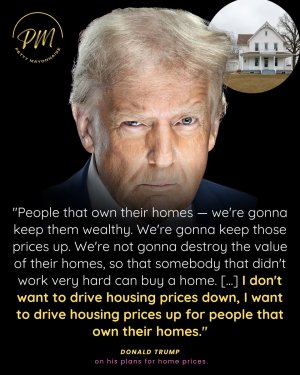
Trump says he wants to 'drive housing prices up' instead of lowering costs for people who 'didn't work very hard'
In a seeming reversal from previous promises about focusing on affordability, Trump said during a Jan. 29 Cabinet meeting, "I don't wanna drive housing prices down, I wanna drive housing prices up"NEED TO KNOW
- President Donald Trump said in a Jan. 29 Cabinet meeting that he wants to keep housing prices up
- Of current homeowners, Trump said, "We're not gonna destroy the value of their homes so that somebody who didn't work very hard can buy a home"
- The latest promise comes just weeks after a Truth Social post in which the president detailed a plan to "drive Mortgage Rates DOWN, monthly payments DOWN, and make the cost of owning a home more affordable"
"People that own their homes, we're gonna keep them wealthy. We're gonna keep those prices up," he said. "We're not gonna destroy the value of their homes so that somebody who didn't work very hard can buy a home."
Stepping back a bit, he added, "We're gonna make it easier to buy, we're gonna get interest rates down, but I wanna protect the people that, for the first time in their lives, feel good about themselves. They feel like, you know, that they're wealthy people."
Trump then circled back to his plan to increase housing costs: "There's so much talk about, 'Oh, we're gonna drive housing prices down.' I don't wanna drive housing prices down, I wanna drive housing prices up for people that own their homes, and they can be assured that's what's gonna happen."
The president's latest plan comes just weeks after he announced his intention to make housing more affordable, including backing an initiative to ban corporations from being able to purchase single-family homes.
link
Polds4OSU
Marshall
Walmart spox refutes Trump late night Social Media claim and isn’t shutting down 250 California stores
Trump twice shared a video titled “California Governor PANICS as Walmart Shuts Down 250+ Stores Across State.” The video, echoed by the text in one of the posts Trump shared, claimed that Walmart is preparing to shut down these stores because the retailer can’t afford California’s “$22” per hour minimum wage.But California’s statewide minimum wage is $16.90 per hour, not $22 – and Walmart told CNN on Thursday morning that it isn’t conducting a massive store closure in California for any reason.
“This isn’t accurate information,” a Walmart spokesperson said. “In fact, we actually just recently opened a new store in California.”

The oligarchs from Blackstone Real Estate Income Trust rejoice.Trump says he wants to 'drive housing prices up' instead of lowering costs for people who 'didn't work very hard'
In a seeming reversal from previous promises about focusing on affordability, Trump said during a Jan. 29 Cabinet meeting, "I don't wanna drive housing prices down, I wanna drive housing prices up"
NEED TO KNOW
In a seeming reversal from his recent promises about increasing affordability, President Donald Trump said during a Cabinet meeting on Thursday, Jan. 29, that his goal is to keep housing prices up to avoid inadvertently benefiting Americans who "didn't work very hard."
- President Donald Trump said in a Jan. 29 Cabinet meeting that he wants to keep housing prices up
- Of current homeowners, Trump said, "We're not gonna destroy the value of their homes so that somebody who didn't work very hard can buy a home"
- The latest promise comes just weeks after a Truth Social post in which the president detailed a plan to "drive Mortgage Rates DOWN, monthly payments DOWN, and make the cost of owning a home more affordable"
"People that own their homes, we're gonna keep them wealthy. We're gonna keep those prices up," he said. "We're not gonna destroy the value of their homes so that somebody who didn't work very hard can buy a home."
Stepping back a bit, he added, "We're gonna make it easier to buy, we're gonna get interest rates down, but I wanna protect the people that, for the first time in their lives, feel good about themselves. They feel like, you know, that they're wealthy people."
Trump then circled back to his plan to increase housing costs: "There's so much talk about, 'Oh, we're gonna drive housing prices down.' I don't wanna drive housing prices down, I wanna drive housing prices up for people that own their homes, and they can be assured that's what's gonna happen."
The president's latest plan comes just weeks after he announced his intention to make housing more affordable, including backing an initiative to ban corporations from being able to purchase single-family homes.
link


So how can this not be a conflict of interest? A private citizen sues the IRS. He also happens to be the president. The president directs the IRS to settle for say 2 billion. Who pays? The taxpayers that's who.

Samsung News
www.samsung-news.com
So how can this not be a conflict of interest? A private citizen sues the IRS. He also happens to be the president. The president directs the IRS to settle for say 2 billion. Who pays? The taxpayers that's who.
Samsung News
www.samsung-news.com
It’s theft is what it is.
This is some Marcos era Philippine looting of the government coffers level kleptocracy.

One day. Just one damn day without something idiotic. Just one damn day.It’s theft is what it is.
This is some Marcos era Philippine looting of the government coffers level kleptocracy.
Polds4OSU
Marshall
Trump sues the IRS and Treasury Department for $10 billion
President Donald Trump is suing the Internal Revenue Service and Treasury Department for $10 billion, alleging that they failed to prevent a former IRS employee from improperly disclosing his tax returns, and those of his sons and his company, to news outlets.The lawsuit, filed Thursday at a federal courthouse in Miami, says Trump is suing in his personal capacity, not as president. The other plaintiffs include two of Trump’s sons — Donald Trump Jr. and Eric Trump — and the Trump Organization.

"Defendants have caused Plaintiffs reputational and financial harm, public embarrassment, unfairly tarnished their business reputations, portrayed them in a false light, and negatively affected President Trump, and the other Plaintiffs’ public standing," the complaint said.
The Treasury and IRS did not immediately respond to requests for comment Thursday night.
A former IRS contractor, Charles Littlejohn, was sentenced to 5 years in prison in 2024 after he pleaded guilty the year before to leaking Trump’s tax records to The New York Times. The Times in 2020 published exclusive reporting that showed Trump had paid only $750 in federal income taxes in 2016 and 2017.
Everyone still remembers that every time he announces a NEW Tariff that AMERICAN's prices go up because WE PAY them right.
Trump declares "threat" from Cuba, announces new tariff plan
link
Aw crap. Someone told him about the Cuban missile crisis didn't they?
Polds4OSU
Marshall
Obama signed a Netflix deal several years after his presidency....
Q: Would do you say to those that are critical of the fact that Amazon paid $40 million to acquire the rights for this movie?
TRUMP: Well, I think they'd have to go and ask President Obama, who got paid a lot of money and hasn't done anything
 www.threads.com
Q: Would do you say to those that are critical of the fact that Amazon paid $40 million to acquire the rights for this movie?
TRUMP: Well, I think they'd have to go and ask President Obama, who got paid a lot of money and hasn't done anything
Aaron Rupar (@aaron.rupar) on Threads
Q: Would do you say to those that are critical of the fact that Amazon paid $40 million to acquire the rights for this movie? TRUMP: Well, I think they'd have to go and ask President Obama, who got paid a lot of money and hasn't done anything
www.threads.com
Similar threads

- Replies
- 0
- Views
- 123


- Replies
- 3
- Views
- 214
- Replies
- 48
- Views
- 2K