

You are using an out of date browser. It may not display this or other websites correctly.
You should upgrade or use an alternative browser.
You should upgrade or use an alternative browser.
Trump 47
- Thread starter PF5
- Start date
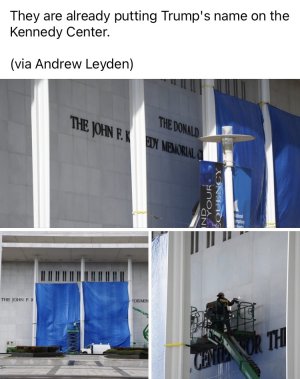

first the distasteful 'Presidential Walk of Fame', now the disgusting renaming of the John F. Kennedy Memorial Center for the Performing Arts...they have already changed the name on the website!!!
How long are they going to enable this weak, fragile POS?!
You know that's coming down about 2 seconds after he kicks the bucket.
Stillwater Townie
Sheriff
I don't know. It's too frightening to imagine what Trump will have to say or do before enough Republicans will be willing to impeach him.first the distasteful 'Presidential Walk of Fame', now the disgusting renaming of the John F. Kennedy Memorial Center for the Performing Arts...they have already changed the name on the website!!!
How long are they going to enable this weak, fragile POS?!

Polds4OSU
Marshall
They already working on the buildingfirst the distasteful 'Presidential Walk of Fame', now the disgusting renaming of the John F. Kennedy Memorial Center for the Performing Arts...they have already changed the name on the website!!!
How long are they going to enable this weak, fragile POS?!
Breaking News: Workers began adding President Trump’s name to the Kennedy Center, despite no action by Congress to legally rename it. This sparked outrage among the Kennedy family, since it was built to be a living memorial to the 35th president.

The New York Times (@nytimes) on Threads
Breaking News: Workers began adding President Trump’s name to the Kennedy Center, despite no action by Congress to legally rename it. This sparked outrage among the Kennedy family, since it was built to be a living memorial to the 35th president.
 www.threads.com


You remember that time in my brother’s living room in 2016…first the distasteful 'Presidential Walk of Fame', now the disgusting renaming of the John F. Kennedy Memorial Center for the Performing Arts...they have already changed the name on the website!!!
How long are they going to enable this weak, fragile POS?!
Sometimes I really, really hate being right.
They already working on the building
Breaking News: Workers began adding President Trump’s name to the Kennedy Center, despite no action by Congress to legally rename it. This sparked outrage among the Kennedy family, since it was built to be a living memorial to the 35th president.
The New York Times (@nytimes) on Threads
Breaking News: Workers began adding President Trump’s name to the Kennedy Center, despite no action by Congress to legally rename it. This sparked outrage among the Kennedy family, since it was built to be a living memorial to the 35th president.
View attachment 16735
Betcha I know one Kennedy who is cool with it, or at least claims to be.

PF5
Sheriff
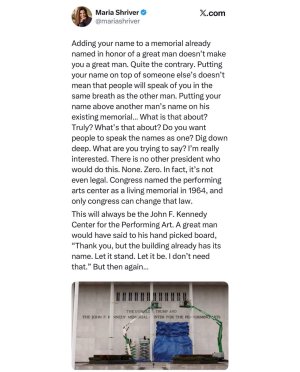
By an act of Congress — Public Law 88-260 signed into law by President Lyndon B. Johnson — it was originally planned to be called The National Cultural Center. But in January of 1964, it officially became the John F. Kennedy Center for the Performing Arts.
On January 23, 1964, President Johnson said, “All those who worked in this cause can now know that they are not only honoring the memory of a very great man, but they are enriching our whole American life.”
President Kennedy was not an artist. He was a champion of the arts. “If art is to nourish the roots of our culture, society must set the artist free to follow his vision wherever it takes him,” he said in 1961. “We must never forget that art is not a form of propaganda; it is a form of truth.”
He recognized that if the United States was to continue to grow and flourish, it would have to continue to develop its culture, declaring, “To further the appreciation of culture among all the people. To increase respect for the creative individual, to widen participation by all the processes and fulfillments of art — this is one of the fascinating challenges of these days.”
His time in office was all too brief. But in those 35 months, President Kennedy brought us safely through the Cuban Missile Crisis. He began the political work that led to the passage sweeping civil rights legislation. And he set the goal that pointed us toward the moon.
But perhaps his greatest achievement was to be a visionary leader who understood the value of supporting the visions of others; that enriching and supporting the arts was the means to make our nation into the best version of herself. With his eyes always on the future, he said in 1961, “I look forward to an America which will not be afraid of grace and beauty.”
On January 23, 1964, President Johnson said, “All those who worked in this cause can now know that they are not only honoring the memory of a very great man, but they are enriching our whole American life.”
President Kennedy was not an artist. He was a champion of the arts. “If art is to nourish the roots of our culture, society must set the artist free to follow his vision wherever it takes him,” he said in 1961. “We must never forget that art is not a form of propaganda; it is a form of truth.”
He recognized that if the United States was to continue to grow and flourish, it would have to continue to develop its culture, declaring, “To further the appreciation of culture among all the people. To increase respect for the creative individual, to widen participation by all the processes and fulfillments of art — this is one of the fascinating challenges of these days.”
His time in office was all too brief. But in those 35 months, President Kennedy brought us safely through the Cuban Missile Crisis. He began the political work that led to the passage sweeping civil rights legislation. And he set the goal that pointed us toward the moon.
But perhaps his greatest achievement was to be a visionary leader who understood the value of supporting the visions of others; that enriching and supporting the arts was the means to make our nation into the best version of herself. With his eyes always on the future, he said in 1961, “I look forward to an America which will not be afraid of grace and beauty.”


Polds4OSU
Marshall
Trump at rally Friday night bragged About Suing the Government and Declared, ‘I Hereby Give Myself $1 Billion.’ He was not joking-he was testing out how his supporters would react if he gave himself $1 billion of our tax dollars. They cheered. Expect him to do this. https://www.mediaite.com/media/tv/t...-and-declares-i-hereby-give-myself-1-billion/
Polds4OSU
Marshall
Never forget Pam Bondi and Kash Patel used our taxpayer dollars to have THOUSANDS of FBI agents do all the redacting you’re seeing currently.
Great use of our money…it’s up there with endless golf, underground bunkers, trips to the Super Bowl/UFC/NASCAR, placards that are inappropriate, banners of his ugly-ass face, trips for the VP and his family, Kristi Noem’s private jets, jet rides for Kash Patel’s girlfriend, etc.
 www.threads.com
Great use of our money…it’s up there with endless golf, underground bunkers, trips to the Super Bowl/UFC/NASCAR, placards that are inappropriate, banners of his ugly-ass face, trips for the VP and his family, Kristi Noem’s private jets, jet rides for Kash Patel’s girlfriend, etc.
BRANDON FRANKEL (@brandontour) on Threads
Never forget Pam Bondi and Kash Patel used our taxpayer dollars to have THOUSANDS of FBI agents do all the redacting you’re seeing currently. Great use of our money…it’s up there with endless golf, underground bunkers, trips to the Super Bowl/UFC/NASCAR, placards that are inappropriate...
www.threads.com
Polds4OSU
Marshall
Ben Shapiro calls Kash Patel, Dan Bongino, Pam Bondi and Donald Trump "good people" and says that if Tucker Carlson wants to know the truth about the Epstein Files, he can "just call JD Vance on the phone."
 www.threads.com
Craig R. Brittain (@brittainforsenate) on Threads
Ben Shapiro calls Kash Patel, Dan Bongino, Pam Bondi and Donald Trump "good people" and says that if Tucker Carlson wants to know the truth about the Epstein Files, he can "just call JD Vance on the phone."
www.threads.com
Stillwater Townie
Sheriff
Hell, he might as well make it for $1 trillion.Trump at rally Friday night bragged About Suing the Government and Declared, ‘I Hereby Give Myself $1 Billion.’ He was not joking-he was testing out how his supporters would react if he gave himself $1 billion of our tax dollars. They cheered. Expect him to do this. https://www.mediaite.com/media/tv/t...-and-declares-i-hereby-give-myself-1-billion/

Sheep being led to the slaughter by the pied piper of lawless corruption and antiAmerican activities.Hell, he might as well make it for $1 trillion.
Well, if it is fronto-temporal cognitive issues we might be getting ready for a wild ride. In 4 years he can get much worse. And, the nation has for whatever reason decided to allow this one man to say things that no president in our history would be allowed to say. How far can it go?
At this point he has called people very rude names, made fun of their bodies, and called for the death of sitting congressmen without even a whiff of a call for censure.
If two years from now he calls a reporter a fat c#^t or says "I'd shoot that democrat myself if nobody else does" are we going to just accept it? Because that level of dialogue could be where this is heading.
Polds4OSU
Marshall
Trade war with Canada has contributed to a significant decline in U.S. liquor sales
Jim Beam shutting down bourbon production at Kentucky distillery for a year as Trump’s trade wars hit sales | The Independent https://share.google/IH4mXCuAPh4Tt8uj9
Jim Beam shutting down bourbon production at Kentucky distillery for a year as Trump’s trade wars hit sales | The Independent https://share.google/IH4mXCuAPh4Tt8uj9
Similar threads

- Replies
- 0
- Views
- 123


- Replies
- 3
- Views
- 212
- Replies
- 48
- Views
- 2K