Political and Economic Theory Thread

Fiscal responsibility is about sustainability over time, not necessarily austerity. Fiscal responsibility means spending discipline (something our nation lacks) and efficiency rather than austerity. In addition to spending wisely, it’s about supporting economic conditions that strengthen the overall fiscal picture.

Although significantly reducing the $39T debt is laudable, the goal should be strongly curtailing or eliminating future deficits. We cannot continue the current growth of interest. Respectfully, printing away debt is not an answer.
Exactly. We should reduce the budget deficit by bringing government revenues closer to expenditures. By reducing the amount of borrowing required, we can demonstrate fiscal discipline to creditors and credit rating agencies and make borrowing easier and cheaper as a result.
 
Exactly. We should reduce the budget deficit by bringing government revenues closer to expenditures. By reducing the amount of borrowing required, we can demonstrate fiscal discipline to creditors and credit rating agencies and make borrowing easier and cheaper as a result.
Dream on. We're at the point now where the U. S. Treasury has to borrow money to pay interest on the debt, a bad sign of things to come. As U. S. Treasury bonds become more unappealing to buy to foreign countries; the interest rate will have to keep rising until we're plunged into a depression with inflation. Interest rate and unemployment rate could both be at around 20%.

Dream on also with auditing the Dept. of Defense or War to uncover million$ of waste. I don't think Musk was allowed in the Pentagon.
 
Fiscal responsibility is about sustainability over time, not necessarily austerity. Fiscal responsibility means spending discipline (something our nation lacks) and efficiency rather than austerity.

If fiscal responsibility means spending discipline, and austerity means "policies that aim to reduce government budget deficits through spending cuts, tax increases, or a combination of both" are you differentiating by saying that you don't want the tax increases that can be part of austerity? Do you disagree with that definition of austerity? Because, I can't see how it is any different unless "spending discipline" does not mean "spending cuts."
 
If fiscal responsibility means spending discipline, and austerity means "policies that aim to reduce government budget deficits through spending cuts, tax increases, or a combination of both" are you differentiating by saying that you don't want the tax increases that can be part of austerity? Do you disagree with that definition of austerity? Because, I can't see how it is any different unless "spending discipline" does not mean "spending cuts."
Fiscal responsibility simply means managing government finances in a sustainable way over time (keeping debt manageable relative to economic growth). Yes, spending cuts and revenue increases (closing loopholes) are a part of this. But we also need policies that grow the economy (which increase tax revenues naturally). Fiscal responsibility is about managing debt relative to economic growth, not just cutting spending. Policies that support growth can improve government finances more effectively than austerity, especially during weaker economic periods. Not arguing that austerity could be a tool, but certainly not a requirement.

* Yes, I am certainly against tax increases that just increase the tax burden on the small population that already overwhelming fund the government (unless it is eliminating tax loopholes like carried interest)
* Suggesting we can print away debt is not a sustainable idea. Printing money doesn't make debt disappear, it just changes how it is paid. It further weakens the currency, likely drives additional inflation, and creates broader economic instability.
* Having a $1T surplus would be phenomenal, but that does not need to be the goal -- we need to stop spiraling debt growth
 
Fiscal responsibility simply means managing government finances in a sustainable way over time (keeping debt manageable relative to economic growth). Yes, spending cuts and revenue increases (closing loopholes) are a part of this. But we also need policies that grow the economy (which increase tax revenues naturally). Fiscal responsibility is about managing debt relative to economic growth, not just cutting spending. Policies that support growth can improve government finances more effectively than austerity, especially during weaker economic periods. Not arguing that austerity could be a tool, but certainly not a requirement.

* Yes, I am certainly against tax increases that just increase the tax burden on the small population that already overwhelming fund the government (unless it is eliminating tax loopholes like carried interest)
* Suggesting we can print away debt is not a sustainable idea. Printing money doesn't make debt disappear, it just changes how it is paid. It further weakens the currency, likely drives additional inflation, and creates broader economic instability.
* Having a $1T surplus would be phenomenal, but that does not need to be the goal -- we need to stop spiraling debt growth
The differentiation you are making then is that austerity means the cuts are not sustainable and are done with no consideration of growth?

TBH, I have always considered spending cuts/responsibility and austerity to mean essentially the same thing. Sort of like pro-life and anti-abortion or trader and speculator. Basically the same but the nuance is in if you want the thing to sound good or not.
 
Dream on. We're at the point now where the U. S. Treasury has to borrow money to pay interest on the debt, a bad sign of things to come. As U. S. Treasury bonds become more unappealing to buy to foreign countries; the interest rate will have to keep rising until we're plunged into a depression with inflation. Interest rate and unemployment rate could both be at around 20%.

Dream on also with auditing the Dept. of Defense or War to uncover million$ of waste. I don't think Musk was allowed in the Pentagon.
I mean, we can just say, naaaah on the debt and declare war against anyone who throws a fit about it.

What kind of dumbass would lend us money?
 
If fiscal responsibility means spending discipline, and austerity means "policies that aim to reduce government budget deficits through spending cuts, tax increases, or a combination of both" are you differentiating by saying that you don't want the tax increases that can be part of austerity? Do you disagree with that definition of austerity? Because, I can't see how it is any different unless "spending discipline" does not mean "spending cuts."
You already know the answer to this question I think.

Among other things, one of the effects austerity measures have is a transfer of wealth from the poor to the rich. This would massively deepen the ongoing issues that we have with wealth disparity, not improve them.

It is an interesting phenomenon when people at the very top end of the net worth pyramid are getting all of their needs met and much much more, are still not satisfied with that and want an even larger portion of the pie. They want even less of an investment in their community.
 
You already know the answer to this question I think.

Among other things, one of the effects austerity measures have is a transfer of wealth from the poor to the rich. This would massively deepen the ongoing issues that we have with wealth disparity, not improve them.

It is an interesting phenomenon when people at the very top end of the net worth pyramid are getting all of their needs met and much much more, are still not satisfied with that and want an even larger portion of the pie. They want even less of an investment in their community.

I understand your concern about inequality, and I agree that policy should avoid disproportionately impact any income group. That said, I think it’s a bit misleading to describe austerity as a transfer of wealth from the poor to the rich. A transfer implies money is actually moving from one group to another, and that’s not really what’s happening when government spending is reduced—benefits or services may be scaled back, but that’s different from wealth being shifted upward.


As I stated previously, austerity is just one approach to fiscal responsibility, and usually refers to more aggressive or rapid spending cuts. Fiscal responsibility itself is really about sustainability—managing debt relative to economic growth. That can include spending discipline, but also policies that support growth and improve efficiency.


My concern is that framing this as “cuts = helping the rich” oversimplifies a much more complex set of tradeoffs. The real question is how to manage government finances in a way that supports long-term growth while being thoughtful about how different groups are affected.

Final thought to your last sentence: Continually adding to a humongous debt is not investing in our community. In it a short-sided approach that is stealing from future generations.
 
If fiscal responsibility means spending discipline, and austerity means "policies that aim to reduce government budget deficits through spending cuts, tax increases, or a combination of both" are you differentiating by saying that you don't want the tax increases that can be part of austerity? Do you disagree with that definition of austerity? Because, I can't see how it is any different unless "spending discipline" does not mean "spending cuts."
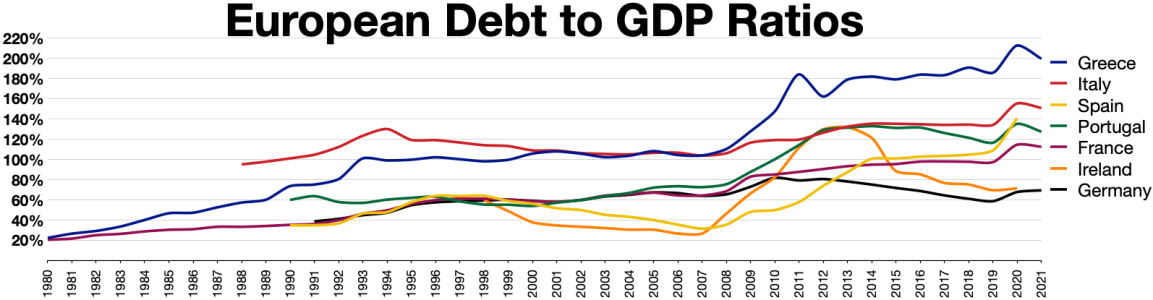
The problem with “austerity” is that it is always tax increases now for budget cuts over 10 years, which may or may not actually materialize. And “budget cuts” means “decrease in the rate of growth”. We know from our recent experience with inflation that “we reduced inflation to 2.5%” means that prices are still rising, just at a slower pace. When you start out at a point where people can’t afford groceries or gas making them able to afford less a little more slowly is no relief. Similarly, when the government is already insolvent making it even more insolvent but a little more slowly won’t fix anything. “Austerity” doesn’t work because it doesn’t come close to fiscal responsibility.

I’ve already stated my philosophical reasons for opposing new or increases in government social programs, which was ignored. Utilitarianism demands that programs that don’t produce the intended good be ended or modified, because it is consequentialist. The outcome is the only thing that matters in utilitarianism. But we can’t modify or eliminate ineffective social programs because they are created and sustained politically. You get ads throwing grandma off the cliff.

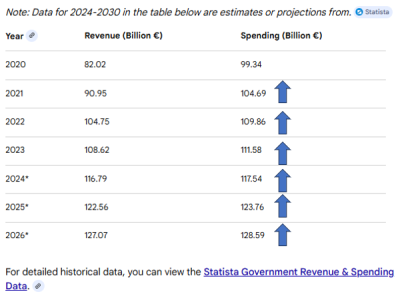
Greece government spending by year. Austerity doesn't work because it never actually happens.
1775260667446.png

Since Greece "austerity" started in 2010...
1775260807389.png

At some point you actually have to stop spending.
 
Last edited:
Dream on. We're at the point now where the U. S. Treasury has to borrow money to pay interest on the debt, a bad sign of things to come. As U. S. Treasury bonds become more unappealing to buy to foreign countries; the interest rate will have to keep rising until we're plunged into a depression with inflation. Interest rate and unemployment rate could both be at around 20%.

Dream on also with auditing the Dept. of Defense or War to uncover million$ of waste. I don't think Musk was allowed in the Pentagon.
It was actually mostly a cut and paste from the definition of austerity to see who agreed with it.
 
It was actually mostly a cut and paste from the definition of austerity to see who agreed with it.

eyes lemur GIF
 
Things got busy for a bit there, so this took longer than I expected. I also want to apologize in advance, this is going to be long. First, lets define some terms:

Capitalism

Capitalism is the system where there is private ownership of the means of production. Private meaning individuals, groups, or shareholders owning things. A 21st century way of defining this is that individual(s), groups or shareholders own the businesses and the enterprises. This generally means that the state is not the predominant owner nor is there collective, public, employee or worker ownership of businesses and enterprises at a significant scale.

This system rewards those who already have means or were born into means much more than those who do not. It also means that those who own the means of production have a distinct advantage over those who do not and have to work for a wage, or do not have capital to start their own business or enterprise. This leads to increasing wealth stratification over time and emphasizes growth over everything else, including human rights, workers rights, the environment, democracy/representative forms of government and looks to capture them all for its own purposes.

I don't think that capitalism is all bad and has some distinct strengths. My interest is finding something that keeps the majority of those strengths while addressing the many weaknesses, especially the system breaking ones that it has. Historically, without guardrails, it tends to destroy itself and work in opposition to the free market in relatively short order. It happened in the early 20th century leading world war twice before guardrails were created and then it took about 40 years in the strongest economy in world history to destroy those guardrails and the foundations that made it successful in the first place. In some places and historical examples, it didn't even take that long.

That being said, I do think capitalism is a net negative at this point in human history due to the inequity, anti-democratic, human rights and surveillance state it has created for profit. It also has shown that it is unable to tackle the rising climate change risks. This is not to mention the flexible labor pool that AI is designed to be, permanently reducing all worker's bargaining power for a higher (in many cases livable) wage. This system is on deaths doorstep. What replaces it?


Liberalism

This is the ideology that most of us are familiar with, so this one is going to be more brief. It has been the predominant power structure in the west, starting with the American and French revolutions and methodically spreading across Europe over the ensuing 150 years. Based on enlightenment ideals about human rights and particularly on negative rights, it has been the predominant ideology in American politics, both for the Democrats and the Republican parties, at least until very recently.

Married to capitalism, its contradictions between lofty goals of human rights and equality are juxtaposed with capitalism, which operates in an authoritarian manner and works to undercut those rights over time. This is especially apparent with the neoliberal economic order, which reinforced both those founding ideals with its contradictions and got us into the mess we have today.


Socialism

Socialism comes down to ownership. Unlike the predominant narrative in the US, it is not when the government does stuff. The definition of socialism is simply "worker ownership of the means of production". In 21st century terms, it is who owns the businesses and who owns the enterprises.

Historically, the predominant understanding ended up being dictated by the USSR after the 1917 Russian revolution, which was state ownership of the means of production, with people voting via democratic centralism on what should be done. So in theory there was "worker ownership" but only via the state. In actuality, the reality is that only lasted a few months before a vanguard of party members (bolsheviks) became the only folks voting on it after the they lost an election to the social revolutionaries, a party that wanted to implement a type of social democracy and instead dissolved the duma (parliament). This didn't stop the USSR and many of the other communist countries to continue to define it that way however, despite the fact that it practically never worked that way and was more or less just controlled by the party.

Please note: state ownership of most industries is not what I am advocating for. I think history has shown this system is inferior and rife with human rights and civil rights abuses and stifled creativity and growth. For industries where the profit motive go against human wellbeing like in insurance, healthcare and prisons, those should be ran by the state or non-profits. Also, note that the "free market" did not go away in these historical examples, as by many prose accounts there was a very robust black market and a high degree of bribery and corruption to meet market need that the system could not. That culture continues today in the countries that composed the former USSR.


Democratic Socialism

What makes democratic socialism different than most historical examples of socialism is that it embraces democratic processes while setting up more decentralized & horizontal power structures. It is based on a continuation of enlightenment values, where rights are not just seen as negative rights (someone cannot prevent you from doing X), but also as positive rights (you are empowered to have Y). The idea would be to create a society that would most likely result in human flourishing for the most people due to the basic needs being universally met.

Instead of the economy being centrally planned and everything being controlled by a single party or complete control by the government, the goal of the system is to shift the balance of power in the marketplace to workers and away from capital owners. The goal of a new system is to take the things that capitalism is good at and combine it with an approach that allays its shortcomings and provides a more equitable approach to economics.

It also is the realization that some sectors should not have a profit motive, specifically, healthcare and insurance are two sectors where there is motivation to NOT cover paying people, so decommodifying would be a wise move.

A typical democratic socialist platform would look something like this:

  • Medicare 4 all/universal healthcare
  • Expansion of Labor rights
  • More progressive taxation
  • Social housing (check out the Vienna model for more info)
  • "Free" college (covered by taxation)
  • Universal childcare
  • Green New Deal or a similar environmentally conscious energy policy
  • Extensive safety nets
  • Collective ownership of businesses (employee/worker owned for most sectors in medium to large companies)
  • Creation of a public bank
This isn't exhaustive and you will likely see/hear other platform issues depending on the person and their own persuasion.


Economic Democracy/Market Socialism

An economic system that keeps market principles and commodification intact for the majority of the sectors of the economy, but reduces private ownership of the means of production in favor of worker owned enterprises. The idea behind this is that command economies cannot address the knowledge question (Hayek) adequately and they run into issues with supply & demand. Whereas capitalism is able to grow quickly, but is unstable, and tends to become more and more oppressive to the working class over time.

Market socialism has an economy composed of primarily worker owned business & enterprises (co-ops) and publicly owned business. Publicly owned entities are entities that are owned by the public of a region, but are independent from the state.

Partial ownership, however small, and shared profits from the operation of the business mean that as the business grows, the vast majority of wealth does not just go to one person or several people. It goes to the workers that made that growth possible also. This is important as it would prevent the primary cause of our wealth stratification which is vastly unequal rewards for success in the workplace.

One worker, one vote for major company decisions. Non-worker shareholders of the business are unable to vote, but can hold shares of the company. Leadership positions at companies would be elected instead of selected and this means that company leadership is chosen from and accountable to the workers themselves, not a board of directors or to private equity. This also has helped reduce the wage discrepancy between workers and leadership to a more reasonable level.

Co-ops have higher employee satisfaction, higher wages than non-worker owned entities in the same industry, far more benefits, better work/life balance and much lower levels of wealth stratification. They also are just as competitive than typical capitalist businesses, if not more so. Their biggest hurdle is funding for creation. Most people who start a business want to keep the majority of wealth it generates for themselves and once a business is established, it is hard to make it worker owned, although programs like an Employee Stock Ownership Plan can lead to a successful employee owned business.

We really only have two historical examples of any country getting close to this system, one is Sweden under the Meidner Plan (specifically the wage-earner proposal of the plan) and the other is Yugoslavia in the 1980s. Both ended up being unsuccessful, but for different reasons. In Sweden, the wage-earner proposal essentially bought out a portion of each large company on behalf of the workers a year at a time, and while it made some headway, capitalists were able to block the full implementation of the program and eventually reversed it. In Yugoslavia, a similar system grew out of the old Soviet block they still had a lot of central planning and massive amounts of foreign debt, compounded by massive subsidies to companies operating at a loss (good reddit post summarizing a paper in an academic journal). The latter was particularly egregious, as the point of markets is that some enterprises do well, make a profit and grow, while others don't do well and fail. With robust safety nets, this will make a harder transition time for an employee at a failed enterprise easier.

There are two additional policies to help facilitate and economic system transition, that would be creating a bank of the commons to have an additional outlet for co-op creation and also an altered corporate tax structure that would provide lower taxes to co-ops and a higher tax on standard corporations.

If you are interested in reading more about how such a system would function from someone a lot smarter than me and is far more comprehensive, I recommend the book After Capitalism by David Schweikart. He goes into great detail on how banking, lending and entrepreneurship would work, business structures, etc.

This would be my preferred economic system based on the information we have at this time.

What democratic socialism isn't:

Social Democracy


Social democracy is simply capitalism with robust safety nets. It is not socialism as ownership structure does not change and private ownership dominates the economy. Ironically, this is what most Americans picture when they think of socialism. There are many examples of successful social democracies: the Nordic countries are the most famous, but most western European countries and even the US from the 1930s-1970s also fit the bill, although our safety nets were not as robust as the European countries. The main issue they have had is that none of them have been able to stave off the capitalists in the long run and the safety nets have ended up being weakened and democratic processes becoming monetized over time. This has even happened in the Nordic countries, they just had a better starting point than us. The issue is they don't address the problem of ownership, so capital finds ways to weaken these safety nets over time and the system collapses, leading to authoritarianism and/or fascism.


State Capitalism

China is not currently a socialist country. They were from a period of time after Mao rose to power, but after Deng's reforms in the 80s, they embraced capitalism with a government stake in many of their larger businesses, but allowed private ownership. Now, over 96% of their business entities are privately owned (Source: http://english.scio.gov.cn/pressroom/2024-06/14/content_117253322.htm). They do have some have aspects of central planning mixed in with their market economy, but that percentage of private businesses tells the tale. What confuses a lot of people that mistakenly call them socialist is due to the marxist-leninist vanguard party (CCP) that runs the country, but that describes an authoritarian governmental structure, not alterations in the ownership of the means of production.

While the whole populace is part of the All-China Federation of Trade Unions, this is a symbolic entity. They are not adversarial in the least (they can only take action and strike if the party gives them the green light) and it is illegal to form your own union, or to participate in wildcat strikes. China is also starting to deal with the massive wealth stratification that a capitalist system causes over time and is catching up to the US in that regard.


Communism

A stateless, moneyless, classless society with communal ownership of the means of production. It sounds great, but I don't think humanity is anywhere close to evolved enough for such a system. Sorry Star Trek fans, fully automated, luxury space communism is probably at least a couple centuries away. Historically, most of the countries that claimed to be communist were nowhere close to this goal and have historically had some of the worst human rights abuses and highest body counts in history. Why? In my opinion it is due to the extreme concentration of power this approach takes.


Conclusion

In short, we are seeing similar material conditions and contradictions in our capitalist systems that gave rise to socialist movements in the late 1800s and early 1900s. Will we choose a different path that avoids the pitfalls that lie on both sides of the road? Only time (and us!) will tell. What are your thoughts about these ideas and any other political/economic theories you find that resonate with you?

Honestly, I did not get around to writing a response the other day when I planned to do so and since then have had life events that impact my response.

You did a nice job laying out the options with your feelings shining through a bit as expected.

Ideally, I'd love to see market capitalism work perfectly. The problem is the money seems to tilt toward capital and with money comes power and with power comes favoritism. If it completely worked, there would be no reason to have to break up monopolies because the balance of power between labor/capital and the market forces would prevent the monopoly from forming, or at least from lasting. But, that has not been the case in history.
Social Democracy is the most active in trying to prevent this power shift therefore is my favorite, but I accept it is also flawed.

There are three issues I see with basically all of the others except state capitalism which is a non-starter.
1. There is no evidence they can work. Unlike capitalism which has existed in some forms now going on centuries, the others are all basically failed experiments or unproven theories. The Law of Unintended Consequences reigns in those areas.
2. They can have the same power imbalances that are the flaw of capitalism. If the workers elect a "Trump" to run the company. Or, the government pushes worker rights too far. Or, any number of potential issues similar problems could ensue.
3. The same issue that is the problem with capitalism, the concentration of wealth and power in the few, is also its magic. I'm retiring from my primary job this month. I found out this week that I will no longer have my other job that that I had planned to continue. My options are one, go back to work for someone in an ER which I will not do. Two, go ahead and fully retire and have a little less luxurious retirement than I had planned. Or three, I have had some business ideas that I had considered and I could go ahead and start.

But, the business will take capital. If I do that, I'm looking at sinking 10-20% of my retirement nest egg in to get it off the ground. Maybe higher the way prices have been. Let's say the business does amazing and we end up with 20 employees. Should I have a 1/20 vote on the business given I created it, risked myself and put all the work in to make it so that others could just show up and start working? If it fails, are any of the other workers going to chip in to make me whole on my investment?

If we were in an economy where that was the case, no way would I consider that. Taking the risk to start a business without the potential reward to myself and my family just isn't worth it and the other options would win. Even if there was some sort of public funding (which would also give power to those running the funding) and all I risked was the significant time, stress, and effort, I don't know if I would do it at this point in my life.
 
Back
Top