ICE

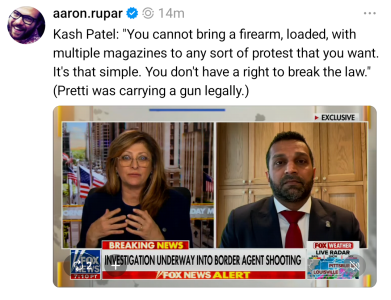
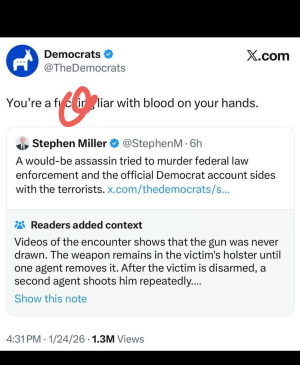
Because there were several guys pointing their weapons and firing their weapons. My count was 14 shots fired. I haven’t counted how many guns were pointed, but it was probably around 4 or 5 agents. I’ll let you take over the math.
What were the firearms and their magazine capacity? Then I'll do the math for you.
 
WELKER: Part of the outrage people are expressing is they feel like you're asking them to believe something they don't see. Is that was the administration is asking?

BLANCHE: You shouldn't try to gaslight the administration about what happened. That was not a peaceful protest.

 
Senator Chris Murphy: “It should freak the American public out that the Trump administration lies this easily, will lie to your face when you can see the evidence for yourself.”

 
Van Hollen: "They really think the American people are stupid. I mean, we can all see the video. We saw the video with Renee Good. We saw the video with Alex Pretti. The real domestic terrorists are in the White House right now."

 
Republicans are going to get wiped out in the midterms if this continues. You can feel some of them starting to squirm.

Everyone - PLEASE write to your rep and senators. State and Federal. Let them know not only where your vote is going, let them know where your money is going. If you want a course change, the pressure is going to have to come from the bottom up.
 
Well, @Rob B. , I noticed you got really quiet. To be clear, you don’t owe anyone a 24/7 stream of consciousness, but would love to hear your take of the situation.

I’d also like to point out that this is the federal government that has killed another citizen. Not the local police, but federal officers that are answerable to one man. I just can’t believe we’re at a point where officials that only answer to the president have now killed two American citizens and Trump supporters seem ok with this. Where do you stand? Are you ready to say this is wrong and changes need to be made? I asked you after the last time this happened - you said you’d like to see changes but how far are you willing to go to protect American citizens from their government? Even the citizens you may not agree with.

Police kill citizens, but they are local officers. This is the FEDERAL government. The federal government is now killing US citizens on US streets. The government says he was armed and means to do harm, but we had video proving the opposite. Are you going to believe we have always been at war with Eastasia?

I ask you again - what’s it going to take for Trump to lose your support? To say this is wrong and something has to be done. I think you want what is best for the country. Use your eyes and heart and head here. Use your soul. You know this is wrong and we can’t let the federal government continue to do this.
Since you asked in a civil manner without the typical personal attacks. (Much appreciated BTW). Here is my take on the situation.


If you lean left, if you care deeply about civil rights, human dignity, abuse of power, and protecting vulnerable people, these questions are for you too. They are not an attack on compassion or empathy, and they are not a demand that you abandon your values. They are an invitation to slow the moment down and ask whether the way we act in the street actually aligns with the outcomes we say we want. Caring about people and thinking critically are not opposites. Wanting safer communities, fair laws, and humane treatment does not require chaos, escalation, or putting lives at risk. If the goal is justice, accountability, and fewer people harmed, then common sense, restraint, and clear thinking belong in the conversation just as much as passion does.

If I am protesting the arrest of people with criminal histories, do I fully understand what those histories are? Do I know the difference between a civil immigration violation and a violent or repeat criminal offense? Am I reacting to a headline, or to verified facts about the individual cases involved? Would I be willing to personally take responsibility for one of the people being arrested? Would I adopt one of these individuals into my home if the alternative were detention or deportation? Would I be willing to be legally responsible for their actions while their case is pending? Would I provide food, shelter, transportation, and daily supervision? Would I transport them back and forth to court dates or immigration hearings? Would I guarantee they appear in court if released into my care, and if they failed to appear, would I accept legal consequences for that failure? Would I allow them to sleep under my roof with my children in the house? Would I feel comfortable leaving them alone in my home? Would I trust them around my spouse, my kids, my neighbors, or my pets? Would I install locks, cameras, or safeguards, and if so, why would those be necessary? Would I accept financial liability if they caused harm or property damage? Would I still defend my position publicly if the person I sponsored reoffended? If I would not take one person into my own home, why do I expect society to absorb unlimited risk? Is compassion meaningful if it never requires personal sacrifice? Is it moral to demand outcomes I would not personally participate in?

What business is this of mine, right now, in this moment? Am I directly involved in what is happening, or am I inserting myself into something that does not concern me legally or practically? What do I believe will actually change because I am standing here today? Am I confusing feeling strongly with thinking clearly? If I walk away right now, does anything meaningful get worse, or do I just lose the feeling of being involved? What is my specific goal here? Is my goal emotional release, public visibility, moral signaling, or an actual policy outcome? Can I clearly explain what law I want changed and how that change would realistically occur? Do laws change because of street interference, or because of legislation, courts, elections, and sustained pressure? If my actions today succeed perfectly, what does success actually look like tomorrow morning? Am I assuming everyone else will stay calm while I act impulsively? Am I relying on someone else’s restraint to protect me from the consequences of my own choices? Do loud noises, crowds, and adrenaline usually improve judgment, or do they make mistakes more likely? If something goes wrong, am I prepared to accept responsibility for my role in it?

Why am I standing this close to armed professionals performing a job I do not control? Do I believe proximity increases my moral authority, or does it just increase risk? If a vehicle moves unexpectedly, if someone panics, if someone stumbles, what happens next? Is this moment worth someone getting hurt? Is it worth me getting hurt? What am I hoping the officers will do differently because I am here? Do I believe yelling, blocking, or interfering causes better outcomes, or just faster escalation? If I believe enforcement is wrong, am I creating evidence and records, or am I creating chaos, and which one actually helps courts, oversight, and accountability? If I care about people being arrested, have I supported legal aid, court navigation, or lawful advocacy? Have I spent time understanding the legal process I am trying to disrupt, or am I performing concern in public?

If I were writing the law myself, what would it actually say? How would it handle violent offenders, repeat offenders, and due process? What resources would it require, where would that money come from, and what unintended consequences would it create? Do I believe laws stop applying when enough people disagree with them, and if that were true, which laws would still exist tomorrow? Would I want that standard applied to issues I care about less? Have I ever called 911? Do I expect law enforcement to exist when I need help, and if so, how do I reconcile that with believing all enforcement is illegitimate? If I am not a citizen, do I believe street chaos improves my legal outcome, or would calm legal counsel and verified support help more than confrontation?

Am I here to save lives, or to feel righteous? If someone is injured today, will I still believe this was worth it? If nothing changes at all, will I admit this accomplished nothing? Am I thinking, or am I reacting? Am I acting out of principle, or out of anger? If I walk away, does that make me weak, or does it make me rational? What happens after today, after the crowd leaves, after the cameras are gone? What does my future look like if this escalates instead of resolves? Is common sense cowardice, or is it how people go home alive?

These questions are not meant to shame, silence, or score points. They exist to interrupt reflex and replace it with thought. Before stepping into the street, before escalating a moment that cannot be taken back, before assuming righteousness guarantees safety, it is worth sitting with these questions honestly. Not to prove anything to others, but to be clear with ourselves. Lives are not improved by confusion, noise, or impulse. They are improved by clarity, responsibility, and choices that reduce harm rather than multiply it. If thinking carefully keeps even one person from getting hurt, then asking the questions matters.

I don't believe it was necessary to have shot and killed Alex Pretti. I also don't believe it was necessary for him to show up as an armed protestor. I also wasn't at the scene and don't know the exact circumstances that led to his death. Neither was anyone else on this message board.

 
Last edited:
Facts are good. May we use analogies in conjunction with facts? Or is that discouraged here?
While extremely hypocritical and insanely ironic, I’m viewing this as the closest thing to a mia culpa we’ll see from you.

I will say that you arguing semantics—yes, literally the definition of that phrase—and then gaslighting folks in the midst of this situation pissed me off more than anything I’ve read in a long while.

Like I said before, I like you and—similar to Rob—appreciate you both sharing a differing perspective here. I don’t believe I’ve ever called you out like this. But this one pressed my buttons.
 
Last edited:
Since you asked in a civil manner without the typical personal attacks. (Much appreciated BTW). Here is my take on the situation.


If you lean left, if you care deeply about civil rights, human dignity, abuse of power, and protecting vulnerable people, these questions are for you too. They are not an attack on compassion or empathy, and they are not a demand that you abandon your values. They are an invitation to slow the moment down and ask whether the way we act in the street actually aligns with the outcomes we say we want. Caring about people and thinking critically are not opposites. Wanting safer communities, fair laws, and humane treatment does not require chaos, escalation, or putting lives at risk. If the goal is justice, accountability, and fewer people harmed, then common sense, restraint, and clear thinking belong in the conversation just as much as passion does.

If I am protesting the arrest of people with criminal histories, do I fully understand what those histories are? Do I know the difference between a civil immigration violation and a violent or repeat criminal offense? Am I reacting to a headline, or to verified facts about the individual cases involved? Would I be willing to personally take responsibility for one of the people being arrested? Would I adopt one of these individuals into my home if the alternative were detention or deportation? Would I be willing to be legally responsible for their actions while their case is pending? Would I provide food, shelter, transportation, and daily supervision? Would I transport them back and forth to court dates or immigration hearings? Would I guarantee they appear in court if released into my care, and if they failed to appear, would I accept legal consequences for that failure? Would I allow them to sleep under my roof with my children in the house? Would I feel comfortable leaving them alone in my home? Would I trust them around my spouse, my kids, my neighbors, or my pets? Would I install locks, cameras, or safeguards, and if so, why would those be necessary? Would I accept financial liability if they caused harm or property damage? Would I still defend my position publicly if the person I sponsored reoffended? If I would not take one person into my own home, why do I expect society to absorb unlimited risk? Is compassion meaningful if it never requires personal sacrifice? Is it moral to demand outcomes I would not personally participate in?

What business is this of mine, right now, in this moment? Am I directly involved in what is happening, or am I inserting myself into something that does not concern me legally or practically? What do I believe will actually change because I am standing here today? Am I confusing feeling strongly with thinking clearly? If I walk away right now, does anything meaningful get worse, or do I just lose the feeling of being involved? What is my specific goal here? Is my goal emotional release, public visibility, moral signaling, or an actual policy outcome? Can I clearly explain what law I want changed and how that change would realistically occur? Do laws change because of street interference, or because of legislation, courts, elections, and sustained pressure? If my actions today succeed perfectly, what does success actually look like tomorrow morning? Am I assuming everyone else will stay calm while I act impulsively? Am I relying on someone else’s restraint to protect me from the consequences of my own choices? Do loud noises, crowds, and adrenaline usually improve judgment, or do they make mistakes more likely? If something goes wrong, am I prepared to accept responsibility for my role in it?

Why am I standing this close to armed professionals performing a job I do not control? Do I believe proximity increases my moral authority, or does it just increase risk? If a vehicle moves unexpectedly, if someone panics, if someone stumbles, what happens next? Is this moment worth someone getting hurt? Is it worth me getting hurt? What am I hoping the officers will do differently because I am here? Do I believe yelling, blocking, or interfering causes better outcomes, or just faster escalation? If I believe enforcement is wrong, am I creating evidence and records, or am I creating chaos, and which one actually helps courts, oversight, and accountability? If I care about people being arrested, have I supported legal aid, court navigation, or lawful advocacy? Have I spent time understanding the legal process I am trying to disrupt, or am I performing concern in public?

If I were writing the law myself, what would it actually say? How would it handle violent offenders, repeat offenders, and due process? What resources would it require, where would that money come from, and what unintended consequences would it create? Do I believe laws stop applying when enough people disagree with them, and if that were true, which laws would still exist tomorrow? Would I want that standard applied to issues I care about less? Have I ever called 911? Do I expect law enforcement to exist when I need help, and if so, how do I reconcile that with believing all enforcement is illegitimate? If I am not a citizen, do I believe street chaos improves my legal outcome, or would calm legal counsel and verified support help more than confrontation?

Am I here to save lives, or to feel righteous? If someone is injured today, will I still believe this was worth it? If nothing changes at all, will I admit this accomplished nothing? Am I thinking, or am I reacting? Am I acting out of principle, or out of anger? If I walk away, does that make me weak, or does it make me rational? What happens after today, after the crowd leaves, after the cameras are gone? What does my future look like if this escalates instead of resolves? Is common sense cowardice, or is it how people go home alive?

These questions are not meant to shame, silence, or score points. They exist to interrupt reflex and replace it with thought. Before stepping into the street, before escalating a moment that cannot be taken back, before assuming righteousness guarantees safety, it is worth sitting with these questions honestly. Not to prove anything to others, but to be clear with ourselves. Lives are not improved by confusion, noise, or impulse. They are improved by clarity, responsibility, and choices that reduce harm rather than multiply it. If thinking carefully keeps even one person from getting hurt, then asking the questions matters.

I don't believe it was necessary to have shot and killed Alex Pretti. I also don't believe it was necessary for him to show up as an armed protestor. I also wasn't at the scene and don't know the exact circumstances that led to his death. Neither was anyone else on this message board.
Yapping Didnt Read GIF
 
Republicans are going to get wiped out in the midterms if this continues. You can feel some of them starting to squirm.

Everyone - PLEASE write to your rep and senators. State and Federal. Let them know not only where your vote is going, let them know where your money is going. If you want a course change, the pressure is going to have to come from the bottom up.
Better yet, call them. Writing them is not nearly as effective.
 
Since you asked in a civil manner without the typical personal attacks. (Much appreciated BTW). Here is my take on the situation.


If you lean left, if you care deeply about civil rights, human dignity, abuse of power, and protecting vulnerable people, these questions are for you too. They are not an attack on compassion or empathy, and they are not a demand that you abandon your values. They are an invitation to slow the moment down and ask whether the way we act in the street actually aligns with the outcomes we say we want. Caring about people and thinking critically are not opposites. Wanting safer communities, fair laws, and humane treatment does not require chaos, escalation, or putting lives at risk. If the goal is justice, accountability, and fewer people harmed, then common sense, restraint, and clear thinking belong in the conversation just as much as passion does.

If I am protesting the arrest of people with criminal histories, do I fully understand what those histories are? Do I know the difference between a civil immigration violation and a violent or repeat criminal offense? Am I reacting to a headline, or to verified facts about the individual cases involved? Would I be willing to personally take responsibility for one of the people being arrested? Would I adopt one of these individuals into my home if the alternative were detention or deportation? Would I be willing to be legally responsible for their actions while their case is pending? Would I provide food, shelter, transportation, and daily supervision? Would I transport them back and forth to court dates or immigration hearings? Would I guarantee they appear in court if released into my care, and if they failed to appear, would I accept legal consequences for that failure? Would I allow them to sleep under my roof with my children in the house? Would I feel comfortable leaving them alone in my home? Would I trust them around my spouse, my kids, my neighbors, or my pets? Would I install locks, cameras, or safeguards, and if so, why would those be necessary? Would I accept financial liability if they caused harm or property damage? Would I still defend my position publicly if the person I sponsored reoffended? If I would not take one person into my own home, why do I expect society to absorb unlimited risk? Is compassion meaningful if it never requires personal sacrifice? Is it moral to demand outcomes I would not personally participate in?

What business is this of mine, right now, in this moment? Am I directly involved in what is happening, or am I inserting myself into something that does not concern me legally or practically? What do I believe will actually change because I am standing here today? Am I confusing feeling strongly with thinking clearly? If I walk away right now, does anything meaningful get worse, or do I just lose the feeling of being involved? What is my specific goal here? Is my goal emotional release, public visibility, moral signaling, or an actual policy outcome? Can I clearly explain what law I want changed and how that change would realistically occur? Do laws change because of street interference, or because of legislation, courts, elections, and sustained pressure? If my actions today succeed perfectly, what does success actually look like tomorrow morning? Am I assuming everyone else will stay calm while I act impulsively? Am I relying on someone else’s restraint to protect me from the consequences of my own choices? Do loud noises, crowds, and adrenaline usually improve judgment, or do they make mistakes more likely? If something goes wrong, am I prepared to accept responsibility for my role in it?

Why am I standing this close to armed professionals performing a job I do not control? Do I believe proximity increases my moral authority, or does it just increase risk? If a vehicle moves unexpectedly, if someone panics, if someone stumbles, what happens next? Is this moment worth someone getting hurt? Is it worth me getting hurt? What am I hoping the officers will do differently because I am here? Do I believe yelling, blocking, or interfering causes better outcomes, or just faster escalation? If I believe enforcement is wrong, am I creating evidence and records, or am I creating chaos, and which one actually helps courts, oversight, and accountability? If I care about people being arrested, have I supported legal aid, court navigation, or lawful advocacy? Have I spent time understanding the legal process I am trying to disrupt, or am I performing concern in public?

If I were writing the law myself, what would it actually say? How would it handle violent offenders, repeat offenders, and due process? What resources would it require, where would that money come from, and what unintended consequences would it create? Do I believe laws stop applying when enough people disagree with them, and if that were true, which laws would still exist tomorrow? Would I want that standard applied to issues I care about less? Have I ever called 911? Do I expect law enforcement to exist when I need help, and if so, how do I reconcile that with believing all enforcement is illegitimate? If I am not a citizen, do I believe street chaos improves my legal outcome, or would calm legal counsel and verified support help more than confrontation?

Am I here to save lives, or to feel righteous? If someone is injured today, will I still believe this was worth it? If nothing changes at all, will I admit this accomplished nothing? Am I thinking, or am I reacting? Am I acting out of principle, or out of anger? If I walk away, does that make me weak, or does it make me rational? What happens after today, after the crowd leaves, after the cameras are gone? What does my future look like if this escalates instead of resolves? Is common sense cowardice, or is it how people go home alive?

These questions are not meant to shame, silence, or score points. They exist to interrupt reflex and replace it with thought. Before stepping into the street, before escalating a moment that cannot be taken back, before assuming righteousness guarantees safety, it is worth sitting with these questions honestly. Not to prove anything to others, but to be clear with ourselves. Lives are not improved by confusion, noise, or impulse. They are improved by clarity, responsibility, and choices that reduce harm rather than multiply it. If thinking carefully keeps even one person from getting hurt, then asking the questions matters.

I don't believe it was necessary to have shot and killed Alex Pretti. I also don't believe it was necessary for him to show up as an armed protestor. I also wasn't at the scene and don't know the exact circumstances that led to his death. Neither was anyone else on this message board.
TLDR, but I read the last paragraph. Two questions, do you support the Second Amendment, and was Kyle Rittenhouse justified as an armed protestor/should he have been found not guilty?
 
I would also disagree with that sentiment. I'd anecdotally measure left 2A approval at 25-30% with the right being 90%+.

But all the same, this is what it's there for.

"People shouldn't be afraid of their government. A government should be afraid of its people."
Being for regulating guns isn't not believing in the second amendment. That kind of thinking shows just how much the narrative the facist right talking points have filtered into our brains. No nuance to any of your thinking on the second amendment.
 
Back
Top