

You are using an out of date browser. It may not display this or other websites correctly.
You should upgrade or use an alternative browser.
You should upgrade or use an alternative browser.
American Healthcare continues to go backward
- Thread starter steross
- Start date

Trumpensborn?

If you make it 135 million… every single American losing 0.4 pounds, or 350 million Americans losing on average 0.4 pounds, it’s still a ridiculous claim. By this time next year the country will be fatter on average.

2.6M views · 67K reactions | At a dramatic White House press conference, Americans got a cut on Ozempic prices, a new diet plan, and perhaps the greatest image of the Trump presidency | The Daily Show
At a dramatic White House press conference, Americans got a cut on Ozempic prices, a new diet plan, and perhaps the greatest image of the Trump presidency
 www.facebook.com

My brother and I talked about this for a long time this afternoon and there were several thoughts that came out of the discussion.2.6M views · 67K reactions | At a dramatic White House press conference, Americans got a cut on Ozempic prices, a new diet plan, and perhaps the greatest image of the Trump presidency | The Daily Show
At a dramatic White House press conference, Americans got a cut on Ozempic prices, a new diet plan, and perhaps the greatest image of the Trump presidency
1. Mark Cuban is likely to end up running TrumpRx. He already has the platform. He's going to get richer.
2. It's a hostile take-over of pharmacy and is going to lead to the destruction of our profession. We're both glad that we're near the end of our careers. We've had good ones. We've accomplished a lot.
3. Pharmacy seems to hate pharmacists. We don't know why. Nursing doesn't hate nurses. Nursing has pushed out into advanced clinical roles without being embarrassed of or leaving behind basic nursing functions. CNAs still do CNA things. LPNs still do LPN things. RNs still do RN things. But pharmacy seems to have an inferiority complex over basic pharmacist functions. We fought to get the right to vaccinate people. Now we want techs to be able to do it. WTF! It's like we're embarrassed over the basic things that pharmacists do our leadership wants to give them away to someone else rather than having pharmacists do them. I was at a state meeting where they were discussing having pharmacy techs doing med histories in the emergency room, something that I was training students to do in pharmacy school. And the statement was made "techs do it just as good." I said, "stop and think about what you just said. Is that a statement that you really want to make, that a tech with a high school diploma is just as good at taking a med history as a pharmacist with a doctorate and residency? Really?" Stunned silence.
4. Do you know who teaches CNAs? RNs. Do you know who teaches pharmacy techs? Pharmacy techs. Do you know why CNAs don't teach CNAs like pharmacy techs teach pharmacy techs? Because nurses won't allow it. I asked my brother, "How did nurses become so much smarter than us?"
It's like we as a profession have an inferiority complex. We want to be junior physicians and we're ashamed of our distributive functions. But it is good and honorable work, dammit! Maybe overpriced, but good and honorable work nonetheless!
TrumpRx will kill us. Why the American Pharmacist Association is not responding to it I don't know. They've got an entire section of their advocacy dedicated to the Dobbs decision though.
APhA documentIt's like we as a profession have an inferiority complex.
This is what I'm talking about. We fought tooth and nail for many years to gain the privileges for pharmacists to be able to vaccinate patients. Rather than keeping that hard-won privilege, we give it away to pharm techs because they are cheaper. Nurses would never do this, they would never give away a core nursing function to a CNA because CNAs are cheaper. They advance into more clinical functions without giving up core nursing functions. From the APhA advocacy page:
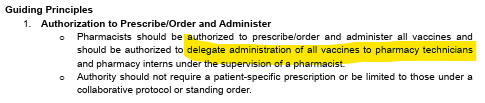
This frustrates me to no end.
APhA document
This is what I'm talking about. We fought tooth and nail for many years to gain the privileges for pharmacists to be able to vaccinate patients. Rather than keeping that hard-won privilege, we give it away to pharm techs because they are cheaper. Nurses would never do this, they would never give away a core nursing function to a CNA because CNAs are cheaper. They advance into more clinical functions without giving up core nursing functions. From the APhA advocacy page:
View attachment 15691
This frustrates me to no end.
It is interesting that you call what the pharmacy techs gain in privilege as "pharmacist giving away" but what nurses gain (from doctors) you call "advancing into more clinical functions."
Sorry, there is no difference. The nurses gain because the powers that be make more money having them do it in place of a doc. In the process, the docs lose power and make less. The pharmacy techs gain because the powers that be make more money having them do it, and the pharmacists lose power and make less. Scope creep is a general problem, not a pharmacy problem.
And, the sad thing is doctors and pharmacists used to own "cookie production." Now, we are fighting with nurses and techs for a bigger slice of the one cookie that our corporate overlords give us while they take the entire batch. In 2012, 25.8% of physicians in this country were employees. In 2024, 77.6% are employees. I don't know the numbers for independent pharmacists, but I suspect it is probably the same.
The MAHA movement complains that docs don't care anymore and just hand out meds for everything blah, blah, blah. A primary care doc (non-VA) said the other day that she already has to work through lunch and stay an hour after the end of her day to chart or takes charts home to complete. Her employer said that they need more people seen so they are adding 3 more a day to her schedule. No salary or benefit change, just here is more of what we need from you. Gee, if ever there was a situation to force a caring professional into a pill-pusher with no consideration or autonomy.........
Nurse scope creep is a physician problem, that is Interprofessional. Pharm tech scope creep is a pharmacist problem. It is intraprofessional. It is APhA advocating for it. It would be like the AMA advocating for nurse practitioners taking over whatever physician space they are going to take over next.It is interesting that you call what the pharmacy techs gain in privilege as "pharmacist giving away" but what nurses gain (from doctors) you call "advancing into more clinical functions."
Sorry, there is no difference. The nurses gain because the powers that be make more money having them do it in place of a doc. In the process, the docs lose power and make less. The pharmacy techs gain because the powers that be make more money having them do it, and the pharmacists lose power and make less. Scope creep is a general problem, not a pharmacy problem.
And, the sad thing is doctors and pharmacists used to own "cookie production." Now, we are fighting with nurses and techs for a bigger slice of the one cookie that our corporate overlords give us while they take the entire batch. In 2012, 25.8% of physicians in this country were employees. In 2024, 77.6% are employees. I don't know the numbers for independent pharmacists, but I suspect it is probably the same.
The MAHA movement complains that docs don't care anymore and just hand out meds for everything blah, blah, blah. A primary care doc (non-VA) said the other day that she already has to work through lunch and stay an hour after the end of her day to chart or takes charts home to complete. Her employer said that they need more people seen so they are adding 3 more a day to her schedule. No salary or benefit change, just here is more of what we need from you. Gee, if ever there was a situation to force a caring professional into a pill-pusher with no consideration or autonomy.........
Nurse scope creep is a physician problem, that is Interprofessional. Pharm tech scope creep is a pharmacist problem. It is intraprofessional. It is APhA advocating for it. It would be like the AMA advocating for nurse practitioners taking over whatever physician space they are going to take over next.
I don't really see how that matters. The fact is in the past the pharmacist owned the pharmacy and would not have really minded that change because it would free the pharmacist up to do other things. Now as an employee, you don't want some other employee doing your job.
It is the same as PAs. PAs have made the same advances as nurses and that was intraprofessional. Well, now they are "physicians associates" not "assistants" and see it differently. But docs loved PAs doing stuff when the PA worked for the doc. Now they both work for the man, it ain't the same.
It has nothing to do with "intraprofessional" or "interprofessional." It is about more control for administrators and companies, and more money for administrators and companies.
APhA document
This is what I'm talking about. We fought tooth and nail for many years to gain the privileges for pharmacists to be able to vaccinate patients. Rather than keeping that hard-won privilege, we give it away to pharm techs because they are cheaper. Nurses would never do this, they would never give away a core nursing function to a CNA because CNAs are cheaper. They advance into more clinical functions without giving up core nursing functions. From the APhA advocacy page:
View attachment 15691
This frustrates me to no end.
Question because I have no idea what the answer is but why is vaccination such a sticking point in your opinion (no pun intended)?
Personally I really like that I get get a flu and covid shot at the pharmacy so Im all for it being allowed there. But if the cost is no different to me then what does it matter who gives it? And Im not saying that techs can do the pharmacist's job-I dont think anyone sane would want the guy who got C's in HS biology calculating a dosage of medicine, but IM vaccination is pretty straightforward. I have never really considered that a core function of a pharmacist.
If Im incorrect here I am glad to learn and be corrected.

PF5
Sheriff

137K views · 5K reactions | Sen. Bernie Sanders expressed his frustration at senate democrats voting to reopen the government. | Newsweek
Sen. Bernie Sanders expressed his frustration at senate democrats voting to reopen the government.
www.facebook.com
Does it make any difference to you? Not really.Question because I have no idea what the answer is but why is vaccination such a sticking point in your opinion (no pun intended)?
Personally I really like that I get get a flu and covid shot at the pharmacy so Im all for it being allowed there. But if the cost is no different to me then what does it matter who gives it? And Im not saying that techs can do the pharmacist's job-I dont think anyone sane would want the guy who got C's in HS biology calculating a dosage of medicine, but IM vaccination is pretty straightforward. I have never really considered that a core function of a pharmacist.
If Im incorrect here I am glad to learn and be corrected.
Why does it make a difference to me? Because the American Pharmacist Association is supposed to be advocating for their pharmacist members and not be corporate shills advocating for policies which create higher profit margins for Walgreens and CVS while their pharmacist members get laid off. Because I spent 30 damn years teaching those pharmacist members to become pharmacists and I still give a shit about them and I worry for their future even though my own years as a pharmacist are riding into the sunset.
I’m trying to talk my brother into running for APhA president.
Last edited:

Polds4OSU
Marshall
Hormone therapies for menopause will no longer carry a black box warning about serious risks such as breast cancer, heart attack and stroke, the FDA says.
 www.facebook.com
3.2M views · 24K reactions | Hormone therapies for menopause will no longer carry a black box warning about serious risks such as breast cancer, heart attack and stroke, the FDA says. | NBC News
Hormone therapies for menopause will no longer carry a black box warning about serious risks such as breast cancer, heart attack and stroke, the FDA says.
www.facebook.com
Cool, I can quit ignoring those stupid black box warnings then.Hormone therapies for menopause will no longer carry a black box warning about serious risks such as breast cancer, heart attack and stroke, the FDA says.
3.2M views · 24K reactions | Hormone therapies for menopause will no longer carry a black box warning about serious risks such as breast cancer, heart attack and stroke, the FDA says. | NBC News
Hormone therapies for menopause will no longer carry a black box warning about serious risks such as breast cancer, heart attack and stroke, the FDA says.
Turns out the Women’s Health Study was misinterpreted?Cool, I can quit ignoring those stupid black box warnings then.
Here’s a side-by-side summary table comparing the original WHI-era interpretation (circa 2002–2010) with the current, data-informed view (2020s–2025), incorporating follow-ups, meta-analyses, and newer clinical guidance.
Would you like me to include a visual chart (infographic) summarizing this evolution — showing how interpretation shifted from “hormones are dangerous” → “timing and context matter”? It’s often useful for presentations or teaching.
 Evolution of Interpretation of Women’s Health Initiative (WHI) Data
| Category / Outcome | Early WHI Interpretation (2002–2010) | Updated Understanding (2020s–2025) | Supporting Sources (recent) |
|---|---|---|---|
| Cardiovascular Disease (CVD) | HT increased heart attack and stroke risk; should not be used for prevention. | Risk depends on age and timing. Starting HT within 10 years of menopause or < 60 yrs may have neutral or possibly cardioprotective effects. Late initiation (> 10 yrs post-menopause) increases risk. | JAMA 2024 review; Endocrine Reviews 2021; JAMA Network 2025 timing meta-analysis |
| Stroke / Thromboembolism | WHI found higher stroke and venous thromboembolism rates in older women on oral HT. | Oral route still raises risk, but transdermal or lower-dose regimens show less risk. Avoid in women with prior stroke, VTE, or high clotting risk. | Menopause 2023; Lancet 2022 meta-analysis |
| Breast Cancer | Combined estrogen + progestin therapy increased breast cancer incidence. | Still true for combined therapy, especially with prolonged use. However, estrogen-only therapy (for women with hysterectomy) shows reduced breast-cancer risk in long-term follow-up. | JAMA Oncol. 2023; USPSTF 2024 evidence update |
| All-Cause Mortality | No benefit; possible harm in older cohorts. | No increase in all-cause mortality with either HT type; in some women starting before 60 yrs, possible mortality reduction. | WHI 20-year follow-up (JAMA 2017); Longevity Center, Stanford 2025 summary |
| Metabolic / Insulin Resistance | Not a focus of WHI; unclear impact. | Meta-analyses (2024) show significant reductions in insulin resistance and improved glucose metabolism with HT in healthy postmenopausal women. | Menopause.org 2024 meta-analysis |
| Bone Health / Fractures | HT reduced hip and vertebral fractures; this was a clear benefit. | Still confirmed; remains one of HT’s strongest benefits, particularly early in menopause. | WHI extension; Endocrine Society guidelines 2023 |
| Cognitive Function / Dementia | HT increased dementia risk when started late (> 65 yrs). | The “timing hypothesis” suggests starting HT near menopause may protect against cognitive decline; starting late likely harmful. Still under investigation. | Alz. Dement. 2022; Nat Rev Neurol. 2023 |
| Dietary Modification Trial (low-fat diet) | No major reduction in breast/colorectal cancer or CVD. | Long-term follow-up shows modest reduction in breast-cancer mortality; supports overall healthy diet but not as a “single magic bullet.” | JAMA Netw Open 2023; WHI 20-year extension |
| Calcium + Vitamin D | Minimal effect on fractures or cancer; small benefit for hip fracture. | Consensus unchanged: modest fracture benefit for deficient women; not broad disease prevention. | NHLBI WHI updates 2023 |
| Public Perception / Clinical Practice | Sharp drop in HT use after WHI due to fear of risks. | Gradual re-acceptance: < 4 % of eligible U.S. women now use HT, though safety for early menopausal use is reaffirmed. | Health.com 2025; AP News 2025 |
| Regulatory / Labeling | FDA placed strong warnings about heart, cancer, stroke risk. | 2025: FDA removed the blanket “heart risk” warning for all estrogen-containing therapies, clarifying benefit-risk depends on age and indication. | AP News May 2025 |
| Overall Takeaway | HT considered broadly unsafe for chronic-disease prevention. | Nuanced approach: safe and effective for symptom relief in healthy, recently menopausal women; risks rise with age/time/duration; use lowest effective dose, shortest time needed. | USPSTF 2024; Endocrine Society 2023–2025 |
 Current Consensus Summary
- Do not use hormone therapy to prevent chronic diseases (CVD, dementia, cancer).
- Do consider HT for bothersome menopausal symptoms, especially if age < 60 or within 10 years of menopause.
- Route matters: Transdermal estrogen + micronized progesterone preferred for lowest thrombotic risk.
- Duration: Reassess regularly; shortest effective period (often ≤ 5 years) unless benefits outweigh risks.
- Personalization: Assess individual risk factors (breast cancer, CVD, VTE, liver disease, etc.).
Would you like me to include a visual chart (infographic) summarizing this evolution — showing how interpretation shifted from “hormones are dangerous” → “timing and context matter”? It’s often useful for presentations or teaching.
I agree with some, but certainly not all, of that.I hadn't looked at these data in a long time.... I have some catching up to do...
I’m going to admit that I haven’t kept up and don’t know enough to have an opinion. I need to start learning, and that insulin resistance data would seem pretty important for me to know. Good place to start. The nuances of the CV risk is next.I agree with some, but certainly not all, of that.
Also look at the unfortunate use in the literature of "progestins" and "progesterone" as if they are the same thing even though they have different receptor pharmacology and outcome data. It is slowly improving, but still there.I’m going to admit that I haven’t kept up and don’t know enough to have an opinion. I need to start learning, and that insulin resistance data would seem pretty important for me to know. Good place to start. The nuances of the CV risk is next.
Also, the dilemma of oral vs transdermal estrogens. While clearly the VTE risk is lower for transdermal making it the "obvious choice," but, many women prefer a pill and the current consensus that HRT is "unsafe for chronic disease prevention" just is lazy in my opinion. The benefits of estrogen for osteoporosis, a chronic disease, are quite clear. The benefits of oral estrogen for CVD reduction are very difficult to decipher from the current literature and really should be made on an individualized basis.
Assignment accepted.Also look at the unfortunate use in the literature of "progestins" and "progesterone" as if they are the same thing even though they have different receptor pharmacology and outcome data. It is slowly improving, but still there.
Also, the dilemma of oral vs transdermal estrogens. While clearly the VTE risk is lower for transdermal making it the "obvious choice," but, many women prefer a pill and the current consensus that HRT is "unsafe for chronic disease prevention" just is lazy in my opinion. The benefits of estrogen for osteoporosis, a chronic disease, are quite clear. The benefits of oral estrogen for CVD reduction are very difficult to decipher from the current literature and really should be made on an individualized basis.
Similar threads

- Replies
- 48
- Views
- 2K
- Replies
- 1
- Views
- 407


- Replies
- 0
- Views
- 361